Manufacturing SEO helps small and mid-size manufacturers, machine shops, fabricators, contract manufacturers and industrial suppliers get found by the engineers and buyers who are looking for what they make. Those people rarely search for a company name. They search for a capability, a material, a process, a tolerance or a certification, and they want proof before they send a drawing. This page explains what manufacturing SEO includes with us, how it differs from consumer SEO, what the first three months look like and how pricing works.
How engineers and buyers search
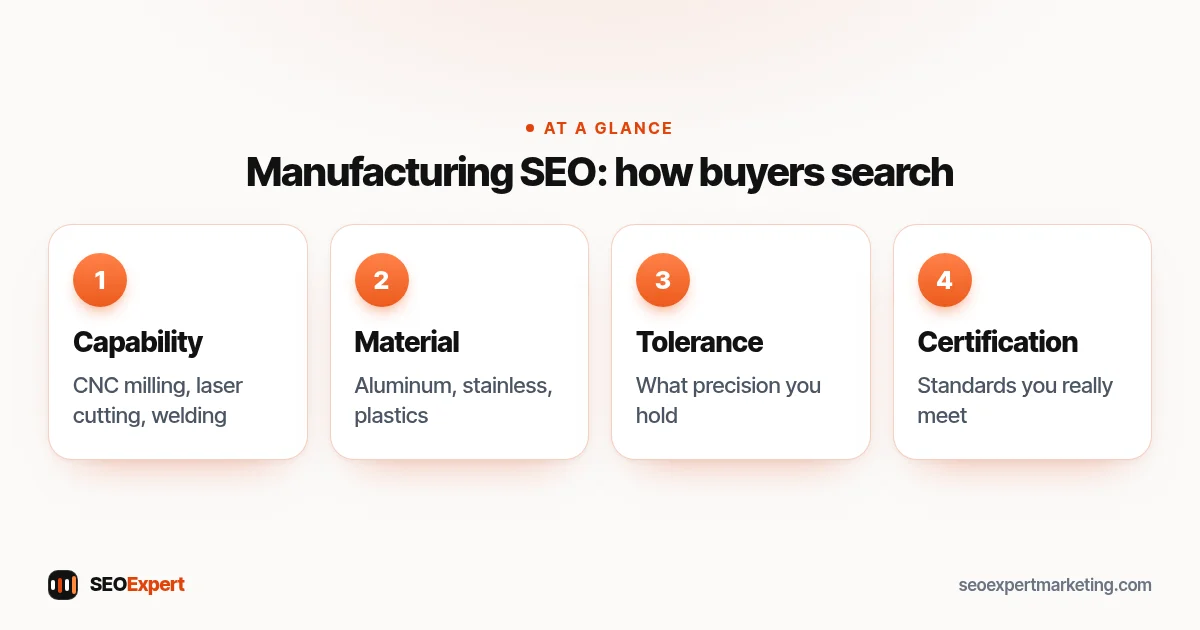
An engineer with a part to source types something like "cnc machining aluminum 6061", "5-axis machining prototype", "iso 9001 sheet metal fabrication" or "injection molding medical grade polycarbonate". A purchasing manager looking for a second source may add a region, a quantity or an industry, such as "low volume contract manufacturing Ohio" or "precision machining for aerospace". These searches are specific, low in volume and high in value: one good request for quote (RFQ) can be worth a year of casual visits.
Because the buyer is technical, good manufacturing SEO starts with detail. A vague page saying "we deliver quality solutions" loses them. They want to know your machines, materials, tolerances, sizes, lead times, quantities and the paperwork you can supply.
What manufacturing SEO includes with us
Capability pages
Capability pages are the core of manufacturing SEO. Each core capability gets its own page: CNC milling, CNC turning, laser cutting, press brake forming, welding, finishing, assembly, whatever you really do. A good capability page lists the equipment, work envelope, typical tolerances you hold, materials, batch sizes and secondary operations, with photos of your own shop and parts you're allowed to show. Our keyword research services show which capabilities and phrasings people actually search.
Materials and process pages
Engineers often search by material first: aluminum, stainless steel, titanium, brass, plastics such as PEEK or Delrin. A page per material you regularly work with, explaining grades, finishes and design tips, answers those searches and shows real expertise. Process explainers (for example, when to choose laser cutting over waterjet) do the same for early-stage research.
Industry-served pages
Buyers trust a supplier who already understands their sector. If you genuinely make parts for medical devices, agriculture, energy, food equipment or automotive aftermarket, a page for each sector can explain the parts you make, the requirements you work to and the documentation you provide. Only build these for industries you really serve; empty sector pages can count as doorway pages under Google's spam policies.
Spec sheets, CAD files and PDFs
Datasheets, line cards and CAD downloads are useful, but a site that hides everything inside PDFs is hard to search. Google can index PDF files (it lists them among its indexable file types), yet an HTML page with the key specs in plain text, plus the PDF or CAD file as a download, usually serves both the engineer and the search engine better. We make sure each important document has a crawlable page around it.
Certifications, shown truthfully
Quality certifications such as ISO 9001 matter to buyers, so show what you hold: the standard, the scope, the certifying body and the expiry date, ideally with the certificate itself. Never imply a certification, registration or approval you don't have. Buyers check, and a false claim costs far more than it gains.
Product pages and structured data
If you sell standard parts or catalog items, each product deserves its own page with dimensions, materials and options. Where it fits, product structured data helps Google understand the page; Google's product structured data guide explains which properties it supports. Custom job shops usually gain more from strong capability pages than from markup.
An RFQ form people actually finish
The RFQ form is where search turns into business. Keep it short, let people attach drawings (STEP, DXF or PDF), ask only for what you need to quote, and say how fast you reply. Show a phone number and an email address too: some buyers prefer to talk first.
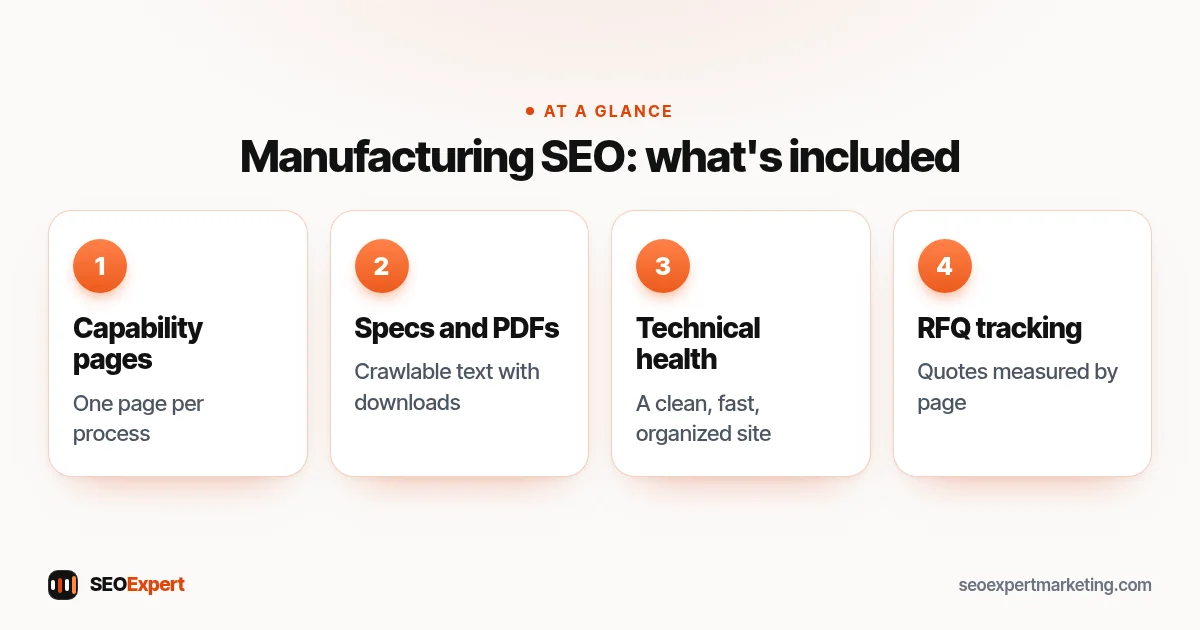
In short, manufacturing SEO with us covers four areas:
Technical manufacturing SEO for industrial websites
Manufacturer websites often grow over many years: old product lines, duplicate PDFs, slow image galleries and pages nobody links to. We fix crawl and indexing problems, speed and mobile issues, and organize the site so every capability, material and industry page has a clear place. Our technical SEO services page lists the checks involved.
Selling to other businesses and other countries
Manufacturing is business-to-business selling, with several people involved in each decision. If you also want to reach buyers outside manufacturing, our B2B SEO services page covers the wider approach. If you export or want buyers in other countries, our international SEO services cover country and language versions; Google's guide to managing multi-regional sites explains the options.
Measuring manufacturing SEO by RFQs, not just traffic
Industrial sales cycles are long. A buyer may find you today, request a quote next month and place a first order after a trial batch. So we track what matters: RFQ form submissions, drawing uploads, calls and emails from the website, and which pages they came from. Traffic numbers alone can mislead; a few visits from the right engineers are worth more than many from students or competitors.
Manufacturing SEO pricing
Manufacturers use the same plans as every client: SEO Starter at $395 a month, SEO Growth at $795 and SEO Authority at $1,495 (USD). Paid yearly, they cost $295, $595 and $1,095 a month, billed once a year. Monthly plans have no long contract, and every plan starts after a written proposal. A small machine shop with a few core capabilities usually starts with SEO Starter; a contract manufacturer with many processes, materials and industries often needs SEO Growth. You can compare the packages line by line.
If you'd rather start with a single job, fixed-price options include a Full SEO Audit for $59 (credited to your first payment if a monthly or yearly plan starts within 30 days), a Keyword Research Report for $79, a Technical SEO Fix Pack for $199 and SEO Page Writing at $39 a page or 5 for $179. The full list is on our SEO price list.
Who our manufacturing SEO suits
It suits owner-run and mid-size manufacturers who can share real details: equipment lists, materials, tolerances, photos of parts they're allowed to show and an engineer or manager who can answer technical questions for an hour a month. It doesn't suit companies that want a generic brochure site, invented capabilities or certifications, or overnight results.
A realistic first three months
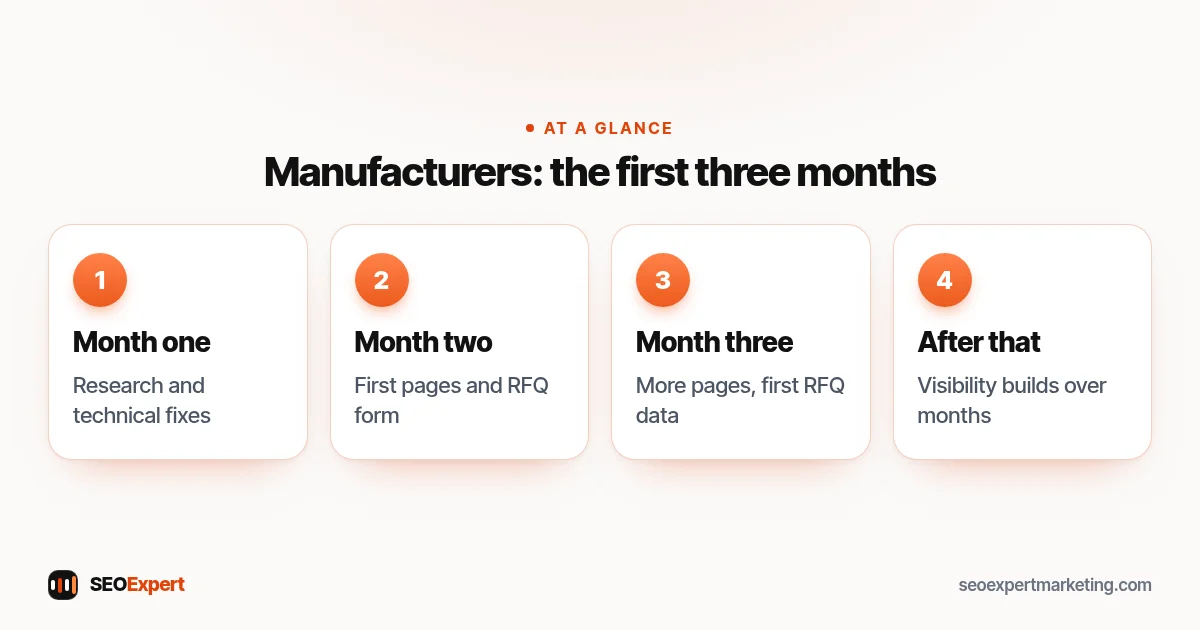
Month one is research and fixes: we review your site, the searches for your capabilities and who ranks for them, and fix the technical problems that block crawling. Month two is building: the first capability and material pages, a clearer RFQ form and tracking. Month three is expanding and measuring: more pages, industry-served pages where they're real, and a first look at which pages bring RFQs. Visibility for competitive terms usually takes longer than three months, and nobody can honestly promise rankings.
A typical timeline of manufacturing SEO with us: