
Our ecommerce SEO services are designed to help small online stores get their category and product pages in front of shoppers already searching Google for what they sell. We're SEO Expert Marketing, a new agency that works remotely with small businesses in the USA, UK, Canada and Australia.
Why an online store needs its own kind of SEO
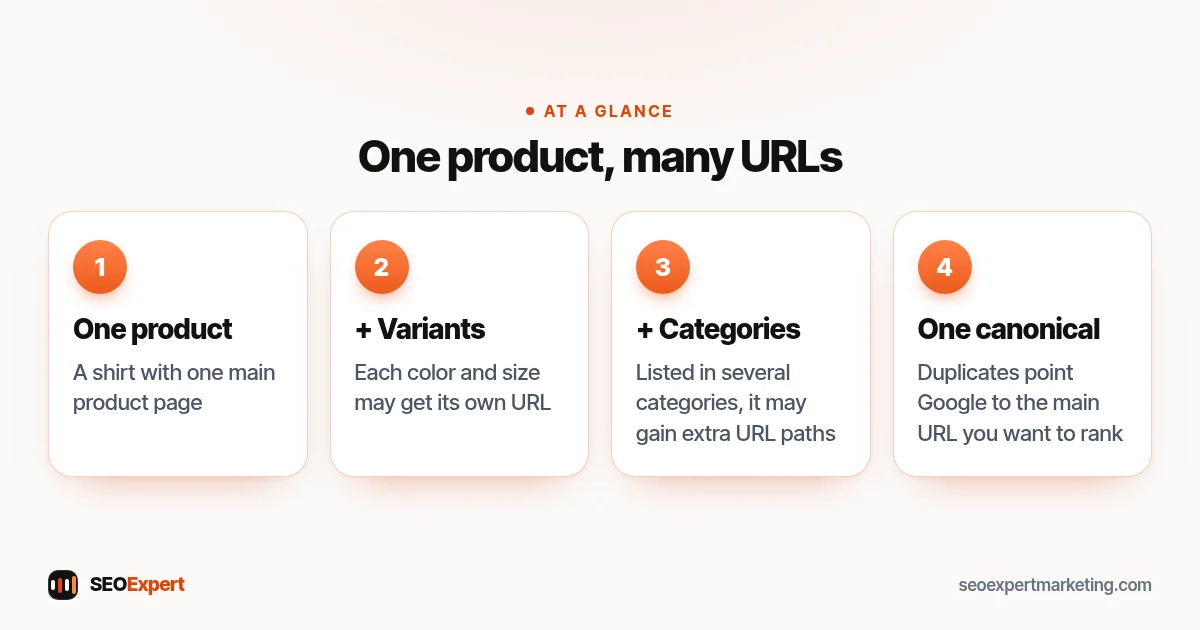
Even a modest catalog can produce far more URLs than products. A shirts category with three color filters, five size filters and four sort orders can create dozens of addresses such as /shirts?color=red&sort=price, all showing much the same products.
You also compete with Amazon and big retailers. If your product page uses the same manufacturer description as theirs, Google has little reason to choose yours.
What our ecommerce SEO services include
We look at seven areas on a store. Your free website review points out which matter most for yours, and your written proposal lists the tasks your plan covers.
1. Category pages
Category pages are usually the best match for broader buying searches such as "trail running shoes". We match each group of searches to one category so your pages don't compete, then improve titles, headings and a short, useful introduction. See also our keyword research service.
2. Product pages
We replace thin or copied manufacturer text with original descriptions that answer real questions about sizing, materials and compatibility. We also check titles, image alt text and how out-of-stock or discontinued items are handled, so pages with search value aren't simply deleted.
3. Filters, variants and duplicate pages
Google's guide to managing faceted navigation URLs, its term for filters, explains that crawling spent on pointless filter pages leaves less time for new, useful ones.
We decide which filtered pages deserve to rank, such as a popular brand within a category. Other filter combinations are usually kept out of Google's crawl with robots.txt, a file telling search engines which addresses to skip. For duplicates Google still needs to see, such as a product in several categories or its color and size variants, a canonical tag names the main address to rank.
4. Product structured data
Structured data (schema markup) describes a product's name, price, availability and genuine reviews in a format Google can read. Many themes add it automatically, but it can be incomplete, duplicated or broken by a theme change. We test it, fix errors and keep it matching what shoppers see. If you also list products in Google Merchant Center, keep its feed's prices and stock in step with your pages.
5. Site structure and internal linking
Google's guide to ecommerce site structure explains that Google can use the links between your pages to judge which matter most, and that Googlebot generally doesn't submit searches into a search box, so products reachable only through site search may be missed.
We check that menus reach your categories, categories link to every product you want indexed, and breadcrumbs and guides point to your best sellers. Your XML sitemap should list those products and categories, not filter, cart or account pages.

6. Page speed
Large images, sliders and too many apps or plugins slow stores down, especially on phones. We find what weighs down your category and product templates and fix what your platform allows; server-side fixes fall under our technical SEO work.
7. Buying guides and earning links
Many shoppers start with questions such as "what size do I need?". Guides that answer them can send readers to the right categories and products.
Links still matter. Realistic sources for a small store are the "where to buy" pages of brands you stock, local press if you have a shop, and guides useful enough to cite. We don't buy links. SEO Authority adds backlink analysis, a review of the sites that already link to your store.
WooCommerce and other store platforms
Our ecommerce SEO services follow the same principles on any platform, but each has habits, such as tag archives or variant URLs, that we check first. WooCommerce stores are our closest fit.
Changing platform or URLs? Every old product and category address needs a 301 redirect to its new page, or its earned visibility can be lost.
What we found when we checked our own WooCommerce shop
This site runs on WooCommerce too. It sells our 8 fixed-price jobs, from the $39 page to the $249 link package. On 10 Nov 2026 we ran the first checks of our ecommerce SEO services on our own shop, the same way we'd start on yours.
| What we checked | What we found on our shop | Why it matters on your store |
|---|---|---|
| Add-to-cart links | robots.txt blocks every address containing ?add-to-cart= | Each product listing can create these links, and none of them is a page worth crawling. |
| Shop page and its sorted versions | The shop page and versions such as /shop/?orderby=price are set to noindex, follow. Our shop lists the same 8 jobs as our SEO price list, so we let the price list be the page Google shows. | Sort orders repeat the same products. On a bigger store the category pages usually stay indexable and only the sorted copies are kept out. |
| Cart, checkout and account pages | Cart and account pages are noindex, an empty checkout sends you to the cart, and none of them is in the sitemap | They differ for every visitor and are no use in search. |
| Product sitemap | Lists all 8 product pages and nothing else | A sitemap should list the pages you want found, not filter, cart or account pages. |
| Product structured data | All 8 product pages have Product and Offer markup with the same USD price as the page (59.00 on the audit, 199.00 on the fix pack) and "in stock" | Google can show price and availability from this markup, so it must match what shoppers see. |
| Canonical tags | Each product page names itself as the main address | When a product appears in several categories or variants, this tag tells Google which URL to rank. |
| Default category | WooCommerce's empty "Uncategorized" archive is noindex | Archives that list nothing useful shouldn't take up Google's attention. |
One thing our shop can't show is filters: with 8 products we have none. On a store with hundreds of products, filters and variants are where we'd look first.
Is your store a good fit?
It probably is if:
- You run a small online store selling products people search Google for.
- Your product pages use copied manufacturer text, or Search Console's Page indexing report lists many duplicate or not-indexed pages.
- You add or retire products often and need out-of-stock and discontinued pages handled.
We probably aren't the right choice if you sell only on marketplaces such as Amazon or Etsy, because the work happens on your own store's website.
What it costs: plans and one-off jobs
Ecommerce SEO services for your store run under our three monthly plans, priced in USD (compare the full SEO services plans).
SEO Growth ($795/month) is usually the closest match for a store with several categories, because it adds keyword mapping, internal linking and competitor analysis. SEO Starter ($395/month), our entry plan, can suit a small catalog that mainly needs repairs, tracking and better content. SEO Authority ($1,495/month) suits bigger catalogs that need content-gap and backlink analysis.
Paid yearly, the same plans cost $295, $595 and $1,095 a month. Monthly plans have no minimum term, so you can cancel any time. Plans are paid by Remitly, Wise or bank transfer.
Every plan includes an initial SEO audit (see our SEO audit page), and you'll see a written proposal confirming scope and price before you commit.
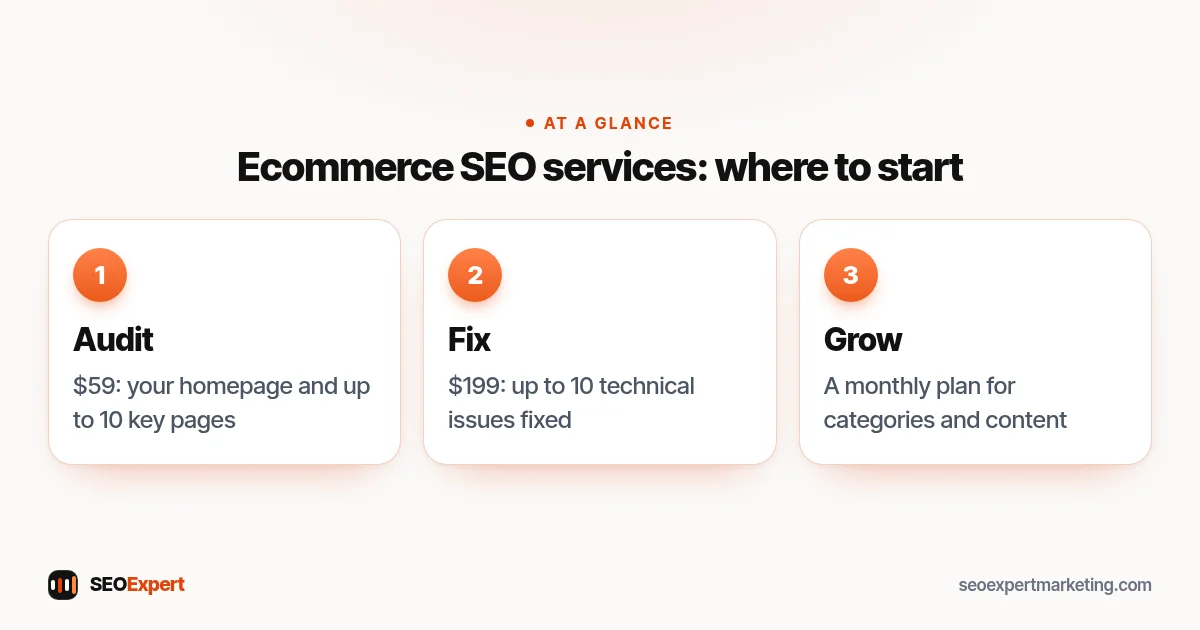
Prefer to start smaller? Two fixed-price jobs work well for stores: the $59 Full SEO Audit of your homepage and up to 10 key pages (credited to your first payment if a plan starts within 30 days), and the $199 Technical SEO Fix Pack. Both are on our SEO price list.
How long ecommerce SEO takes
Foundations come first: duplicate URLs, structured data errors and unlinked products. New copy and guides then need time to be crawled, indexed and trusted.
If most of your sales come in one season, such as the holidays, start on those foundations well before it rather than during the rush.
We can't promise rankings. What we offer is work you can check in each report: the problems found, the changes made and how your keywords and traffic moved.
How to compare an ecommerce SEO company or consultant
Whether you're talking to an agency, a freelance ecommerce SEO expert or us, ask:
- How will you handle filters, variants and duplicate pages on my platform?
- Who writes the product and category copy, and who publishes it?
- What happens to product pages when items sell out or are discontinued?
- What exactly will each report show me?
For our ecommerce SEO services, your written proposal sets out responsibilities, including who makes the changes on your store.
Prefer to check your store yourself? Run our free SEO audit on your home page: it reads your robots.txt, sitemap and structured data. Then open Search Console's Page indexing report to see which product and category pages Google has left out.
Start with a free review of your store
Send your store's URL through our free website review form and tell us your platform, your best-selling categories and your goals. We'll email you the main issues we spot on your store and what we'd fix first. There's no obligation to buy our ecommerce SEO services afterward.