

Our keyword research services find the words your customers really type into Google when they need what you sell, then turn them into a plan you can follow. The work suits small businesses and WordPress sites that aren't sure which searches each page should win. The result is a keyword map you can act on, not a spreadsheet of thousands of terms.
Want to try it yourself first? Our guide to how many keywords each page needs explains why we give every page one main phrase.
We're a new remote agency; see how we'd approach your site with a free website review.
What keyword research is, and why it comes first
Keyword research means finding out how people search for your services, then deciding which of those searches your site should try to win. It shapes your titles, headings, content and internal links, so a mistake here gets repeated everywhere.
Google's SEO Starter Guide asks site owners to think about the words a user might search for, and notes that experts and beginners may search differently: some type “charcuterie”, others “cheese board”. Wording can change by country, too: one customer might type “blocked drain” and another “clogged drain”, so check the terms your own customers use.
What our keyword research services include
The work follows six steps, which sit inside our usual Research, Plan, Improve and Measure process.
1. Start with your business, not a tool
We begin with what you sell, where you work and which services you most want to grow. The words customers use on the phone and in emails often beat industry jargon as starting points.
2. Collect real search data
If your site already gets visits, Search Console's Performance report is the most useful evidence: it lists the real queries people typed when your site appeared, with clicks, impressions and average position.
We add ideas from Google's autocomplete, “People also ask” and related searches, and look at which searches local competitors have pages for: if two rivals rank with a “water heater replacement cost” page and you have none, that search is worth weighing.

3. Sort keywords by search intent
Search intent is the reason behind a search: to learn, compare, find a particular website or buy. For a small business, two kinds matter most, and they need different pages.
- Buyer keywords show someone ready to hire: “emergency plumber Denver”, “water heater repair near me”. They belong on service pages.
- Research keywords show someone learning: “why is my water heater leaking”. They suit guides that link to your service pages.
The quickest intent check is to search the term yourself. If Google shows mostly guides, a sales page will struggle to rank for it, and the reverse is usually true as well.
4. Add local modifiers with care
Local buyers often add a city, town, district or “near me” to their search, so we note which places your customers use. An area deserves its own page only when you have something genuinely different to say about it. Pasting town names into a footer doesn't help: Google's spam policies list blocks of text naming cities and regions as keyword stuffing. For map results, see our local SEO page.
5. Judge difficulty and set realistic targets
A new website rarely wins a broad term like “plumber” quickly; those results are often filled by directories, big brands and long-established firms. Search volumes and difficulty scores from keyword tools are only estimates and differ from tool to tool, so the better test is to look at who actually ranks.
If page one shows small local businesses, a site like yours has a better chance of competing. If it's all national directories, that term becomes a longer-term goal.

6. Map one main keyword to each page
Keyword mapping gives every important page one main keyword and a few supporting terms. When two pages chase the same search, they compete (often called keyword cannibalization), and Google may pick the page you'd rather customers didn't land on. Mapping can also show valuable searches that no page covers yet. A full content-gap analysis is part of our SEO Authority plan.
Example: a keyword map for a plumber in Denver
This is a fictional business, made up to show the format. It isn't a client.
| Page | Main keyword | Supporting terms | Intent | Suggested action |
|---|---|---|---|---|
| Home page | plumber denver | local plumber, plumbers near me | Buyer | Keep |
| Emergency plumbing | emergency plumber denver | 24 hour plumber, burst pipe repair | Buyer (urgent) | Rewrite title and H1 |
| Water heater repair | water heater repair denver | no hot water, water heater not heating | Buyer | Keep |
| Clogged drains | clogged drain denver | drain cleaning, clogged toilet | Buyer | Merge two competing pages |
| Guide (new page) | why is my water heater leaking | water heater leaking from bottom | Research | Create new page |
Each term appears once, so no two pages compete. The guide links to the water heater repair page, because a reader with a leaking tank may soon need a plumber.
Want to size up the competition yourself? Follow our six-step SEO competitor analysis.
Our keyword research services start with the searches closest to a sale: the buyer keywords from step 3.
What our own Search Console data shows
This site is new, so its numbers are small, but they show the two jobs keyword research does: grouping searches that mean the same thing, and sending each kind of search to the right page. These are real figures from our Search Console for 16 to 28 October 2026. An impression is one appearance of our page in Google's results. None of these searches brought a click yet, and most showed our page far down the results.
| What people searched | Which of our pages Google showed | What it tells us |
|---|---|---|
| 56 different wordings of one question, such as "how many seo keywords should i use" (67 impressions), "how many keywords should a website have" (32) and "how many keywords per page" (11) | The same guide every time: how many keywords for SEO, 336 impressions in all | Close variations belong on one page. A page for each wording would only have split them. |
| "keyword research services price" | Our SEO price list, not this page | A search that asks for a price wants a price. The price list shows our $79 report, so Google's choice makes sense. |
| "how many keywords do you get when you hire an seo" (9 impressions) | The same keyword guide | A buyer's question inside a research topic. Our answer: plans track 5, 15 or 30 keywords, and the $79 report covers up to 30. |
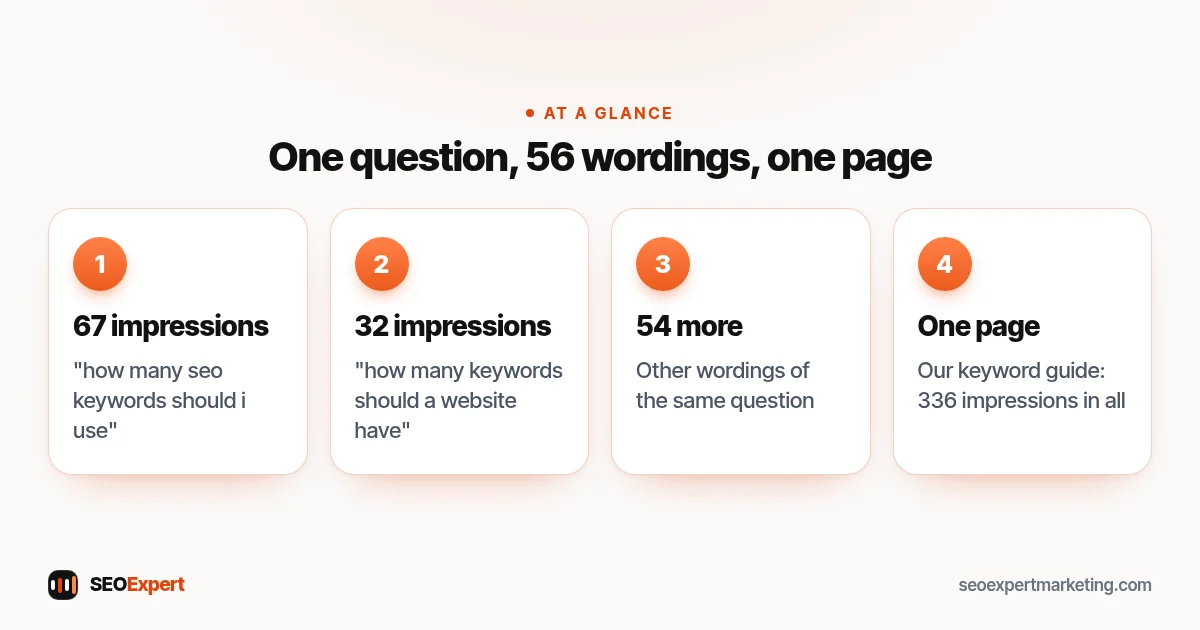
On a client's site with more traffic, this report is the first thing we open, because it shows the words customers already use to find you.
Who it suits, and who should wait
Keyword research services make sense if:
- You're building or redesigning a site and want to plan pages before writing them.
- Your pages get few impressions in Search Console, or appear for searches that don't match what you sell.
- Several of your pages seem to compete for the same search.
- You're adding a service or area and don't know which words people use for it.
- You run an online store and need category and product pages matched to what shoppers search (see ecommerce SEO).
They're not the first priority if something stops Google indexing your site; technical SEO comes first. A one-page site for one service in one town may need little more than clear titles and a fully filled-in Google Business Profile. If you'd rather do the work yourself from a checked list, the $79 report below gives you one.
Whoever you hire, ask why each keyword was chosen and which page it belongs to, and walk away from anyone who promises rankings.
Prefer to start on your own? Our guide on how to do keyword research sets out seven steps.
What it costs: a $79 report or a monthly plan
There are two ways to buy it, both priced in USD.
- Keyword Research Report, $79 once: up to 30 keywords for one website, grouped by search intent (buy, compare, learn), each matched to an existing or new page, with easy quick wins marked. You get a spreadsheet and a short written summary. It's research and planning only, so it doesn't include writing or editing pages.
- Inside a monthly plan: keyword research and mapping arrive with SEO Growth ($795/month), the first plan that lists them, together with competitor analysis and internal linking. Content-gap analysis is added on SEO Authority ($1,495/month). SEO Starter ($395/month) tracks 5 keywords but doesn't list research and mapping.
Paid yearly, the plans cost $295, $595 and $1,095 a month. Monthly plans have no minimum term, so you can cancel any time, and plans are paid by Remitly, Wise or bank transfer. Your proposal sets the scope and price; to see everything else each plan covers, check our SEO services pricing.
How long before it pays off
Keyword research only affects rankings once pages are updated or created and Google recrawls them. An early sign of progress is a mapped page starting to appear for the searches assigned to it, which Search Console's Performance report shows page by page.
On a new site, specific local terms usually have a better chance of moving first; broad terms take longer, if they move at all.
Planning your keywords? Request a free website review
Use the free website review form to send your site, and list your main services, plus any searches you'd like to show up for. No obligation. Questions first? Contact us.
