
An SEO competitor analysis shows you who appears in Google for the searches you want, why they rank, and what you can realistically do better. For a small business it doesn't need expensive tools or a 50-page report. A careful look at the top results for your main searches, the pages that rank and the profiles behind them usually reveals clear, practical gaps. This guide gives you a six-step method and shows how to turn what you find into a plan.
Why competitor analysis matters
Google ranks pages relative to the alternatives. To rank for "emergency plumber" in your town, your page doesn't need to be perfect; it needs to be a better answer than the others on the page. A competitor analysis tells you what "better" means for each search: more detail, clearer prices, stronger reviews, better photos or a faster site. It also stops you copying the wrong businesses: the company you see as your rival offline may not be the one beating you in search.
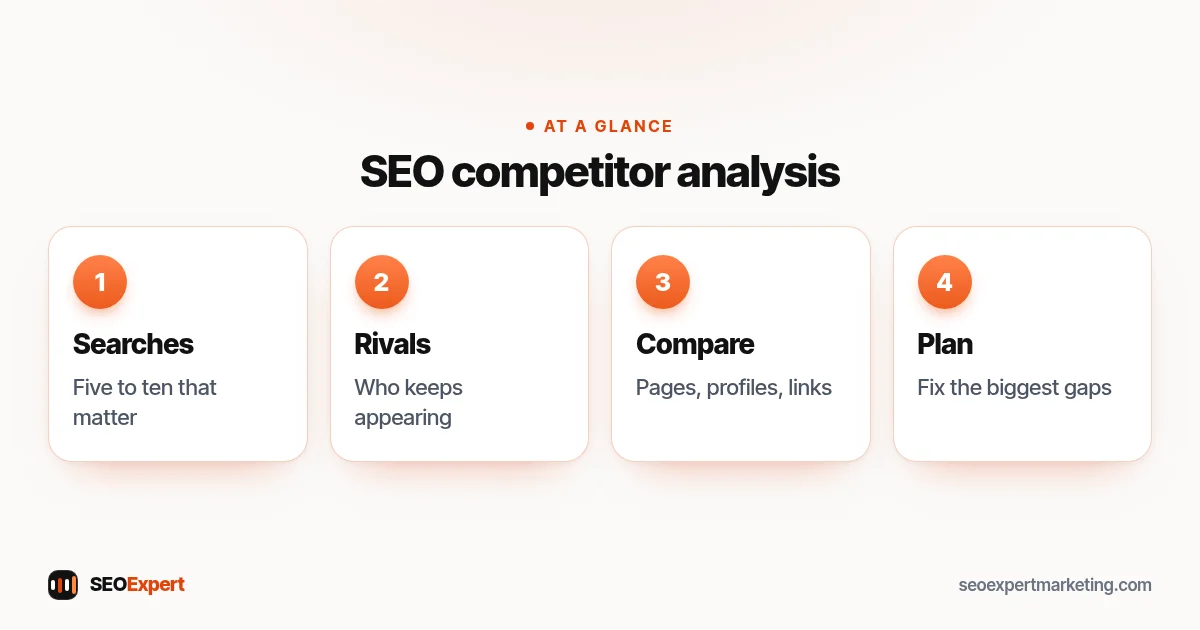
Step 1: List your main searches
Start with five to ten searches that bring customers: your main services plus your town or area, and one or two common questions. If you already have Search Console, the Performance report shows the searches where you already appear. Our guide on how to do keyword research helps you choose.
Step 2: Find your real search competitors
Search each phrase on Google, ideally in a private window and from your area, on both a phone and a computer. Note who appears in the map results and the first page of organic results. Directories and big national sites will show up too; note them, but focus on businesses similar to yours. After ten searches, you'll see the same names appear again and again. Those are your real search competitors.
Step 3: Compare their pages with yours
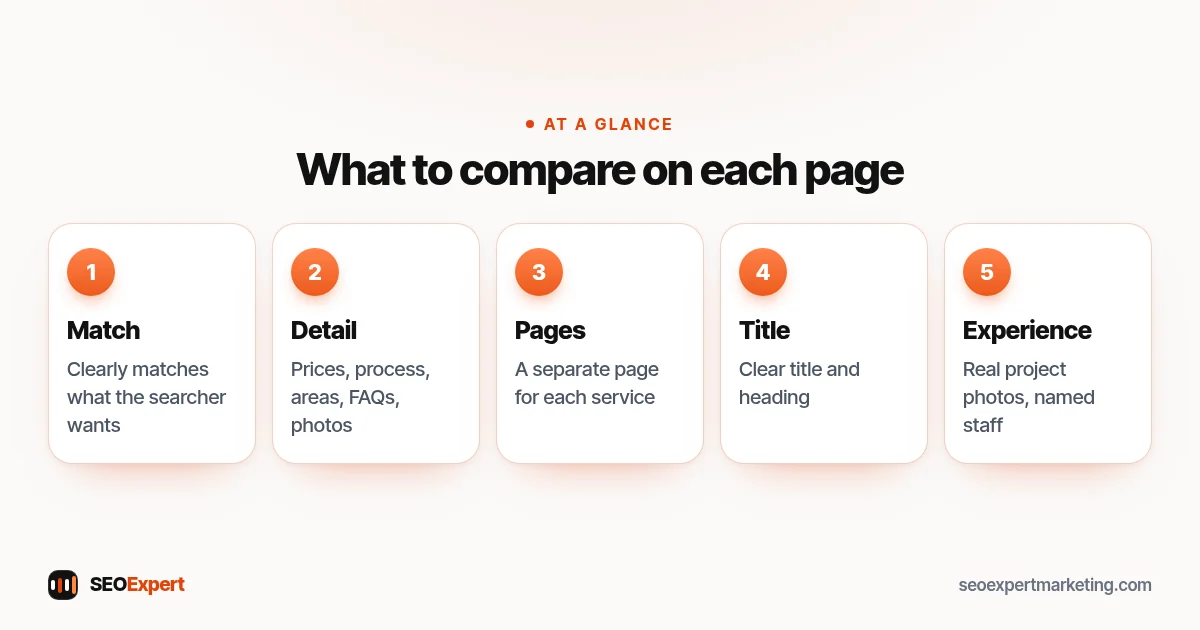
For each main search, open the top-ranking pages and compare them with your page for the same service. Look at:
- Does the page clearly match what the searcher wants?
- How detailed is it: prices, process, areas, FAQs, photos?
- Is there a separate page for each service, or one page for everything?
- How clear are the title and heading?
- Does it show real experience, such as project photos and named staff?
- How fast and easy is it to use on a phone?
Write down what they include that you don't, and what you could do better than all of them.
Five things to compare on each page in a competitor analysis:
Step 4: Compare Google Business Profiles
For local searches, the map results matter as much as the website. Compare primary categories, number and recency of reviews, how owners reply, photos, services listed, opening hours and posts. Profiles with complete details and steady, recent reviews often stand out. Don't copy their categories blindly; choose the ones that genuinely describe your business.
Step 5: Look at links and mentions
Links from other relevant websites help Google judge how well known a business is. Without paid tools, you can still learn a lot: search for a competitor's business name to see where they're mentioned, such as local news, suppliers, associations, sponsorships or directories. Many of these are open to you too. Free versions of SEO tools also show a sample of links. Never buy links to catch up; it breaks Google's spam policies. Our guide on how to get backlinks covers ways to earn them.
Step 6: Turn gaps into a plan
Group what you found into three lists: quick fixes (titles, missing pages, profile details), content to create or improve (fuller service pages, FAQs, guides) and longer-term work (reviews, links, partnerships). Prioritize the gaps closest to revenue, usually service pages and your Business Profile, before blog content. Our SEO content strategy guide shows how to turn the content list into a schedule.
A quick side-by-side check with our free audit
Our free SEO audit can do part of step 3 for you. Add up to three competitor websites and it runs the same checks on each home page as on yours, then shows the results side by side. A line above the table says how many checks you're behind on.
| What it compares | What it tells you |
|---|---|
| Overall score and 7 category scores: technical, on-page, content, speed, local and trust, AI search readiness, security | Where the gap is widest |
| Server answer time and home page size | Whether speed is part of the gap |
| Words on the home page | How much each home page explains |
| Pages in the sitemap | Roughly how big each site is |
| AI search crawlers allowed (OAI-SearchBot, ChatGPT-User, PerplexityBot) | Whether AI answer tools can read the site |
| llms.txt file | Whether the site offers a proposed summary file for AI tools |
| Business schema | Whether the home page names the business for search engines |
| Domain age | How long each website has existed |
It checks home pages only, as they are on the day, and leaves out links and the missing-page test so the match is fair. It doesn't look at Business Profiles, reviews or the pages that rank for each search. Use it next to steps 3 to 5 of this competitor analysis, not instead of them.
Competitor analysis template
| Check | You | Competitor A | Competitor B |
|---|---|---|---|
| Ranks for main search? | Position 14 | Position 2 | Map pack |
| Dedicated service page | No | Yes | Yes |
| Prices or price guide | No | Yes | No |
| Reviews (count, newest) | 18, 3 months ago | 140, this week | 65, last month |
| Real project photos | Few | Many | Some |
| Local links and mentions | Two directories | Local news, suppliers | Association |
This is an illustrative example. In this case, the clearest gaps are a dedicated service page with a price guide and a steady review routine.
Reading the search results page itself
The layout of the results page tells you as much as the pages in it. If a search shows a map pack at the top, local profiles matter most. If it shows a row of videos, a video might be worth making. If "People also ask" questions appear, those questions belong on your page. If every top result is a long guide, a short sales page won't compete; if every result is a service page with a phone number, a long guide won't either. Note the features you see for each main search, because they shape what kind of page has a chance.
Turning a gap into a better page
Suppose the top three results for "kitchen fitting [town]" all list services but none shows prices, project photos or how long a typical job takes. That's your opening: a page with a clear price guide, a gallery of real kitchens you've fitted, a step-by-step outline of the process and honest answers to common worries. You don't need to outspend them; you need to be more useful to the person searching.
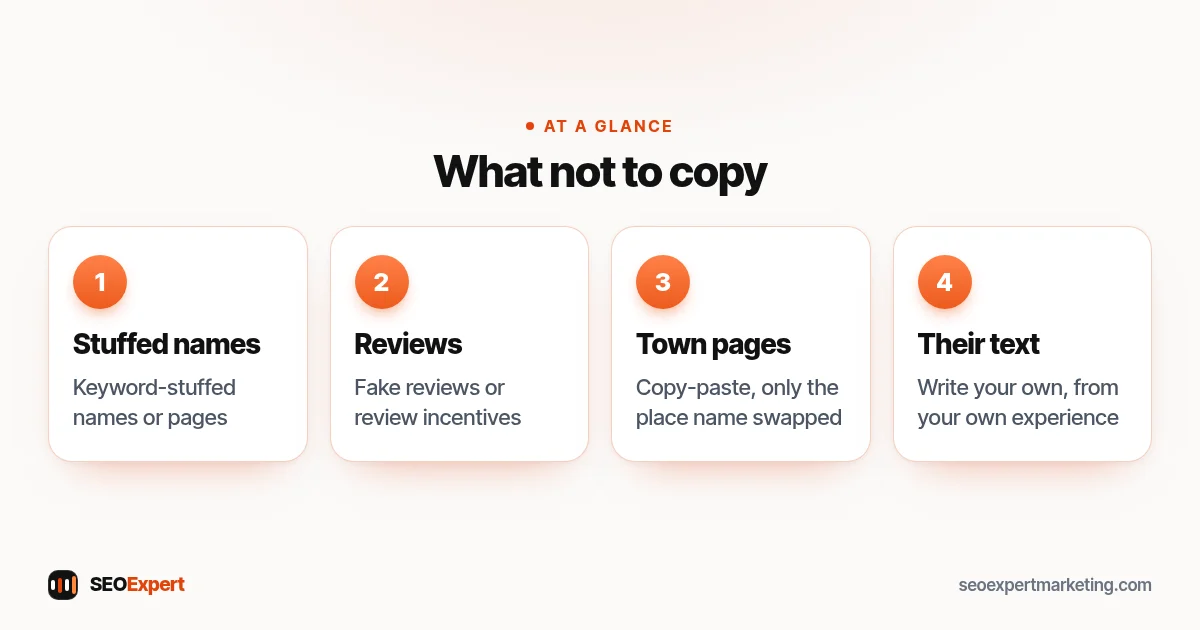
What not to copy
- Keyword-stuffed business names or pages; they break Google's guidelines and can cost you.
- Fake reviews or review incentives.
- Copy-paste town pages that only swap the place name.
- Their exact text: write your own, from your own experience.
Four things not to copy, whatever your competitor analysis finds:
How often to repeat a competitor analysis
A light check every three months is enough for most small businesses: search your main phrases, note any new names and see what's changed. Do a fuller competitor analysis before a redesign, when entering a new area or service, or when a competitor suddenly overtakes you.
Online stores: a slightly different method
For stores, competitors include marketplaces and big retailers you can't outrank for broad terms. Look for gaps instead: specific products, sizes, materials or uses where the top results are weak, thin category pages you could beat with a better range and description, and buying questions nobody answers well. Our guide to category page SEO explains how to build pages that compete.
Need help?
A competitor analysis is part of our keyword research services and is included in our SEO Growth and SEO Authority plans. Send your website and your main competitors through our free website review form, and we reply by email.
Competitor analysis: quick answers
How do I find my SEO competitors?
Search your main services and area on Google from your location and note who appears in the map and organic results again and again.
Do I need paid tools for a competitor analysis?
Not for a small business. Google search, Search Console and a careful comparison of pages and profiles reveal most practical gaps.
Should I copy what my competitors do?
Learn from them, but don't copy their text, tactics that break Google's rules or fake reviews. Aim to be the better answer.
How often should I check competitors?
A light check every three months, and a fuller analysis before a redesign or when a competitor suddenly overtakes you.
