
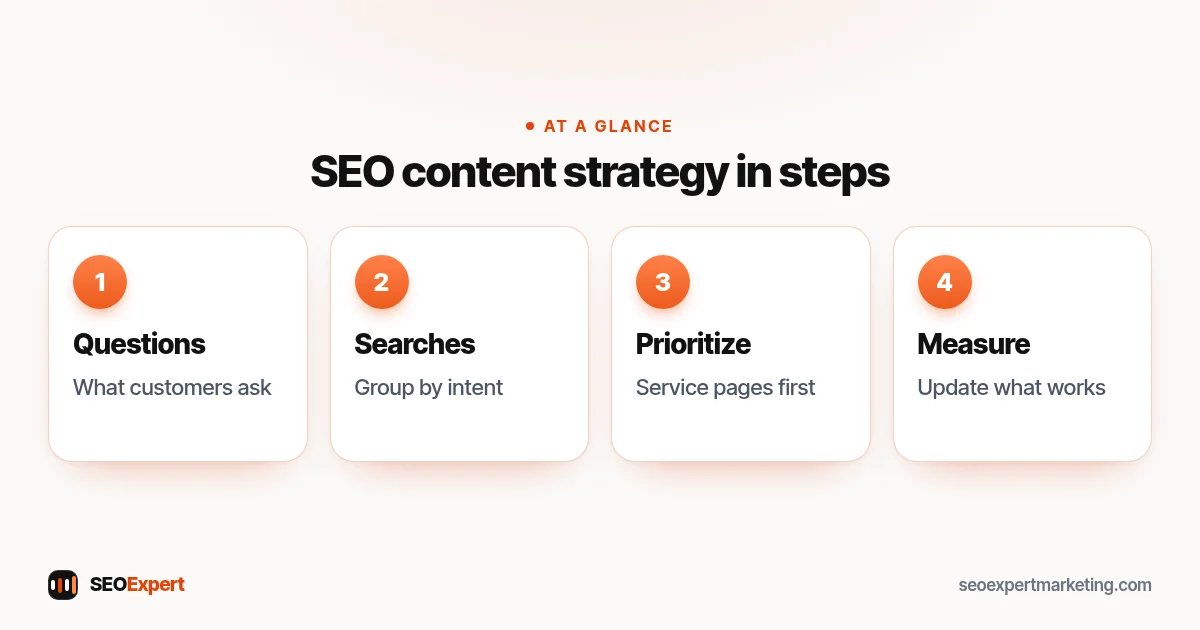
An SEO content strategy is a plan for which pages and articles to create, why, and in what order, so that your content brings visitors from search and turns them into customers. Without one, businesses tend to publish whatever comes to mind, or nothing at all. With one, every piece answers a real question, supports a service and links into the rest of the site. This guide sets out six steps for a small business, with an example and the mistakes to avoid.
What an SEO content strategy is, and isn't
It isn't a promise to publish a blog post every week. Volume on its own doesn't help; Google's guidance on creating helpful, reliable content asks whether content is original, shows first-hand experience and leaves people satisfied, not how often you post. A good SEO content strategy is a short list of the right pages, built in a sensible order, and kept up to date.
Why publishing more isn't a strategy
It's tempting to fill a new site with dozens of articles at once, especially now that AI tools can draft them in minutes. Google's spam policies warn against exactly this. They describe scaled content abuse as many pages generated mainly to manipulate search rankings rather than to help users, and one of their examples is using generative AI tools to produce many pages without adding value for users. Google adds that sites breaking its policies "may rank lower in results or not appear in results at all".
The safer path for a small business is slower: publish a page when you have something useful to say, check it before it goes live, and make sure it supports a service you actually offer. A short list of pages that answer real customer questions does more than a long list that repeats what other sites already say.
Step 1: Start from your services and customers
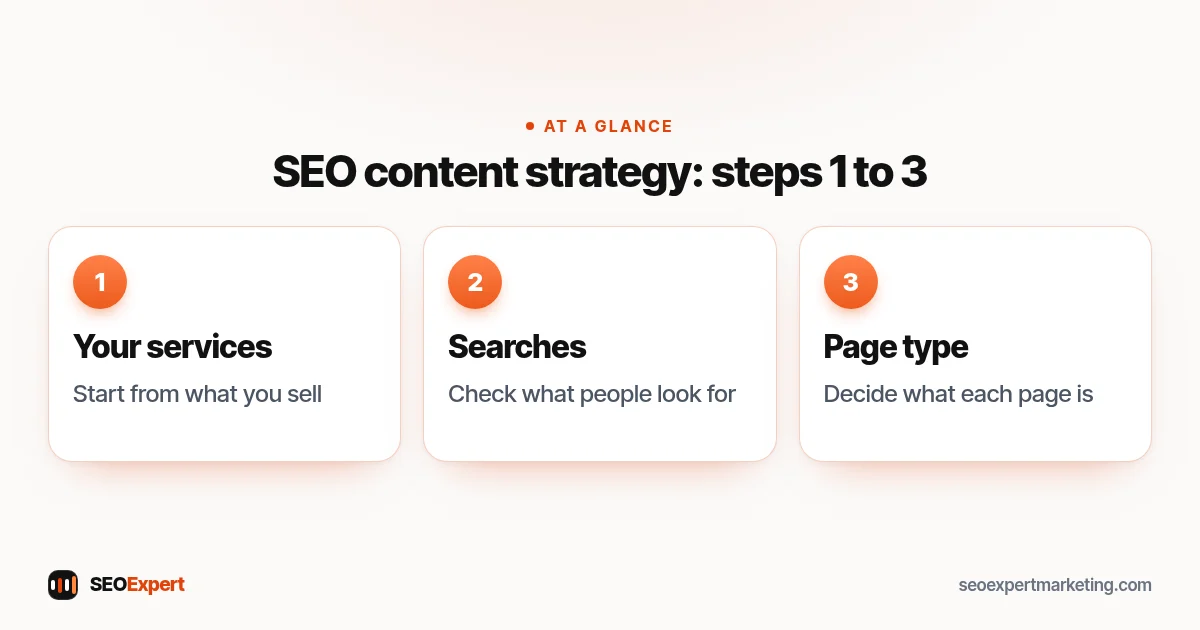
List what you sell and who buys it. Then list the questions customers ask before they buy: costs, timings, comparisons, problems and how to choose. Ask your team what people say on the phone and in emails. These questions are your raw material.
Step 2: Check what people search for
Turn the questions into search phrases and check them: Google's suggestions, the "People also ask" box and, if you have a site already, the queries in Search Console. Group phrases that need the same answer; each group becomes one page. Our guide on how many keywords to target explains the grouping.
Step 3: Decide the type of page
| Search intent | Page type | Example |
|---|---|---|
| Ready to buy | Service or product page | Emergency boiler repair |
| Comparing options | Comparison or cost guide | Combi vs system boiler |
| Researching a problem | How-to or explainer article | Why is my boiler losing pressure? |
| Local | Location page, only if genuine | Boiler repair in a specific town |
The planning half, at a glance:
Searches like "[service] cost" or "[service] near me" belong on service and pricing pages, not in blog posts. Our guide to keyword research for small businesses shows how to match each phrase to the right page.
Step 4: Prioritize
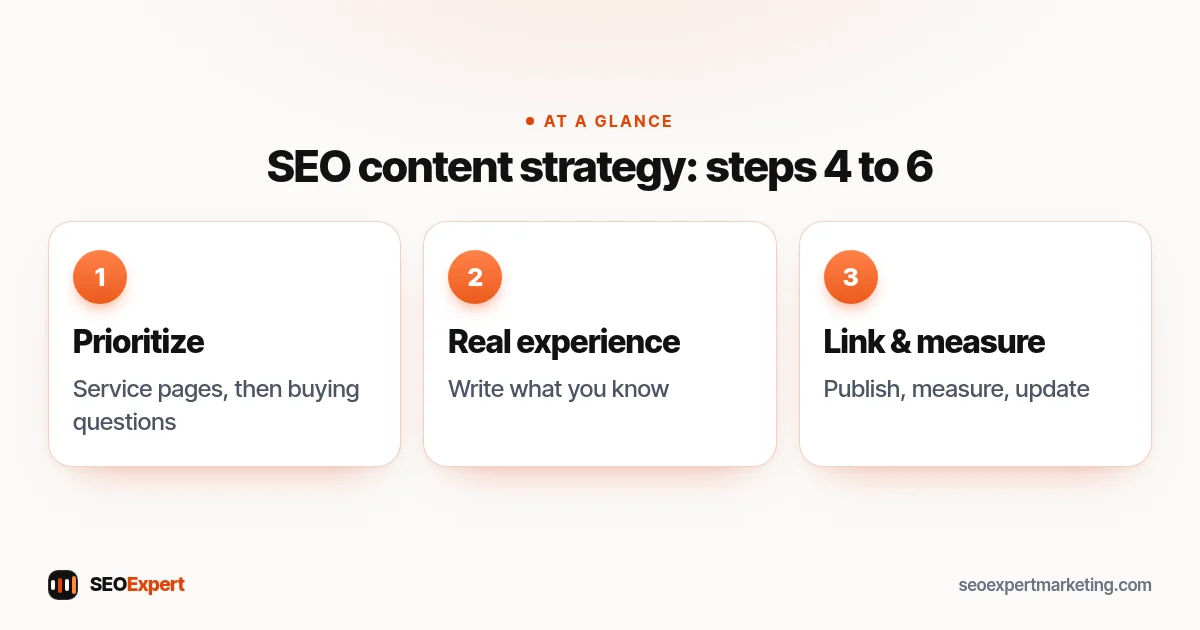
Start with service pages, because they bring enquiries directly. Then add the articles that support them, starting with questions closest to a buying decision, such as costs and comparisons. Leave broad, general topics for later; a small site rarely ranks for them early, and they bring fewer customers.
Step 5: Write with real experience
The biggest advantage a small business has is knowledge. Include real prices, timeframes, photos of your own work, examples from jobs and honest advice about when a customer doesn't need you. That's what makes content worth ranking. AI tools can help with drafting, and Google's guidance on AI-generated content says it rewards quality however it's produced, but using automation mainly to manipulate rankings breaks its spam policies. Check every fact and add what only you know.
Step 6: Link, publish, measure, update
Link each article to the service page it supports, and from service pages to helpful articles. Publish at a pace you can keep up with quality. Each month, check Search Console for which pages gain impressions and clicks, and update pages when prices, rules or your services change. An SEO content strategy is a living list, not a one-off document.
The doing half, at a glance:
Content for local businesses
For a business serving a local area, the plan leans towards service pages, local questions and proof of work. Useful local content includes guides to local regulations or permits, seasonal advice for your climate, project write-ups with photos from real jobs and pages for the main areas you serve when you have something specific to say about each. Our local SEO checklist and our guide to SEO for service area businesses explain how to choose local topics that bring enquiries.
Refreshing old content
Some of the best gains come from improving what you already have. Look in Search Console for pages that get impressions but few clicks, or that sit on page 2. Update them with clearer titles, better answers, newer prices and photos, and stronger links from related pages. Merge thin pages that cover the same topic into one stronger page, with a redirect from the old address. A refresh often moves a page faster than writing a new one from scratch.
Who should write the content?
The best content combines your knowledge with someone's writing time. Many owners record a short voice note or call answering the questions for a page, and a writer turns it into a clear article for them to check. That keeps the content accurate and personal without taking hours of the owner's week. Whoever writes, the owner or an expert on the team should review every page before it goes live. Keep a short style note, covering how you describe your services, words to avoid and how you talk about prices, so every page sounds like the same business.
A simple content calendar
| Month | Content |
|---|---|
| 1 | Improve or create the three main service pages |
| 2 | Cost guide for the main service; FAQ on the service page |
| 3 | Two problem-solving articles linked to service pages |
| 4 | A comparison article; update month 1 pages with new photos and examples |
One or two strong pieces a month is a sustainable pace for most small businesses.
Example: an SEO content strategy for a physiotherapy clinic
Here's an illustrative example, not a client result. The clinic offers sports injury treatment, back pain treatment and post-surgery rehab. Customers keep asking how many sessions they'll need, whether they need a referral and what to wear. The plan: first, a page for each treatment with session prices and what happens at the first visit; then a guide to how many sessions typical injuries need, a page answering "do I need a referral?" for each country they operate in, and an article on running injuries linked to the sports injury page. Each piece answers a real question and points to a service.
Common mistakes
- Publishing generic articles any business could have written.
- Writing about topics nobody searches for, or that don't relate to what you sell.
- Several articles competing for the same search.
- No links between articles and service pages.
- Never updating old content.
- Publishing large volumes of thin or AI-generated pages without checking them.
How we help
Our SEO content writing services plan and write service pages and articles from your knowledge, and our one-off page writing starts at $39 a page. To see how content fits into monthly work, compare our SEO packages, or ask for a free website review on WhatsApp.
SEO content strategy: quick answers
How often should a small business publish content?
At a pace you can sustain with quality. For many small businesses, one or two strong pages or articles a month is plenty.
Should I start with blog posts or service pages?
Service pages. They bring enquiries directly. Articles work best when they support and link to those pages.
Can I use AI to write SEO content?
Google says it rewards quality however content is produced, but automation used mainly to manipulate rankings breaks its spam policies. Check facts and add your own experience.
How do I know if my content strategy is working?
Search Console shows impressions and clicks per page. Over a few months, look for growth on your target pages and more enquiries from search.
