
This local SEO checklist covers everything a small business needs to show up when nearby customers search on Google: your Google Business Profile, your website, reviews, business listings and local content. Work through it from top to bottom. Most items take minutes, cost nothing and can be done by the owner, and together they cover what Google says matters most for local results.
Before you start the local SEO checklist
Gather a few things first so you can work through the local SEO checklist in one sitting: your exact business name as it appears on signage and paperwork, one phone number and one address you'll use everywhere, your opening hours, a list of your services and the areas you cover, and ten or more recent photos of your premises and work. Having these ready keeps every listing consistent from the start.
For the main SEO rules beyond local search on one page, see our SEO cheat sheet.
How Google ranks local businesses
Google's help page on improving your local ranking says local results are mainly based on three things:
- Relevance: how well your profile matches what someone searched for.
- Distance: how far your business is from the person searching.
- Prominence: how well known your business is, based on information such as links to your website and how many reviews you have.
You can't change distance, but every item in this local SEO checklist improves relevance or prominence.
1. Google Business Profile checklist
Your profile is the single most important part of local SEO, because it's what appears in Google Maps and the map results.
- Claim and verify the profile. Google says verified businesses are more likely to show up.
- Choose the right primary category. Pick the one that best describes your main service, then add a few accurate secondary categories.
- Use your real business name. Google's guidelines for representing your business forbid adding keywords or locations to the name, and profiles can be suspended for it.
- Address or service area. Show your address if customers visit you. If you travel to customers, hide the address and list the areas you serve.
- Hours, including holidays. Wrong hours lose customers and attract poor reviews.
- Services, products and attributes. Fill in every section that applies to you.
- Real photos. Your premises, team, vehicles and finished work. Add new ones regularly.
- Website and booking links pointing to the right pages.
Our page on Google Business Profile optimization goes deeper into each setting.
2. Website checklist for local SEO
- Name, address and phone number on every page, usually in the footer, written exactly as on your profile.
- A page for each main service, explaining what it includes, the areas you cover and how to get a quote.
- Area pages only where you have something real to say, such as jobs completed there or local conditions. Near-identical town pages can count as doorway pages under Google's spam policies.
- Title tags that mention the service and the area, for example "Emergency Plumber in Austin, TX | Smith Plumbing".
- A fast, easy mobile site with a tap-to-call button. Most local searches happen on phones.
- LocalBusiness structured data. Google's local business structured data documentation shows how to mark up your name, address, hours and more.
- Search Console set up, so you can see which local searches bring visitors.
If you're not sure whether your website has technical problems, our technical SEO services page lists the checks we run.
Not sure which searches to target? Our guide to local SEO keywords shows how to find them for free.
3. Reviews checklist
- Ask every happy customer, at the moment the job is done, with a direct link to your review form.
- Reply to every review, positive or negative, politely and briefly. Google notes that replies show customers you value their feedback.
- Never buy reviews, write your own or offer rewards for them. Fake reviews break Google's policies and consumer protection law in many countries.
- Handle complaints offline: reply publicly once, then solve the problem by phone or email.
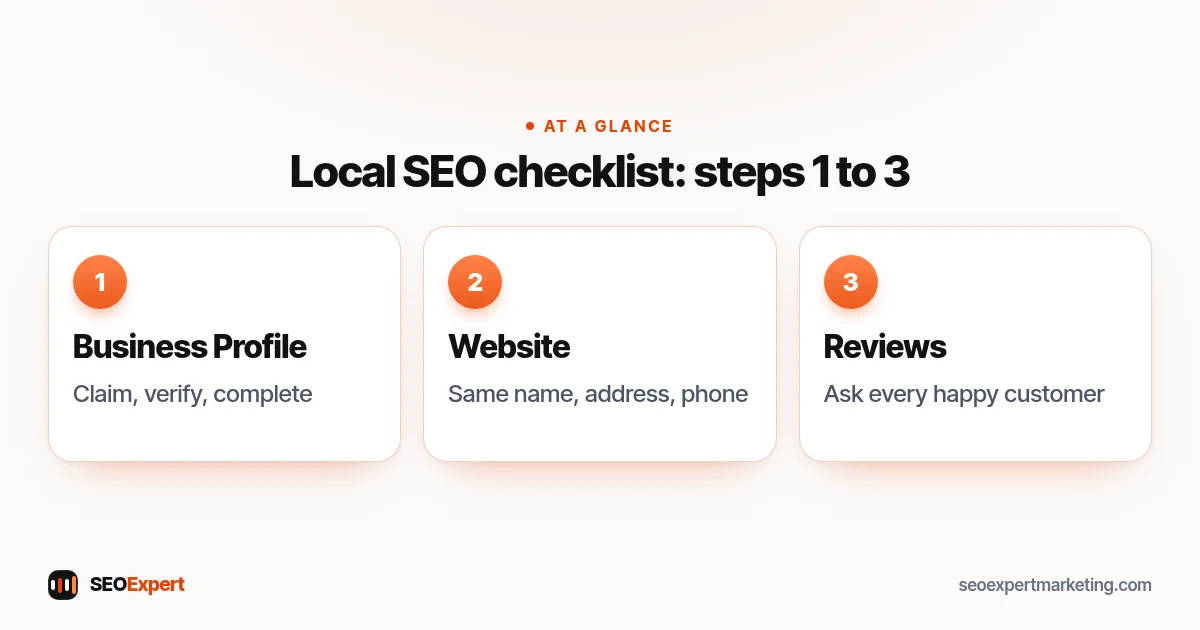
The first half of the local SEO checklist at a glance:
Reviews missing from your profile? See our guide on how to see deleted Google reviews.
4. Citations and business listings checklist
Citations are mentions of your business name, address and phone number on other websites, such as directories and industry sites.
- List your business on the main platforms in your country, such as Bing Places, Apple Business Connect, Facebook and Yelp.
- Add it to directories that matter in your industry or town, such as a chamber of commerce or trade association.
- Keep the details identical everywhere. Old addresses or phone numbers confuse customers and search engines.
- Skip paid packages that promise hundreds of low-quality directory listings.
A Facebook page is one of the listings worth keeping accurate. See our guide on how to make a business Facebook page.
5. Local content and links checklist
- Write about real local work: project write-ups with photos, the neighborhoods you serve, local rules or seasonal problems.
- Get mentioned by local organizations you genuinely work with: sponsors, suppliers, clubs, local news.
- Answer the questions customers ask you before they buy, such as prices, timings and how the job works.
6. Tracking checklist
- Check the Performance section of your Business Profile monthly: calls, website clicks, direction requests.
- Check Search Console for the local searches that bring visitors.
- Ask new customers how they found you and keep a simple tally.
Want the reasoning behind each item? Our guide to local SEO tactics explains them in priority order.
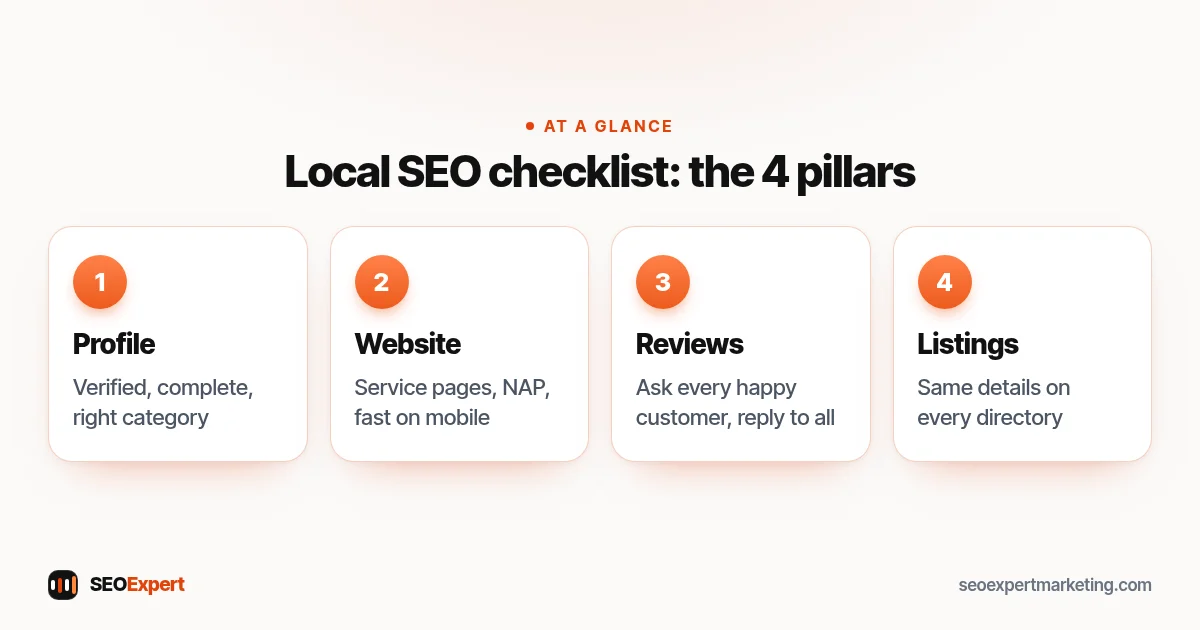
The second half of the local SEO checklist:

Your monthly local SEO checklist
Once the basics are in place, local SEO becomes a short monthly routine:
- Add new photos to your profile.
- Reply to every new review.
- Update hours for upcoming holidays.
- Publish one useful local page or project write-up.
- Check your profile and Search Console numbers, and note what changed.
Common local SEO mistakes
These mistakes can undo the good work on your local SEO checklist:
- Stuffing keywords or town names into the business name.
- Using a virtual office or someone else's address to appear in another city.
- Creating dozens of copy-paste location pages.
- Ignoring negative reviews or arguing with customers in public.
- Setting up the profile once and never touching it again.
A local SEO checklist for service-area businesses
If you travel to customers, such as plumbers, cleaners or electricians, a few items on the local SEO checklist work differently. Hide your home address on the profile and list your service areas instead, keep the areas realistic rather than listing every town in the state, and put your area details on your website's service pages. Photos of real jobs in the towns you serve help both customers and Google understand where you work.
When to get help with your local SEO checklist
Most of this local SEO checklist can be done by an owner with a few hours a month. If you'd rather hand it over, our local SEO services cover the full checklist, our local SEO packages page explains what each plan includes, and a $59 SEO audit tells you which items on the list your business is missing.
Local SEO checklist: quick answers
How long does local SEO take?
Profile fixes and new photos can make a difference within weeks. Reviews, website pages and listings usually build results over several months, and the work keeps paying off as long as you keep it up.
Do I need a website for local SEO?
You can appear in Google Maps with only a Business Profile, but a website helps: it gives Google more information about your services, lets you rank in normal results and gives customers somewhere to check you before they call.
Can I rank in a town where I have no office?
Service-area businesses can list the areas they cover, but distance still matters, so you'll usually appear most often near your base. Don't use fake or virtual addresses to appear elsewhere; Google can suspend the profile.
What's the most important item on the checklist?
A complete, verified Google Business Profile with the right primary category, followed by a steady flow of genuine reviews. Those two items cover much of what Google uses to decide local results.
