
Local SEO citations are mentions of your business name, address and phone number (often shortened to NAP) on websites other than your own: directories such as Yelp, map apps such as Apple Maps and Bing Maps, industry associations, chambers of commerce and local news sites. They help customers find and trust you, they feed the map apps people use every day, and consistent details make it easier for search engines to be confident about who you are and where you work. This guide explains which local SEO citations matter, how to build and clean them up, and where to stop. We also ran Step 1 on our own business; the results are in the table further down.
What counts as a citation?
There are two kinds:
- Structured citations are business listings with set fields for name, address, phone, hours, category and website, such as Yelp, Bing Places, Apple Business Connect, Facebook, Yellow Pages or an industry directory.
- Unstructured citations are mentions in normal text, such as a local news story about your business, a supplier's "where to buy" page or a blog post recommending you.
A citation doesn't need a link to count as a mention, although many include one.
Do local SEO citations still matter?
Yes, but less than many directory sellers suggest. Google's help page on improving your local ranking says prominence, how well known a business is, is based partly on information like how many websites link to your business and how many reviews you have. It doesn't promise that more directory listings mean higher rankings.
Whitespark's Local Search Ranking Factors report, a survey of local SEO specialists published in November 2025, gives a useful outside view. Its author notes that citations have been decreasing in importance for the map results over the past decade, while also reporting that three of the top five factors the experts ranked for AI search visibility are citation factors. The survey reflects expert opinion, not Google data, but the message matches what most practitioners see: a handful of accurate, important listings matter; hundreds of weak ones don't.
Citations also matter for a reason that has nothing to do with Google rankings. Customers find businesses through Apple Maps, Bing, Yelp, voice assistants and industry directories. If your details there are missing or wrong, you lose calls.
Citations and links overlap but aren't the same: a listing can mention you without linking to you, and a link can come from a page that never gives your address. Our guide on how to get backlinks covers the link side.
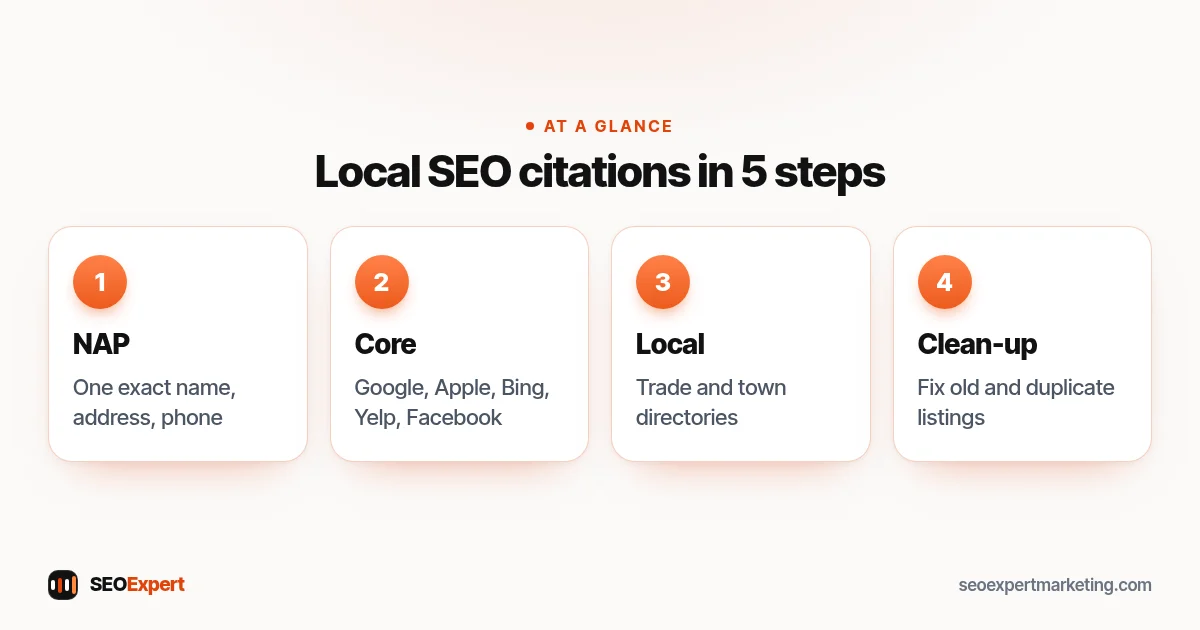
Step 1: Decide your exact NAP
Before you build or fix any listing, write down the exact version of your business details you'll use everywhere:
- Name: your real business name, as on signage and paperwork, with no added keywords.
- Address: one format, including suite or unit number. Service-area businesses that hide their address on Google should keep it hidden on other sites where possible too.
- Phone: one main local number. Avoid using different tracking numbers on different listings.
- Website: the same address everywhere, with or without "www", matching your actual site.
- Category, hours and a short description you can reuse.
Start with your own website: it's the version every listing should copy, so it has to agree with itself first.
We ran Step 1 on our own business
On 17 Nov 2026 we checked how our own details appear on nine pages of this site (home, contact, about, FAQ, privacy policy, terms, refund policy, a service page and this guide) and in the business details coded into our home page and guides for search engines (structured data):
| Detail | Where we looked | What we found |
|---|---|---|
| Name | Footer of all nine pages and the structured data | "SEO Expert Marketing" everywhere. Guides are signed "SEO Expert Marketing Team", which is an author byline, not a listing name |
| Phone | All nine pages and the structured data | The same number everywhere. The structured data writes it with hyphens and the pages with spaces; the digits match |
| Address | Contact, about, FAQ, privacy, terms and refund pages, and the structured data | The same mailing address in all seven places, and every page that shows it says it's for mail, not visits. One service page gives only the city and state |
| Privacy policy, terms and the structured data | The same address in all three | |
| Website | The structured data and the www version of our address | One address without "www"; the www version redirects to it in one step |
Our own site passed, so those exact details are what we'd copy to any listing. If your site shows two phone numbers or two versions of your name, fix the site first; otherwise every new listing copies the mistake.
Step 2: Fix the core platforms first
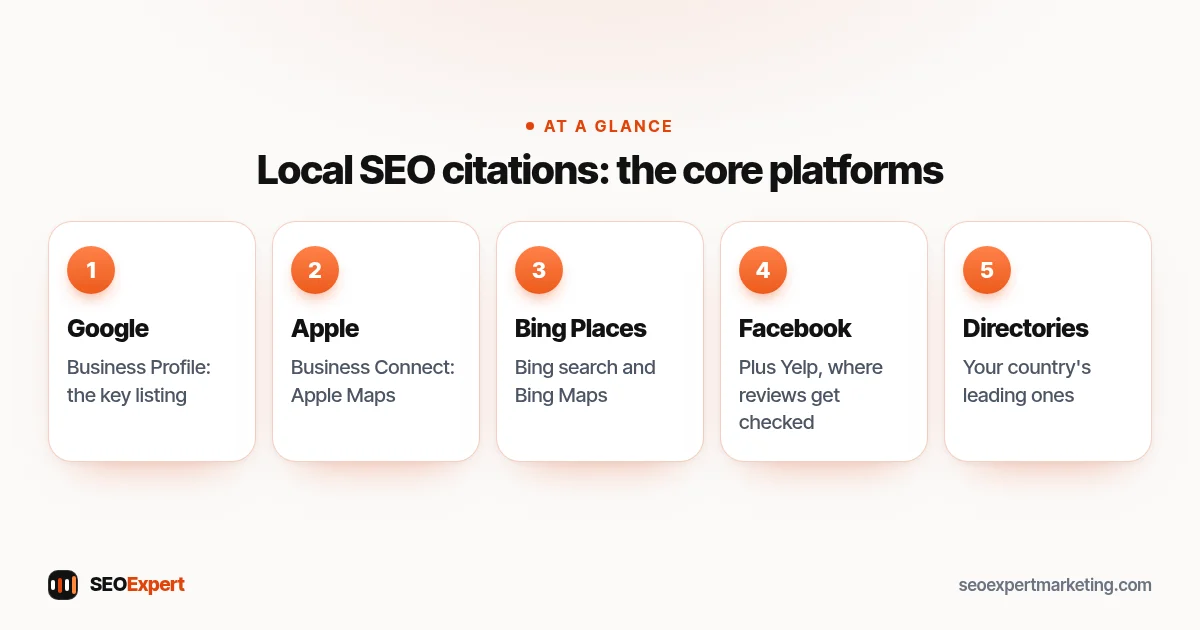
Start with the places that feed maps and assistants and that customers actually use:
- Google Business Profile, the most important listing for local search.
- Apple Business Connect, which controls how you appear in Apple Maps on iPhones. Claim it through Apple Business Connect.
- Bing Places, which feeds Bing search and Bing Maps.
- Facebook and Yelp, where many customers check reviews.
- Your country's main directories, such as Yellow Pages in the USA and Canada, Yell in the UK or True Local in Australia.
Claim each listing, verify it and fill in every field with your exact NAP, hours, category, photos and description.
The core platforms at a glance:
Your Facebook page and LinkedIn company page are among the most visible listings, so give them the same name, phone, address and hours as everything else.
Step 3: Add industry and local citations
After the core platforms, the next citations to build are ones that make sense for your trade and your town. Good places to start:
- Trade associations and professional bodies you belong to.
- Industry directories customers actually use, such as legal, medical or home-services directories.
- Your local chamber of commerce, business groups and town or council business directories.
- Suppliers or manufacturers who list approved installers or stockists.
These are useful because they're relevant: a plumber listed by a plumbing association or a local trade body is a stronger signal than a plumber listed on a generic directory nobody visits.
Step 4: Clean up wrong and duplicate listings
Fixing existing local SEO citations is often worth more than adding new ones. Inconsistent citations are most often caused by a move, a new phone number or a rebrand. To find them:
- Search Google for your business name, your old phone numbers and your old addresses.
- Search the main directories directly for your business name.
- Note every listing with outdated details, then claim and correct it, or ask the site to update or remove it.
- Look for duplicate listings of the same business, and merge or remove them following each platform's process.
Keep a simple spreadsheet of every listing, its login and the date you checked it. It saves hours the next time something changes.
Step 5: Earn unstructured citations
Mentions in real local content are harder to get but more valuable, because they often bring a link and real visitors too. Ideas that work for small businesses:
- Sponsor a local team, event or charity and ask to be listed on their site.
- Offer a useful local comment or story to local news.
- Get featured by suppliers or partners you genuinely work with.
- Publish something locally useful, such as a seasonal guide or local price survey, that others want to mention.
Our link building services page explains how we earn these mentions without buying links.
How many local SEO citations do you need?
There's no magic number. For most small businesses, accurate listings on the core platforms plus a few relevant industry and local sites cover what matters. Building hundreds of citations on low-quality directories rarely helps and can create a maintenance problem: every one of them needs updating if your phone number changes.
Citation services and tools: what to watch for
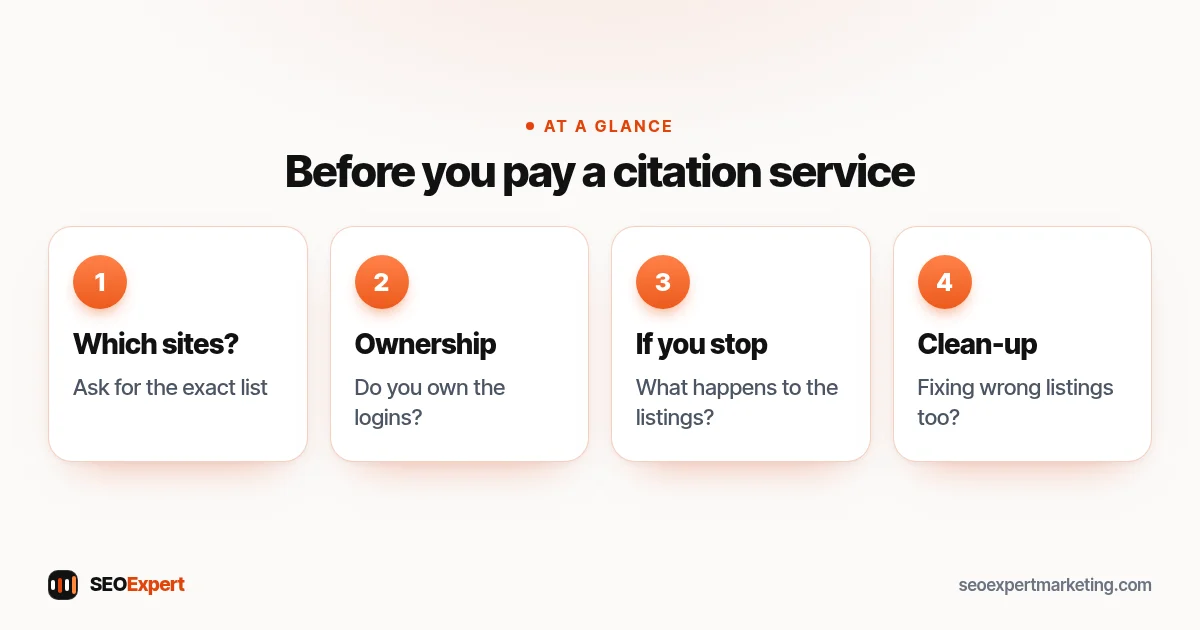
Paid citation-building and listing-management services can save time, especially for businesses with many locations. Before you buy, ask:
- Which sites exactly will you submit to? Ask for the list.
- Do I own the listings and logins afterwards?
- What happens to the listings if I stop paying? Some subscription tools revert or remove listings when you cancel.
- Will you fix existing wrong listings, or only add new ones?
Be wary of packages offering hundreds of listings for a few dollars. Most of those sites get no visitors and add nothing.
Questions to ask before you pay a citation service:
Keeping local SEO citations accurate
Check your core listings every few months and after any change to your hours, phone number, address or name. Update Google Business Profile first, then the core platforms, then everything else on your spreadsheet. Our local SEO checklist includes a short monthly routine, and a local SEO audit once or twice a year will catch listings that have drifted.
For the most important listing, our one-time Google Business Profile Setup ($99) covers your categories, services and service areas, plus your description, hours and attributes. If you'd rather hand over the rest, our local SEO services page explains how we keep your name, address and phone number the same on your website, your Google profile and the directories your customers use. Not sure where you stand? Ask for a free website review.
Local SEO citations: quick answers
Are local citations still a ranking factor?
They're one of many signals. Google says prominence is partly based on how many websites link to your business and on your reviews. A survey of local SEO specialists suggests citations carry less weight for the map results than they used to, but accurate listings on the main platforms are still worth having for customers and other map apps.
Do citations need a link to my website?
No. A mention of your business name, address and phone number counts as a citation even without a link. Listings that include a link can also send you visitors.
What happens if my business details are inconsistent?
Customers may call an old number or drive to an old address, and search engines and map apps may be less confident about which details are correct. Fix the core platforms first, then the rest.
Should I pay for a citation-building service?
It can save time, especially with several locations, but ask for the list of sites, make sure you own the listings and check what happens if you cancel. Avoid cheap bulk packages of low-quality directories.
Do small formatting differences, like hyphens in a phone number, matter?
What matters most is that the details are the same: one name, one number, one address. When we checked our own site, the structured data wrote our phone number with hyphens and the pages with spaces, but the digits matched. A different number would be a real inconsistency.
