

This SEO ROI calculator estimates whether search engine optimization could pay for itself for your business, using your own numbers: how many extra visitors you expect, how many of them contact you, how many buy, and what each new customer is worth. It takes about a minute, and the result is only as good as the numbers you enter, so this page also explains where to find realistic ones.
How the SEO ROI calculator works
The calculator follows the path a visitor takes from Google to your bank account. Extra visitors become inquiries at your website's contact rate; inquiries become customers at your closing rate; customers bring a profit. That monthly profit is then compared with the monthly cost of SEO. Every figure updates as you type, and nothing leaves your browser.

The SEO ROI formula
Return on investment is the profit an investment brings, minus what it costs, divided by what it costs:
SEO ROI = (extra profit from SEO − SEO cost) ÷ SEO cost × 100
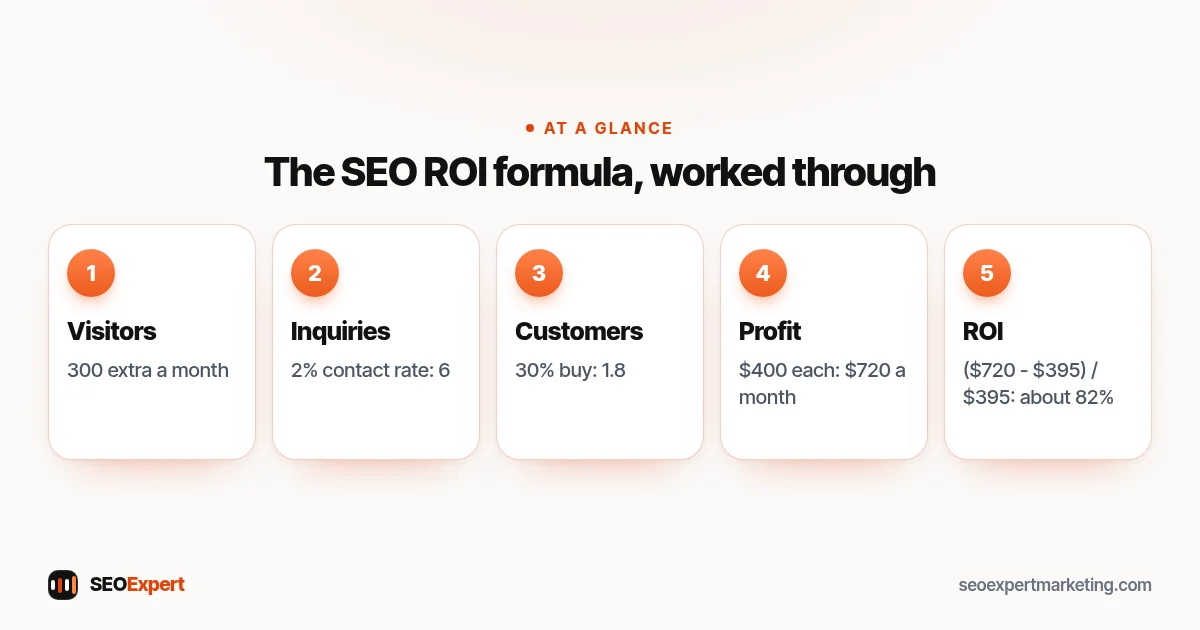
With the example numbers already filled in, 300 extra visitors a month and a 2% contact rate give 6 inquiries. If 30% of them buy, that's 1.8 new customers. At $400 profit each, SEO brings $720 a month. Against a $395 plan, the return is ($720 − $395) ÷ $395 × 100, about 82%. Change any number and the result updates straight away.
Where to find realistic numbers
Visitors from Google
The Performance report in Google Search Console shows how many clicks your site gets from Google search. It's free, and it counts only search visits, which is exactly what SEO affects. For a brand-new website, start at zero.
Extra visitors from SEO
This is the hardest number and the easiest to exaggerate. Look at the searches your customers really make and how many results already compete for them. A local plumber might reasonably hope for a few hundred extra visits a month after six to twelve months of steady work; a national online store might aim much higher. When in doubt, use a cautious figure.
Contact and closing rates
Count the calls, forms and messages your website produced last month and divide by its visitors. If you've never measured it, 1 to 3% is a cautious starting point for service businesses. Your closing rate comes from your own sales records: out of 10 people who asked for a quote, how many became customers?
Profit per customer
Use profit, not price. If a job sells for $1,000 and costs you $600 in materials and labor, the profit is $400. If customers usually come back or stay for months, include that repeat business, but only what you really see in your records.
Reading your result
A positive percentage means the extra profit covers the cost of SEO with money left over. A negative one means it doesn't, with the numbers you entered. The calculator also shows how many new customers a month you'd need just to cover the cost. For many businesses that's one or two, which is a useful way to think about whether SEO makes sense.
Try three scenarios
Run the numbers three times: a cautious case, a likely case and a good case. If SEO only pays off in the good case, a smaller start, such as our one-time SEO services, may suit you better than a monthly plan.
What each of our plans needs to pay for itself
Here is the SEO ROI calculator's own break-even sum applied to our real prices. It uses the example numbers already filled in: $400 profit per new customer, 2% of visitors contacting you and 30% of those buying, so 6 in every 1,000 extra visitors become customers. The customer figures are rounded the same way the calculator shows them.
| Plan and monthly price | New customers a month to cover it | Extra visitors a month to cover it |
|---|---|---|
| SEO Starter, $395 | 1 | about 165 |
| SEO Growth, $795 | 2 | about 331 |
| SEO Authority, $1,495 | 3.7 | about 623 |
| SEO Starter paid yearly, $295 | 0.7 | about 123 |
| SEO Growth paid yearly, $595 | 1.5 | about 248 |
| SEO Authority paid yearly, $1,095 | 2.7 | about 456 |
Two things stand out. If your profit per customer is high, the gap between plans shrinks: at $1,500 profit, even SEO Authority needs about one new customer a month. If you sell low-profit jobs, the visitor figures climb fast: at $100 profit, SEO Starter needs about 4 new customers and about 660 extra visitors a month. Paying yearly lowers each figure by about a quarter, and monthly plans have no minimum term. The SEO packages page lists what each plan includes and how a yearly plan is cancelled.
If none of these looks reachable yet, start smaller. Our $59 Full SEO Audit needs less than a fifth of one $400 customer to pay for itself, and if you start a monthly or yearly plan within 30 days of buying the audit, the $59 is credited to your first payment.
Why timing matters for SEO ROI
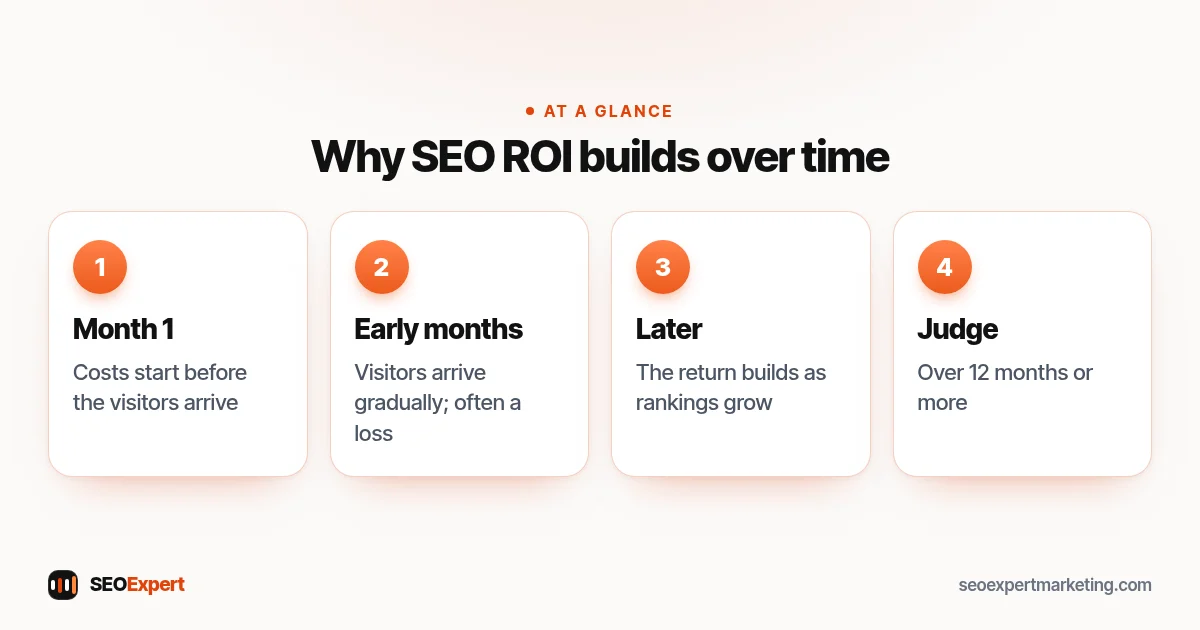
The cost of SEO starts in the first month, but extra visitors usually arrive gradually over several months. That means the first months normally show a loss, and the return builds later as rankings and traffic grow. A fair way to judge SEO is over 12 months or more, not month by month. The calculator shows the monthly picture once the extra visitors have arrived; it doesn't model the ramp-up.
Not sure when the extra visitors might arrive? Our guide to how long SEO takes sets out a typical month-by-month timeline, with what we measured on our own new site.
What the calculator can't tell you
- It can't predict rankings or traffic. Those depend on your competition, your website and Google's own systems.
- It doesn't count visits that turn into sales later, by phone or in person, unless you include them in your rates.
- It ignores the value SEO keeps after you stop paying: pages and links built today can keep bringing visitors.
For a realistic view of your own site, our SEO audit services look at what's holding it back, and our plans page compares the three monthly plans line by line.
Using the result to choose a budget
If your numbers show that one or two extra customers a month would cover the cost, a monthly plan is worth considering. If they show you'd need many more, start with a fix to your website's contact rate or a single fixed-price job, and run the SEO ROI calculator again once you have real data. Our small business SEO page explains what to fix first when the budget is small.
