
SEO pricing models are the different ways SEO providers charge for their work: a monthly retainer, an hourly rate, a fixed project fee or payment tied to results. The model you choose affects more than the invoice. It shapes what work gets done, how progress is reported and who carries the risk if things go slowly. This guide explains the four common SEO pricing models in plain language, with typical prices and the questions to ask before you sign.
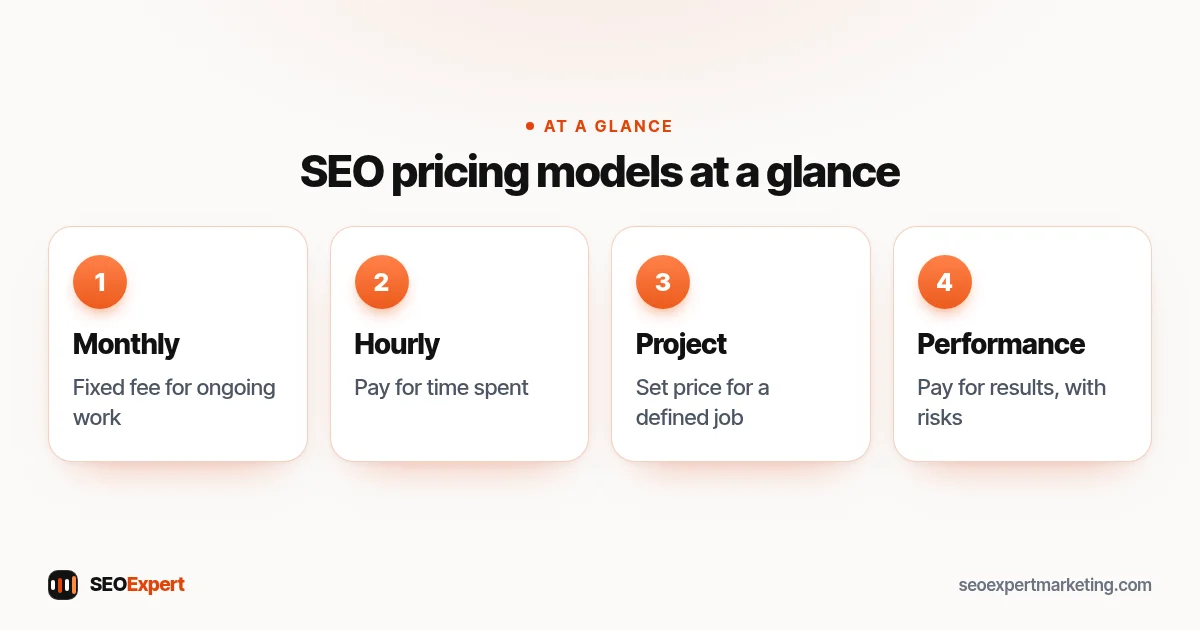
The 4 common SEO pricing models
In Ahrefs' survey of SEO providers, 78.2% said they charge a monthly retainer, 48.9% price per project and 34.8% charge by the hour. The figures overlap because many providers offer more than one model. Pay-for-performance pricing exists too, but it's much less common, for reasons we'll come to.
1. Monthly retainer
You pay a fixed amount every month for an agreed set of work, such as technical fixes, content, local SEO and a report. In the Ahrefs survey, the most common range was $501 to $1,000 a month. It's the most popular of the SEO pricing models because SEO is ongoing: Google keeps changing, competitors keep publishing and your site keeps needing attention.
Good for: businesses that want steady progress and a predictable cost. Watch out for: vague deliverables. A retainer should list what's done each month. Our guide to the SEO retainer covers this model in depth.
2. Hourly rate
You pay for time spent. The most common rate in the same survey was $75 to $100 an hour, and 90% of providers charged $150 an hour or less.
Good for: consultations, training, investigating a traffic drop or reviewing a plan. Watch out for: hours that don't produce anything concrete. Agree a cap and ask for a log of what was done. Our article on the SEO hourly rate explains how to judge a quote.
3. Fixed project fee
You pay a set price for a defined piece of work: an audit, a site migration, keyword research or a batch of new pages. The most common project fee in the Ahrefs survey was $2,501 to $5,000, though small, focused projects can cost far less.
Good for: one-off jobs with a clear end, or getting started before committing to a monthly plan. Watch out for: scope. Make sure the proposal lists exactly what's included and what would cost extra.
4. Pay for performance
You pay only when agreed results happen, such as a keyword reaching a certain position or a number of leads. It sounds like the safest of all SEO pricing models, but it has real problems:
- Easy targets: providers often choose phrases that are easy to rank for but bring few customers.
- Short-term tactics: paying only for quick wins encourages risky shortcuts, including link schemes that break Google's spam policies.
- Unpredictable cost: a good month can produce a large bill.
- Nobody controls Google: rankings depend on Google's systems and on competitors, so promises of specific positions should make you cautious.
Google's own guide, Do you need an SEO?, warns that no one can promise a top ranking on Google.
SEO pricing models compared
| Model | Typical price | Best for | Main risk |
|---|---|---|---|
| Monthly retainer | $501 to $1,000 most common | Ongoing growth | Vague monthly work |
| Hourly | $75 to $100 most common | Advice and small tasks | Hours with no output |
| Project | $2,501 to $5,000 most common | Audits, migrations, page sets | Unclear scope |
| Performance | Varies widely | Rarely the best choice | Easy targets, risky tactics |
Prices from the Ahrefs survey linked above; your quotes will vary by market, competition and provider.
How to choose between SEO pricing models
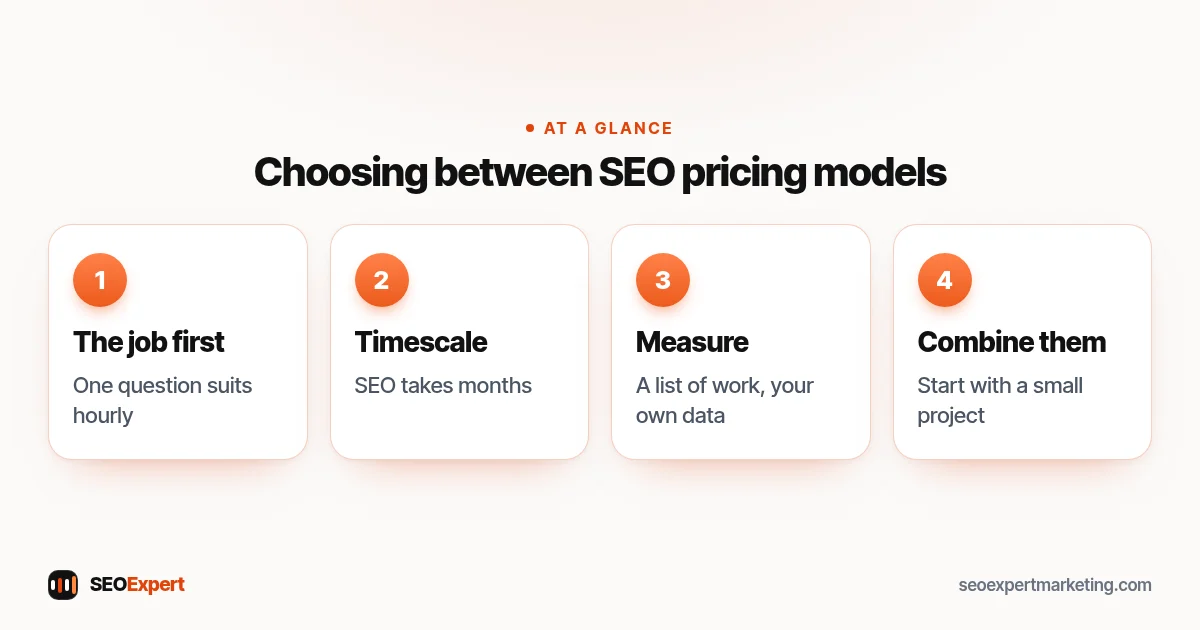
- Start with the job. A single question or problem suits hourly. A defined task suits a project. Steady growth suits a monthly plan.
- Think about time. SEO usually takes months to show steady results, so ongoing work on a monthly basis tends to fit better than a string of separate projects.
- Look at what's measurable. Whatever the model, insist on a list of work done and access to your own data.
- Combine them. Many businesses start with a small project, such as an audit, then move to a monthly plan once they know what's needed.
How to choose between SEO pricing models, in four points:
Hybrid models and add-ons
In practice, many quotes mix models. A common pattern is a one-off setup fee for an audit and technical fixes, followed by a lower monthly fee for ongoing work. Another is a monthly plan with optional extras priced per item, such as additional articles, extra tracked keywords or a link outreach campaign. Hybrids can be fair, but they make quotes harder to compare. Add up what you'd pay over twelve months, including setup fees and likely extras, and compare that total rather than the headline monthly price.
Example: comparing three quotes
Here's an illustrative example, not real quotes. A physiotherapy clinic receives three proposals. Provider A asks $900 a month with a list of four pages, technical fixes and a monthly report. Provider B charges $120 an hour, estimating six to ten hours a month, with no list of tasks. Provider C offers pay-for-performance: $300 for each keyword on page one. On paper, C looks cheapest. But C's keywords include phrases with almost no searches, and nothing in the proposal says how rankings would be achieved. B could cost anything from $720 to $1,200 a month.
A is the easiest to judge, because the clinic can check every month whether the listed work was done. Choosing between SEO pricing models is often less about price than about how easily you can hold the provider to account.
Questions to ask about any pricing model
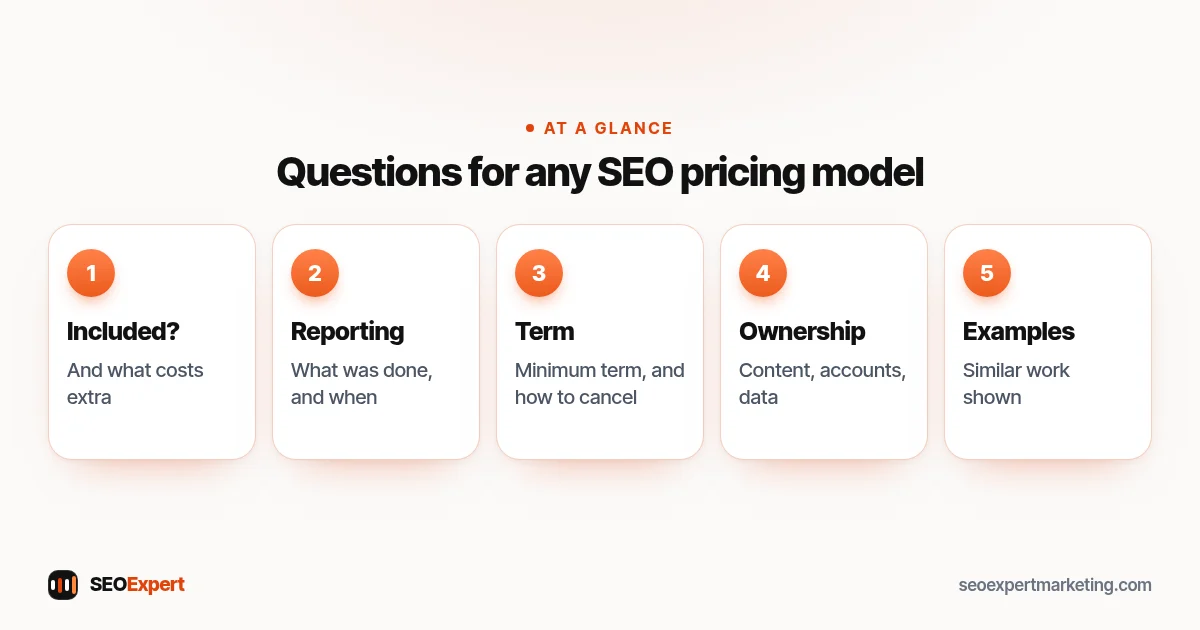
- What exactly is included, and what costs extra?
- How will I know what was done each month or each hour?
- Is there a minimum term, and how do I cancel?
- Who owns the content, accounts and data if we stop working together?
- Can you show examples of similar work?
Questions to ask about any of the SEO pricing models:
How we price our SEO
We use two of these SEO pricing models and publish the prices. Ongoing work is on fixed monthly SEO packages: SEO Starter at $395, SEO Growth at $795 and SEO Authority at $1,495 a month (USD), or $295, $595 and $1,095 a month paid yearly, billed once a year. One-off jobs are fixed-price one-time SEO services, from a $59 audit to link outreach. We don't sell pay-for-ranking deals, because no honest provider can promise positions. Our SEO ROI calculator helps you see what a plan would need to bring in to pay for itself.
For the bigger picture on prices, read our guide to SEO pricing, or ask for a free website review on WhatsApp.
SEO pricing models: quick answers
What is the most common SEO pricing model?
The monthly retainer. In Ahrefs' survey, 78.2% of providers charged one, and many also offered project or hourly pricing.
Is pay-for-performance SEO a good idea?
Usually not. It encourages easy targets and short-term tactics, the cost is unpredictable and nobody can control Google's rankings. A clear monthly plan with honest reporting is normally safer.
Which SEO pricing model is best for a small business?
Many small businesses start with a fixed-price audit to find out what's needed, then move to a modest monthly plan for steady work. Hourly advice suits owners who want to do the work themselves.
Can I switch between SEO pricing models?
Usually, yes. Ask before you sign whether a project fee can be credited toward a monthly plan, and what notice is needed to change or stop.
