
Organic SEO is the work of improving your website so it appears in Google's unpaid search results, the listings below and around the ads. Visitors who arrive this way are called organic traffic, and you don't pay Google for each click. That makes it one of the most cost-effective ways for a small business to get found, once it's working. This guide explains what it is, how it compares with paid search, the six steps that drive it and how to measure progress honestly.
Organic vs paid search
Search results pages usually mix two kinds of listing. Paid listings are ads, marked as sponsored, and you pay each time someone clicks. Organic listings are chosen by Google's ranking systems based on relevance and quality; you can't pay to appear there. The two work very differently:
| Organic results | Paid search | |
|---|---|---|
| Cost per click | None | You pay every click |
| Speed | Months to build | Immediate |
| When you stop | Results fade slowly | Traffic stops at once |
| Control | Google decides | You set budget and targeting |
| Trust | Often trusted more by searchers | Clearly labelled as ads |
Many businesses use both: ads for quick results while SEO builds up.
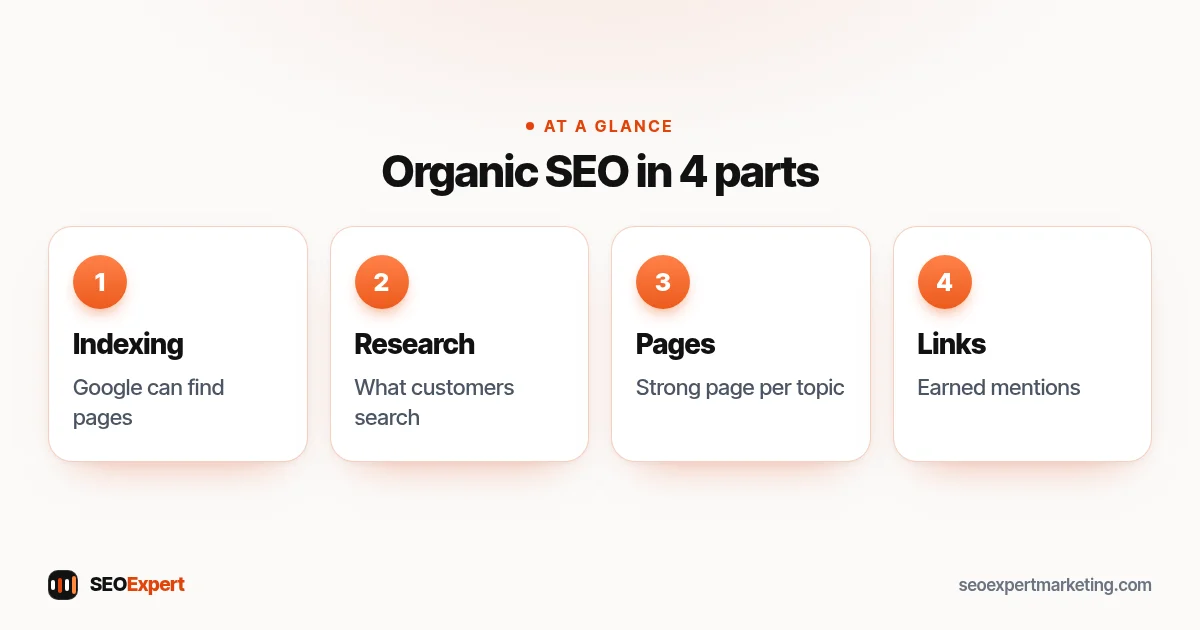
How organic SEO works
Google's SEO Starter Guide describes the basics: help Google find and understand your pages, and make them useful for the people searching. SEO is everything that makes that happen, from technical setup to content and links. There's no trick and no payment that buys organic rankings; Google's spam policies describe what happens to sites that try.
The 6 steps of organic SEO
1. Make sure Google can find your pages
Set up Google Search Console, submit a sitemap and check that your important pages are indexed. Fix anything blocked by robots.txt, noindex tags or errors.
2. Understand what people search for
Research the words customers use, the questions they ask and the services they compare. Our keyword research services page explains how we do this.
3. Create a strong page for each topic
Give each service, product group or question its own page that answers it better than the alternatives. Write from experience, with specifics: prices, timeframes, examples.
4. Get the on-page details right
Clear titles, descriptive headings, internal links between related pages and images with alt text help Google understand each page. Our guide to on-page SEO vs technical SEO explains how these fit together.
5. Earn links and mentions
Links from relevant sites tell Google that others find your content useful. Earn them through partners, associations, local press and content people genuinely want to reference.
6. Measure and improve
Use Search Console to see which searches bring impressions and clicks, improve pages close to page 1 and keep adding useful content. This is ongoing work, not a one-off project.
How long does organic SEO take?
Usually months rather than weeks, and it varies a lot between sites. Google's starter guide says changes can take from several hours to several months to be reflected in results. A newer site in a competitive market takes longer; an established site fixing obvious problems can move faster. Our guide to how long SEO takes covers this in detail.
Organic search for local businesses
For local businesses, organic results come in two forms: the map pack and the normal listings below it. Both are unpaid. Your Google Business Profile, reviews and consistent business details drive the map results; your website drives both. A local plan covers all of them. See our local SEO checklist.
Organic SEO and content
Content is where most of the long-term work happens. Every page you publish is another chance to match a search, but only if it's genuinely useful. Before writing, check what already ranks for the search and ask what you could add: real prices, local knowledge, photos of your own work, answers to the follow-up questions people ask you on the phone. One strong page beats five thin ones. Update important pages when things change, such as prices, regulations or your services, so they stay accurate.
Who should do the work?
Many small business owners handle the basics themselves: Search Console, the Business Profile, reviews and writing about what they know. Expert help is most useful for technical problems, competitive markets and planning, or simply when time is short. Whoever does it, insist on a clear list of work each month and access to your own data. Our DIY SEO guide shows what you can do yourself.
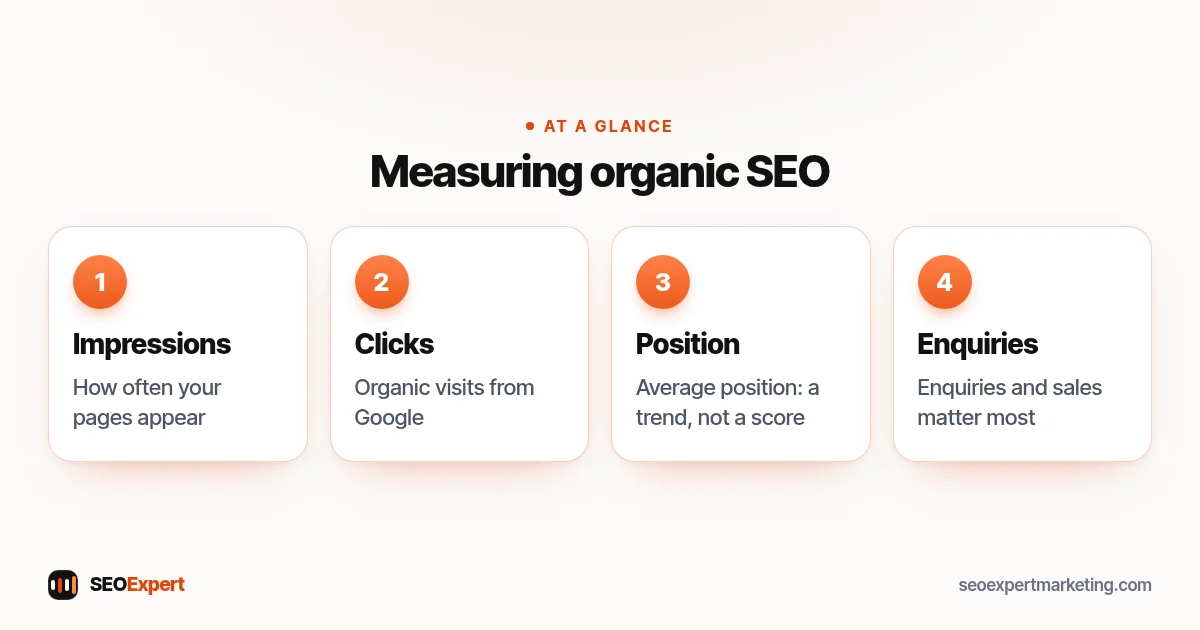
How to measure organic SEO
- Impressions: how often your pages appear in organic results, from Search Console's Performance report.
- Clicks: organic visits from Google.
- Average position: useful as a trend, not as a score.
- Enquiries and sales: the number that really matters, tracked in Google Analytics.
Expect impressions to grow first, then clicks, then enquiries. Our guide to the SEO report explains how to read these numbers.
Four numbers to watch, at a glance:
Organic SEO and AI answers
Google now shows AI-generated overviews for some searches, above or among the normal results. The same foundations apply: Google's guidance on AI features says the best practices for SEO remain relevant for AI Overviews and AI Mode, and these features include links to web pages. Clear pages that answer specific questions, written from real experience, are the best preparation. Keep an eye on Search Console: impressions and clicks for your key pages will show whether the shape of results for your searches is changing.
Organic SEO myths
- "Organic means free." There's no cost per click, but the work takes time or money.
- "Running ads helps organic rankings." Google keeps ads and organic rankings separate.
- "You can pay Google to rank organically." You can't.
- "Once you rank, you stay there." Competitors and Google's systems keep changing, so rankings need maintaining.
Example: an organic SEO plan for a florist
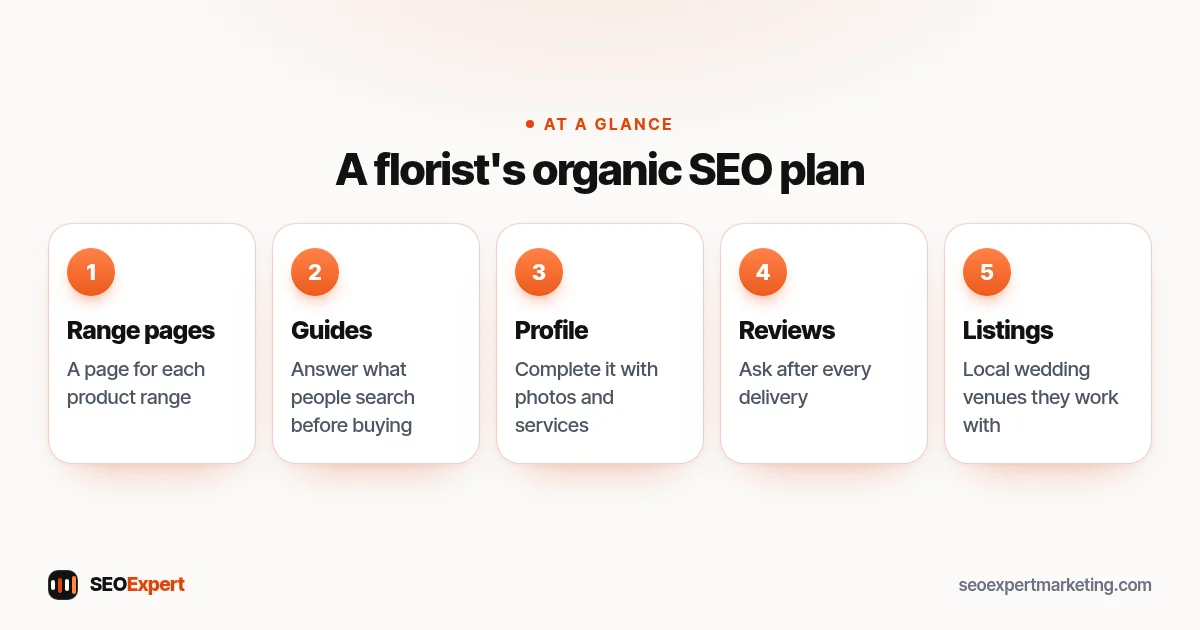
Here's an illustrative example, not a client result. A florist gets most orders from walk-ins and Instagram. The plan for the first six months: fix the site so each product range has its own page; write guides that answer what people search before buying, such as funeral flower etiquette and how long bouquets last; complete the Google Business Profile with photos and services; ask for reviews after every delivery; and get listed with the local wedding venues they already work with. After that, the plan continues with seasonal pages ahead of Valentine's Day and Mother's Day, published early enough for Google to find them.
The florist's organic SEO plan, step by step:
Get help with organic SEO
Our SEO services cover this from start to finish: technical setup, content, local SEO and honest link building, with plans from $395 a month. Start with a free website review on WhatsApp.
Organic SEO: quick answers
What does organic SEO mean?
Improving your website so it appears in Google's unpaid results. Visitors from those results are organic traffic, and you don't pay per click.
Is organic SEO better than paid ads?
They do different jobs. Ads are fast and stop when you stop paying; organic SEO is slower but keeps working. Many businesses use both.
How much does organic SEO cost?
It depends on your market and the work needed. You can do the basics yourself, or hire help; our plans start at $395 a month.
Does running Google Ads help organic rankings?
No. Google keeps ads and organic rankings separate. Ads can, however, show you which searches and messages bring customers.
