
DIY SEO means doing your own search engine optimization instead of hiring an agency or consultant. For many small businesses it's a realistic choice: the most important work, such as setting up Search Console, writing clear service pages, completing your Google Business Profile and asking for reviews, needs time and care more than technical skill. This guide gives you a practical DIY SEO plan, the free tools to use, a weekly routine that fits around running a business and an honest view of when it's worth getting help.
Can you really do SEO yourself?
Yes, for most small local businesses. Google's own SEO Starter Guide is written for exactly this reader: someone who owns or manages a website and wants it to show up in Google, without being an expert. What DIY SEO needs is consistency. An hour or two a week, every week, beats a burst of activity followed by months of nothing.
DIY SEO gets harder when your market is very competitive, your website has serious technical problems, or you run an online store with thousands of products. Those situations are covered at the end of this guide.
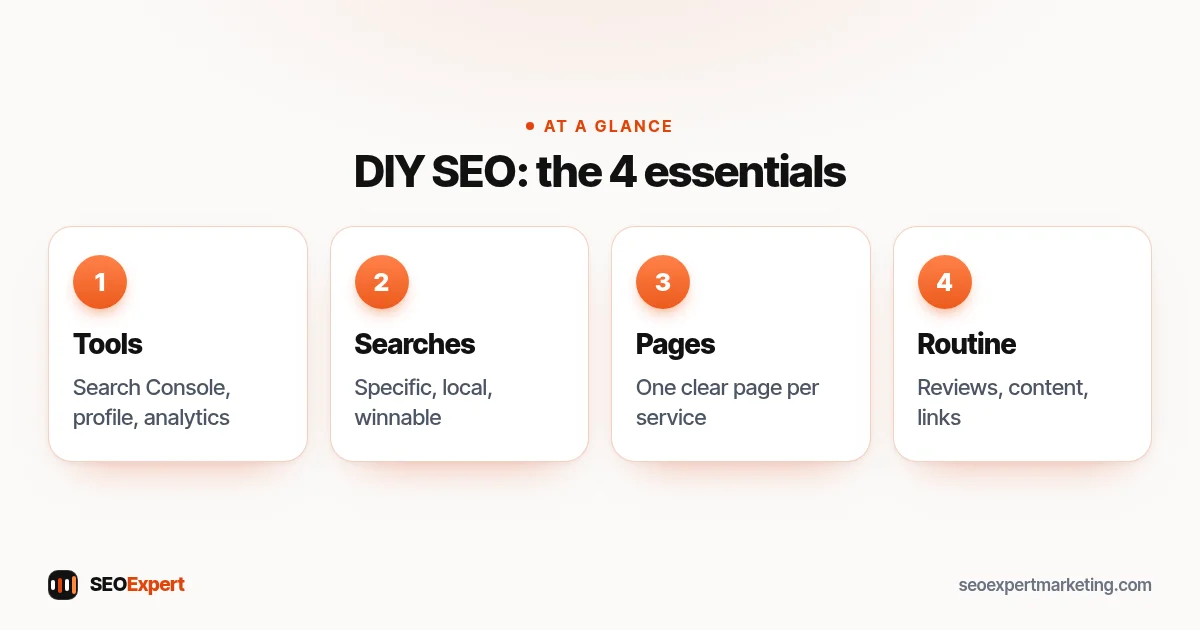
Step 1: Set up the free tools
- Google Search Console: shows which searches bring people to your site, which pages Google has indexed and any problems it found. Google's About Search Console help page explains how to add and verify your site.
- Google Business Profile: essential if you serve customers in a local area.
- Google Analytics: shows what visitors do once they arrive, such as calls, form submissions and purchases.
- PageSpeed Insights: tests how fast your pages load on phones and computers.
- Your platform's SEO plugin or settings: on WordPress, a plugin such as Rank Math or Yoast lets you edit titles and descriptions; Shopify and Wix have built-in fields.
Step 2: Find the searches that matter to you
Write down the services you most want to sell and how customers describe them in their own words. Then type each one into Google with your town and look at the autocomplete suggestions, the "People also ask" questions and the businesses that appear. You're looking for specific searches, such as "emergency boiler repair Leeds" or "wedding cake prices Bristol", rather than one-word terms you can't realistically win.
Once Search Console has a few weeks of data, its Performance report becomes your best keyword tool: it shows the searches you already appear for, and which ones are close to page 1.
Step 3: Fix your most important pages
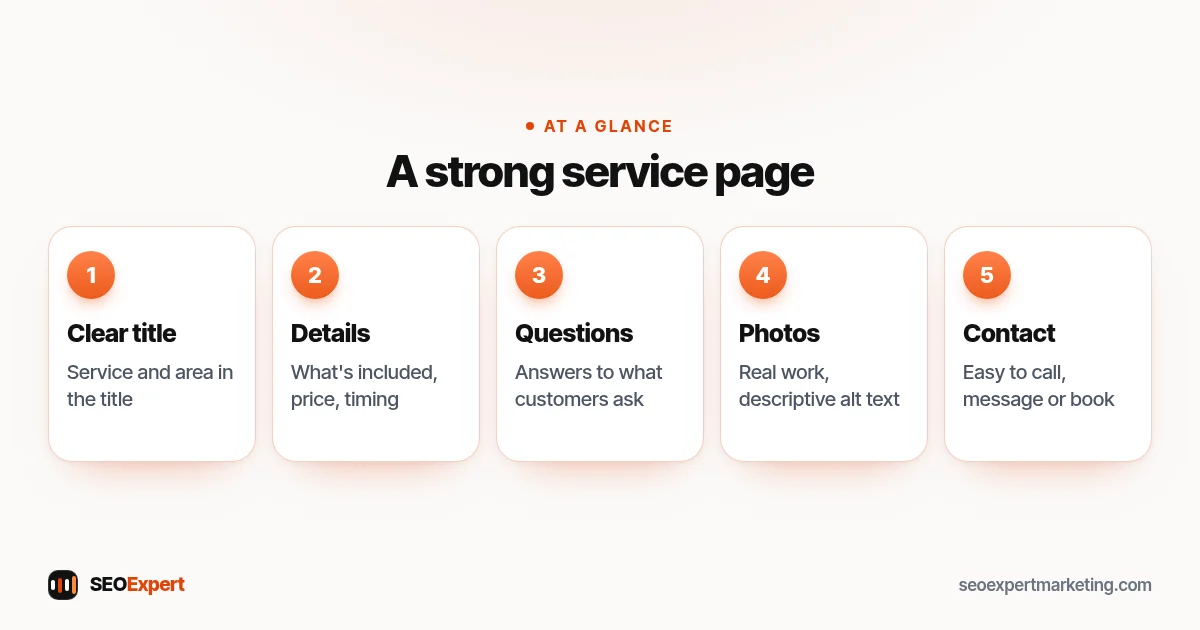
For each main service, make sure you have one page that:
- Has a clear title naming the service and the area, such as "Roof Repairs in Leeds | Smith Roofing".
- Explains what's included, who it's for, what affects the price and how long it takes.
- Answers the questions customers ask you on the phone.
- Shows real photos of your work, with descriptive file names and alt text.
- Makes it easy to call, message or book, especially on a phone.
Write in your own words. Your first-hand knowledge of the job is the thing competitors and generic agencies can't copy.
What each important page needs in a DIY SEO plan, at a glance:
Step 4: Get your local presence right
If you serve a local area, your Google Business Profile often brings more calls than your website. Choose the most accurate primary category, fill in every section, add photos regularly and ask every happy customer for a review. Our local SEO checklist walks through each item.
Step 5: Publish helpful content regularly
Once your service pages are solid, add one useful page or article a month answering a real customer question: prices, how to choose, what to expect, seasonal problems. Each one gives Google another reason to show your site and gives customers another reason to trust you.
Step 6: Earn a few good links
You don't need hundreds of links. A handful of relevant ones from suppliers, trade associations, local organizations you support and local news can make a real difference. Never buy links; Google treats paid links for ranking as spam.
For more worked plans, see our SEO examples for four types of small business.
Example: a plumber's first DIY SEO month
Here's how the plan could look for a one-van plumbing business. This is a worked example, not a client result.
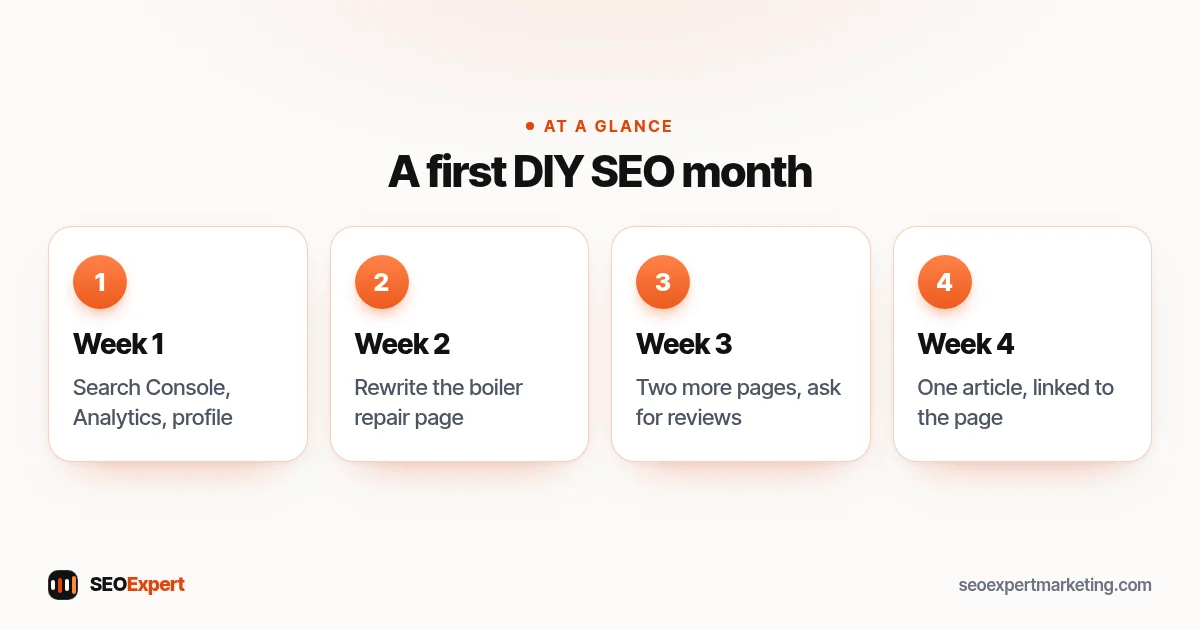
- Week 1: set up Search Console and Analytics, and correct the Business Profile category, hours and service areas.
- Week 2: rewrite the boiler repair page with price guidance, the towns covered and real photos, and give it a clear title.
- Week 3: do the same for drain unblocking and bathroom fitting, and start asking every customer for a review with a short link.
- Week 4: write one article answering the question customers ask most, such as how much a new boiler costs, and link it to the boiler page.
By the end of the month the basics are in place, and the routine below keeps them improving.
Run a trade, clinic or other service business? Our guide to SEO for service businesses adapts these steps for you.
The plumber's first DIY SEO month, week by week:
A simple DIY SEO routine
| How often | Task | Time |
|---|---|---|
| Weekly | Reply to reviews, add a photo to your Business Profile | 15 minutes |
| Weekly | Improve one page or write part of a new one | 1 hour |
| Monthly | Check Search Console: new searches, pages close to page 1, errors | 30 minutes |
| Monthly | Publish one helpful article or project write-up | 2 hours |
| Quarterly | Review your main pages, hours, prices and listings | 1 hour |
That's roughly six to eight hours a month, which is realistic for most owners.
DIY SEO mistakes to avoid
- Chasing broad keywords instead of specific, local searches.
- Copying text from competitors or suppliers.
- Creating near-identical pages for every town you serve.
- Buying cheap link or review packages.
- Changing everything at once, so you can't tell what helped.
Our article on small business SEO mistakes covers these in more detail, and our guide to how long SEO takes explains what to expect month by month.
When DIY SEO isn't enough
Consider getting help when:
- Search Console shows indexing or technical problems you don't understand.
- You're redesigning or moving your website and don't want to lose rankings.
- Your competitors are large companies with dedicated marketing teams.
- You simply don't have the hours, and the routine keeps slipping.
Help doesn't have to mean a big monthly contract. A one-off review can tell you exactly where to focus your own DIY SEO time: our one-time SEO services start with a $59 audit that gives you a prioritized fix list you can work through yourself. If you'd rather hand everything over, our small business SEO page explains the monthly plans.
DIY SEO: quick answers
How long does DIY SEO take to work?
The same as professional SEO: simple fixes can help within weeks, while new pages, reviews and links usually take several months to build results. The difference is that progress depends on how consistently you can keep up the routine.
What's the most important DIY SEO task?
For local businesses, a complete Google Business Profile and one clear page for each main service. For everyone, setting up Search Console so you can see what Google sees.
Do I need paid tools for DIY SEO?
No. Search Console, Google Business Profile, Analytics, PageSpeed Insights and Google search itself cover what a small business needs. Paid tools mainly save time on research and competitor analysis.
Is DIY SEO for small business risky?
Not if you stick to helpful content, accurate listings and genuine reviews. The risk comes from shortcuts such as bought links, copied content or mass-produced pages, which can harm your rankings.
