Most small business SEO mistakes aren't dramatic. They're small decisions that quietly stop Google from understanding your website, or stop visitors from calling once they arrive: a homepage trying to rank for everything, a profile with the wrong category, a cheap link package that looked like a bargain. The good news is that almost all of them can be fixed without a big budget. This guide lists the 12 most common small business SEO mistakes, why each one matters and what to do instead.
Strategy mistakes
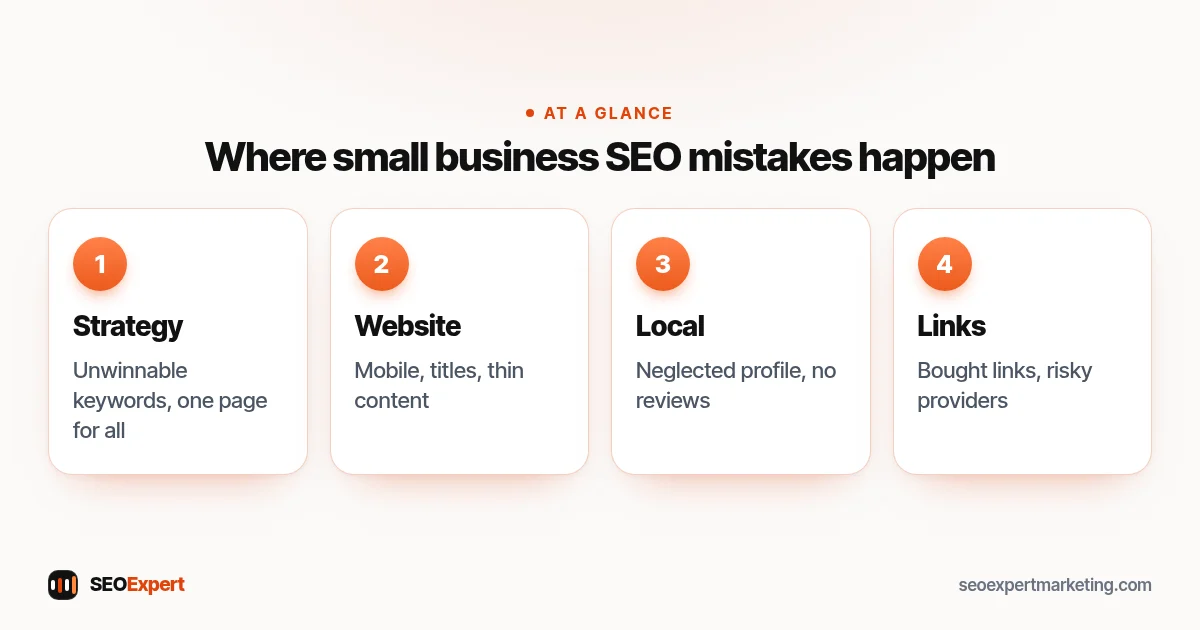
The costliest small business SEO mistakes happen before anyone touches the website: choosing the wrong targets and the wrong expectations.
1. Targeting keywords nobody can win
A new local bakery won't rank for "cake" or "bakery" nationally, and doesn't need to. The searches that bring customers are specific: "birthday cakes Bristol", "gluten-free bakery near me", "wedding cake prices". Start with phrases that combine your service, your area and the details customers care about. They have fewer searches but far more buyers, and they're realistic for a small site to win.
2. One page trying to rank for every service
A single "Services" page listing everything you do gives Google nothing specific to rank. If you offer boiler repair, bathroom fitting and drain unblocking, each deserves its own page explaining what's included, what affects the price and the areas you cover. This is one of the most common small business SEO mistakes, and one of the most rewarding to fix.
3. Expecting results in weeks
Some fixes help quickly, but new pages, reviews and links usually take months to build visibility. Owners who expect fast results often give up just before the work starts to pay off, or fall for providers promising instant rankings. Plan to judge progress over three to six months, using the trend in Search Console rather than a single week.
Website mistakes
Many small business SEO mistakes live on the website itself, and most are quick to spot once you know where to look.
4. Ignoring how the site works on a phone
Most local searches happen on mobile. If the menu is hard to use, the text is tiny or there's no tap-to-call button, visitors leave and call a competitor. Open your own site on your phone and try to book or call in under ten seconds. If you can't, neither can your customers.
5. Vague or duplicate page titles
The title is usually the headline people see in Google's results. Titles like "Home" or the same title on every page waste that space. Google's guide to title links recommends unique, descriptive titles for each page. A good pattern for a local business: service, area, brand, for example "Roof Repairs in Leeds | Smith Roofing".
6. Thin, copied or keyword-stuffed content
Copying text from a supplier, a competitor or a template, or repeating the same keyword in every sentence, produces pages that help nobody. Google's guide to creating helpful, reliable content asks whether content provides original information and shows first-hand experience. Small businesses have a big advantage here: you know your customers' real questions, prices and problems. Write about them in your own words.
7. Copy-paste location pages
Creating dozens of pages that are identical except for the town name is a tempting shortcut. These are what Google calls doorway pages, and they can harm the whole site. Build an area page only when you have something real to say about that area, such as projects completed there, and use your Business Profile service areas for the rest.
8. Not checking whether Google can see the site
A setting left on after a redesign can block a whole website from search. Set up Google Search Console, a free tool, and check the indexing report every month. It's the only way to know for sure which of your pages Google has found and which it has left out.
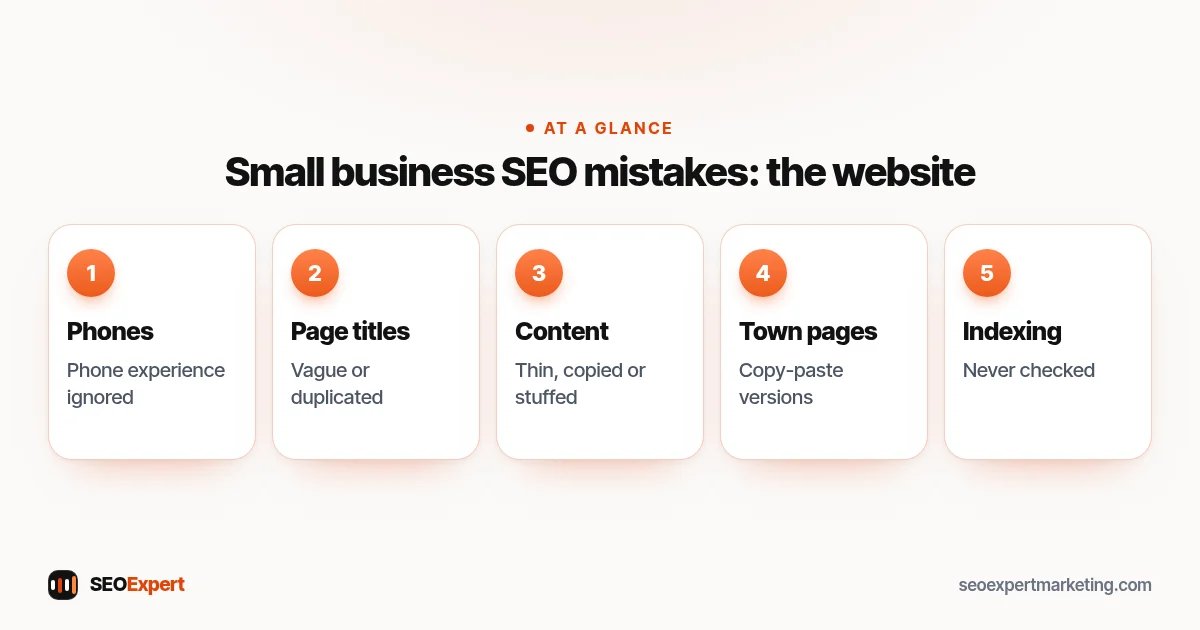
Five of the small business SEO mistakes happen on the website itself:
Local mistakes
For businesses serving a town or region, local small business SEO mistakes often cost the most calls.
9. A neglected Google Business Profile
For local businesses, the profile often brings more calls than the website. Common problems: the wrong primary category, out-of-date hours, no photos for a year, keywords stuffed into the business name and old duplicate profiles. Our local SEO checklist walks through the profile item by item.
10. Not asking for reviews
Many good businesses have only a handful of reviews because they never ask. Ask every happy customer when the job is done, with a direct link, and reply to every review. Never buy reviews or write your own; it breaks Google's policies and consumer law in many countries, and it's easy to spot.
Links and providers
The last two small business SEO mistakes involve shortcuts that look cheap and turn out expensive.
11. Buying cheap link packages
Offers of "100 high-authority backlinks for $50" are a classic trap. Google's spam policies list buying or selling links for ranking as link spam, and low-quality links can do more harm than good. Links worth having come from real relationships: suppliers, local organizations, industry associations and people who find your content genuinely useful.
12. Hiring on promises, not on a plan
Be careful with any provider who promises first position, won't explain what they'll do or keeps your accounts in their name. Ask for a written plan, a sample report and clear terms, and make sure your website, Search Console and Business Profile stay in your name. Our guide to the SEO retainer lists seven questions to ask before you sign anything.
How to fix these small business SEO mistakes
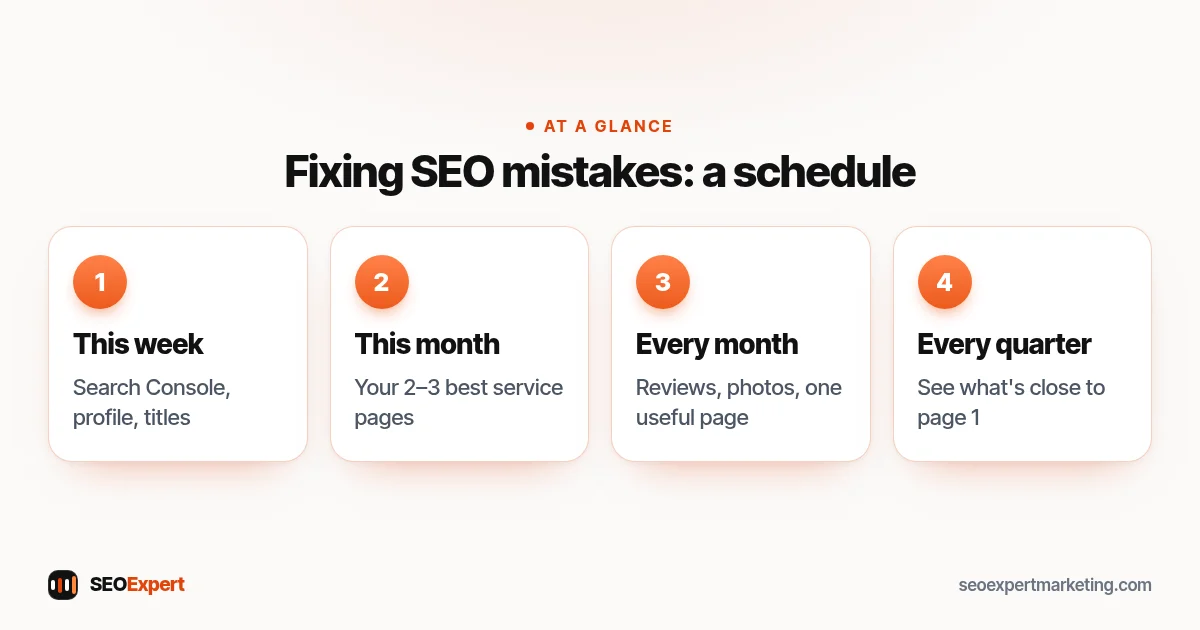
You don't need to fix everything at once. A practical order:
- This week: set up Search Console, check your Business Profile category, hours and name, and fix your page titles.
- This month: create or improve one page for each of your two or three most valuable services.
- Every month: ask for reviews, add photos and publish one useful page answering a customer question.
- Every quarter: check Search Console for what's improving and where you're close to page 1.
Our small business SEO guide explains the full approach, and our page on affordable SEO services covers what a small budget can realistically buy.
Avoiding small business SEO mistakes is easier when you know what SEO can do for you: read our guide to the benefits of SEO for small businesses.
A simple schedule for fixing small business SEO mistakes:
Why these mistakes matter more for small businesses
A large company can absorb a few wasted months or a weak page. A small business usually can't: your marketing budget is tight, your time is limited and a few extra customers a month can make a real difference. Avoiding these small business SEO mistakes means every hour and dollar you put into search goes into work that builds up over time, rather than shortcuts that need undoing later.
If you'd like a second opinion, send us your website address on WhatsApp and we'll point out which of these small business SEO mistakes apply to your site, free and with no obligation.
Small business SEO mistakes: quick answers
What's the biggest SEO mistake a small business can make?
Buying shortcuts, such as cheap link packages or fake reviews, because they can harm the site and the profile for a long time. After that, the most costly mistake is having one general page instead of a clear page for each main service.
Can I fix SEO mistakes myself?
Most of them, yes. Page titles, your Business Profile, reviews, service pages and Search Console need time rather than technical skill. Technical issues such as indexing problems or slow pages may need a developer or an SEO specialist.
How long does it take to recover from SEO mistakes?
Simple fixes like titles and profile settings can help within weeks once Google recrawls the pages. Recovering from bad links or thin content usually takes longer, often several months, because Google needs to see the improved site over time.
Is it a mistake to do SEO without an agency?
No. Many small businesses do well with a few hours a month spent on the basics. An agency makes sense when you don't have the time, when your market is competitive or when technical problems are holding the site back.
