
How long does SEO take? For most small businesses, the honest answer is that some improvements show within a few weeks, while meaningful growth in rankings, traffic and enquiries usually takes several months, and competitive searches can take a year or more. The timeline depends on where your website starts, how competitive your searches are and how consistently the work is done. This guide explains what Google itself says about timing, what the research shows and what to realistically expect month by month.
What Google says about timing
Google's SEO Starter Guide answers the question directly: every change takes some time to be reflected on Google's side; some changes might take effect in a few hours, others could take several months, and you'll usually want to wait a few weeks before judging whether a change helped. It also points out that not every change leads to a noticeable difference.
Part of the delay is simply discovery. Google's page on how to ask Google to recrawl your URLs notes that crawling can take anywhere from a few days to a few weeks. Only after a page is crawled and indexed can it start to rank, and only after it ranks can it bring visitors.
What the research shows
Across the whole web, the data is sobering. Ahrefs studied how long it takes to rank in Google by following large samples of pages over time. Among its findings:
- Of 1 million random URLs first seen in September 2023, only 1.74% reached Google's top 10 for any keyword within a year.
- Looking at 2 million non-empty English pages created in October 2023, 6.11% reached the top 10 within a year.
- Of the pages that did reach the top 10, 40.82% did so within a month.
- 72.9% of pages in the top 10 were more than three years old.
Two lessons follow. Most pages never reach the top 10 at all, so quality and targeting matter more than speed. And established pages dominate, which is why SEO rewards patience and steady improvement rather than short bursts of activity. Treat these figures as a picture of the whole web, not a forecast for your site; a local business targeting specific searches is in a very different position from a page competing for a national keyword.
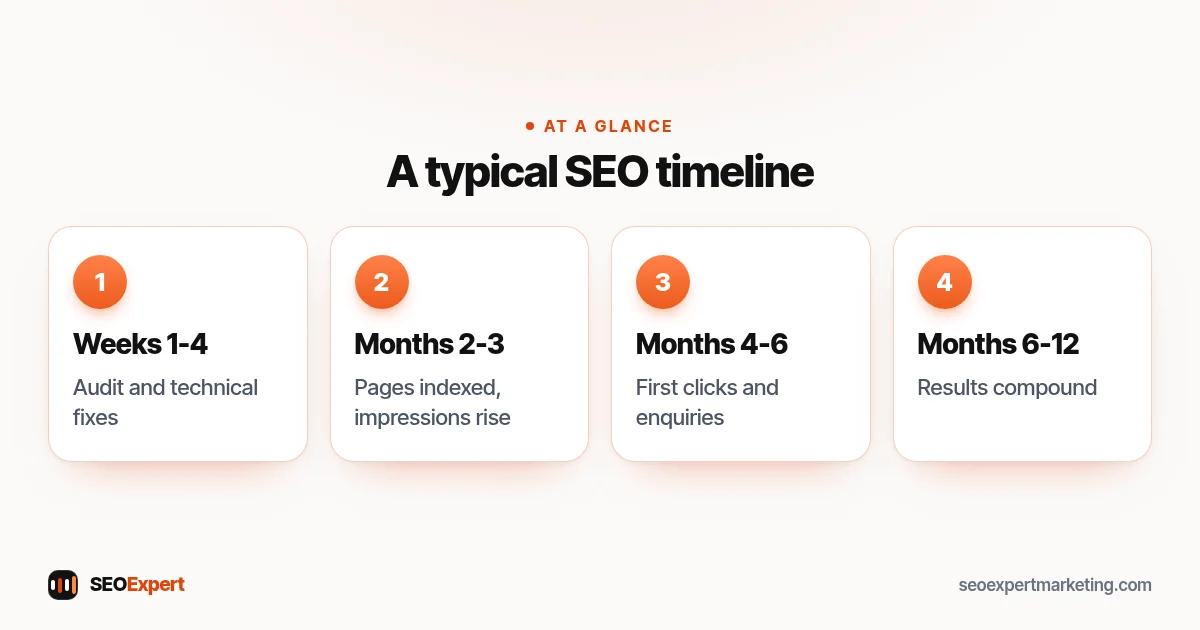
How long does SEO take, month by month?
Every site is different, but a typical small business timeline has five stages:
| Period | What usually happens |
|---|---|
| Weeks 1 to 4 | Audit, technical fixes, Search Console set up, Business Profile cleaned up. Fixed pages are recrawled. |
| Months 2 to 3 | New and improved pages are indexed. Impressions in Search Console start to rise, often for longer, specific searches. |
| Months 4 to 6 | Pages move closer to page 1 for less competitive searches. Clicks and enquiries begin to grow. |
| Months 6 to 12 | Results compound as content, reviews and links build up. Competitive searches start to move. |
| Year 2 onwards | Strong pages hold their positions with regular updates; new pages rank faster on an established site. |
So how long does SEO take for a typical small business? Usually three to six months for the first clear gains, and longer for competitive searches. This is a common pattern, not a promise. Some sites move faster, especially when a technical problem was blocking them; others take longer in crowded markets.
What decides how long SEO takes for your business
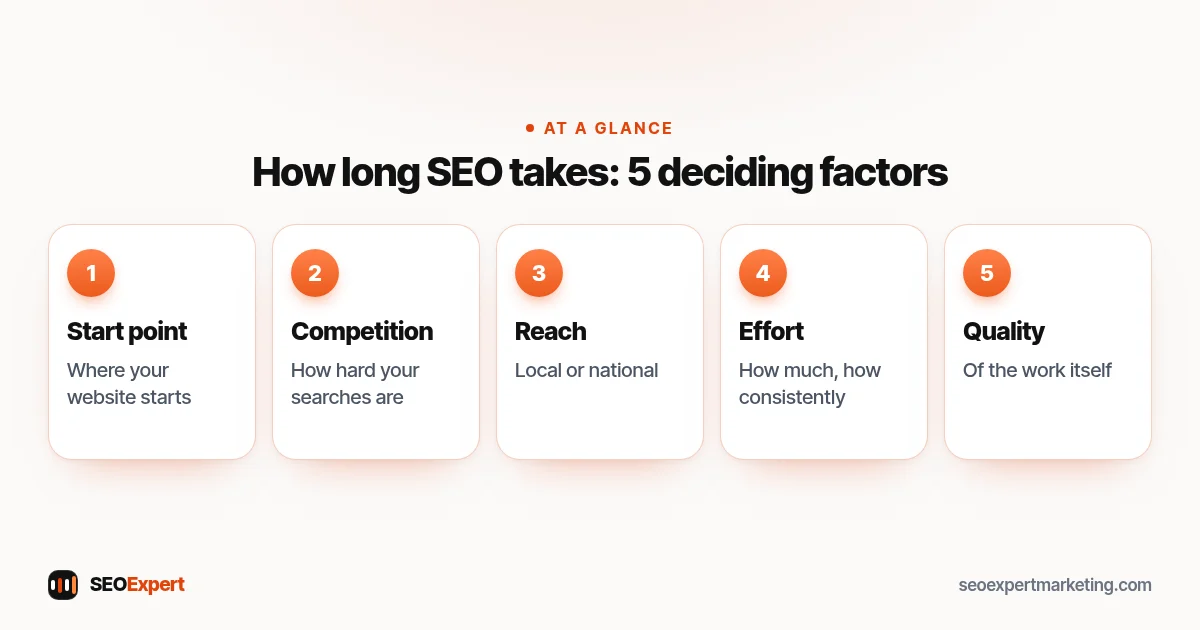
For your own business, five factors decide the answer.
1. Where your website starts
A site that's been online for years with a few technical problems can improve quickly once they're fixed. A brand-new domain has no history, so Google needs time to discover and trust it.
Launching soon? Set up Search Console on day one, so you can see when Google first shows each page; our Google Search Console guide walks through it.
2. How competitive your searches are
"Emergency electrician" in a small town has a handful of competitors; "personal injury lawyer" in a major city has dozens with large budgets. The more competitive the search, the longer it takes and the more content and links it needs. To see how far ahead the businesses above you are, our guide to competitor analysis for SEO shows what to compare.
3. Local or national
Local searches are usually faster, because you're only competing with businesses near the searcher, and your Google Business Profile can appear in the map results before your website ranks well. National and ecommerce searches tend to take longer.
4. How much work is done, and how consistently
Two new useful pages a month for a year will beat twenty rushed pages in one month followed by nothing. Steady work on pages, reviews and links compounds over time.
5. The quality of the work
Pages that answer customers' real questions better than competitors do rank faster and stay longer. Shortcuts such as bought links or copied content can slow a site down or get it penalized, which adds months.
The five factors at a glance:
How to speed up SEO without shortcuts
- Fix technical blockers first. Pages Google can't crawl or index can't rank, however good they are. Our technical SEO services page lists the usual checks.
- Start with specific searches. Service plus town, or a precise question, ranks sooner than a broad term.
- Improve pages that are already close. Search Console shows pages sitting on page 2; small improvements there pay off fastest.
- Complete your Business Profile and ask for reviews. Local visibility often moves before website rankings; see our guide to Google Business Profile optimization.
- Link new pages from your existing pages, so Google finds them quickly and understands how they fit.
- Request indexing for important new or updated pages in Search Console.
Avoid anyone who promises page 1 in days. Rankings depend on Google's systems and your competitors, and no honest provider can promise a position or a date.
How to tell if SEO is working before rankings arrive
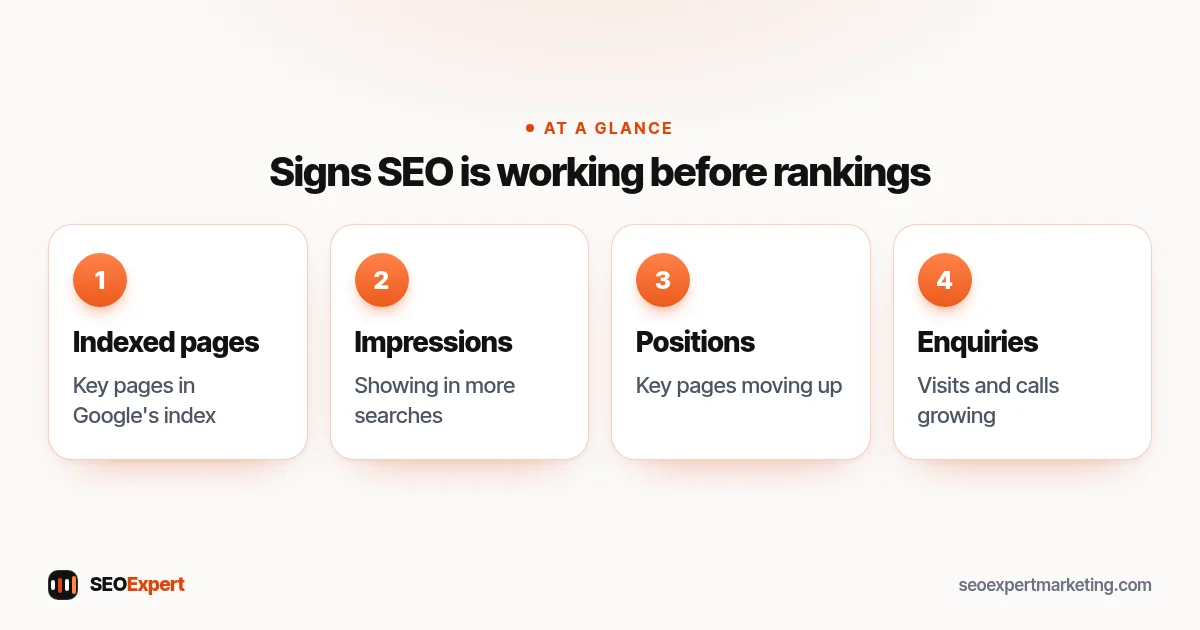
Because the answer is usually "months", track early signals instead of waiting for page 1:
- Indexed pages: are your important pages in Google's index?
- Impressions: is your site appearing in more searches each month?
- Average position for target searches: are key pages moving up, even from page 5 to page 2?
- Clicks and enquiries: are visits and calls from search growing over a quarter?
The four early signs at a glance:
What we measured on our own new site
Our own website went live at the end of September 2026, so we checked the first stages of this timeline against our own figures. WordPress records the day each page was published, and Search Console records the first day Google showed it in search results. By 12 November 2026, 32 of our pages had been shown at least once:
| What we measured | Our figure | What it tells you |
|---|---|---|
| Days from publishing to the first appearance in Google | 0 to 25 days; more than half within 4 days | On a site Google already crawls, being found can take days rather than months. |
| Average position in October 2026 | About 76, which is around page 8 of the results | Being shown isn't the same as being seen: few searchers look past page 1. |
| Times shown and clicks in October 2026 | 7,334 impressions and 3 clicks | Clicks only come once pages climb near the top, and that's the slow part. |
So how long does SEO take on a new site like ours? The first stage, getting pages found and shown, took days. The stage that brings customers, ranking high enough to be clicked, is the one measured in months, and our own pages are still working towards it. Pages that haven't been shown in Google yet aren't counted in these figures.
How long does SEO take with an agency?
An agency doesn't change how fast Google crawls or ranks pages, but it can remove the delays on your side: doing the work every month, prioritizing what matters and avoiding mistakes that cost months. Expect a written plan in the first weeks and progress you can see in reports from the first couple of months. To see whether the wait is worth it for you, try our SEO ROI calculator. If you're weighing up the cost, our guide to how much SEO costs and our small business SEO page explain what to budget for and what to do first.
How long does SEO take: quick answers
When will I see the first results from SEO?
Some things can show within a month: technical fixes, a cleaned-up Business Profile and improvements to pages that already rank on page 2 can show results within weeks. Building strong rankings for competitive searches almost always takes longer.
How long does SEO take for a new website?
Usually longer than for an established site, because Google has no history for a new site: few pages indexed, no links and no track record. It needs time to discover the pages, understand what they're about and see that other sites trust them. Specific, less competitive searches are the fastest route in.
My new page isn't showing in Google yet. How long should I wait?
First check the page with the URL Inspection tool in Search Console: it tells you whether Google has crawled and indexed it. Google says crawling can take from a few days to a few weeks, and on our own site more than half of the pages that appeared did so within 4 days. If it's been longer, link to the page from your other pages, check it's in your sitemap, then request indexing once.
How long should I try SEO before deciding if it works?
Give it at least six months of consistent work, and judge it by the trend in indexed pages, impressions, positions and enquiries rather than by any single week. If none of those are moving after six months, ask what's being done and why.
Does SEO stop working if I stop?
Rankings don't disappear overnight, but competitors keep improving and your pages slowly date. Most businesses keep a lighter level of ongoing work once the main pages are in place.
