SEO content writing services should give you pages your customers want to read: plain explanations of what you do, straight answers to the questions people ask before they buy, and articles that solve real problems. Good SEO copywriting isn't about repeating keywords; it's about matching what searchers need and saying it well. This page explains what we write, how we check it and what it costs, from a single $39 page to a monthly plan.
What Google asks of content
Google's guide to creating helpful, reliable, people-first content asks whether your content provides original information, a substantial and complete description of the topic, and whether someone reading it would leave feeling they've learned enough. It also warns against content made mainly to attract search visits. Our SEO content writing services put the reader first and build the SEO into the structure.
The three questions from that guide we ask of every draft:

What our SEO content writing services cover
Service pages
One page per main service, covering what it is, who it's for, the process, what affects the price, common questions and a clear next step. These are usually the most valuable pages on a small business site.
Local and location pages
Pages for the areas you serve, written only where there's something real to say: work you've done there, local conditions or regulations, the neighborhoods you cover. We don't produce copy-paste city pages.
Articles and guides
Practical articles answering questions customers ask, such as costs, comparisons, checklists and how-tos. They build trust, attract earlier-stage searchers and give other sites something worth linking to.
Rewrites and consolidation
Often the best content work is improving what you already have: expanding thin pages, merging duplicates that compete with each other and updating outdated information. Our SEO audit services show which pages need it first.
How we write
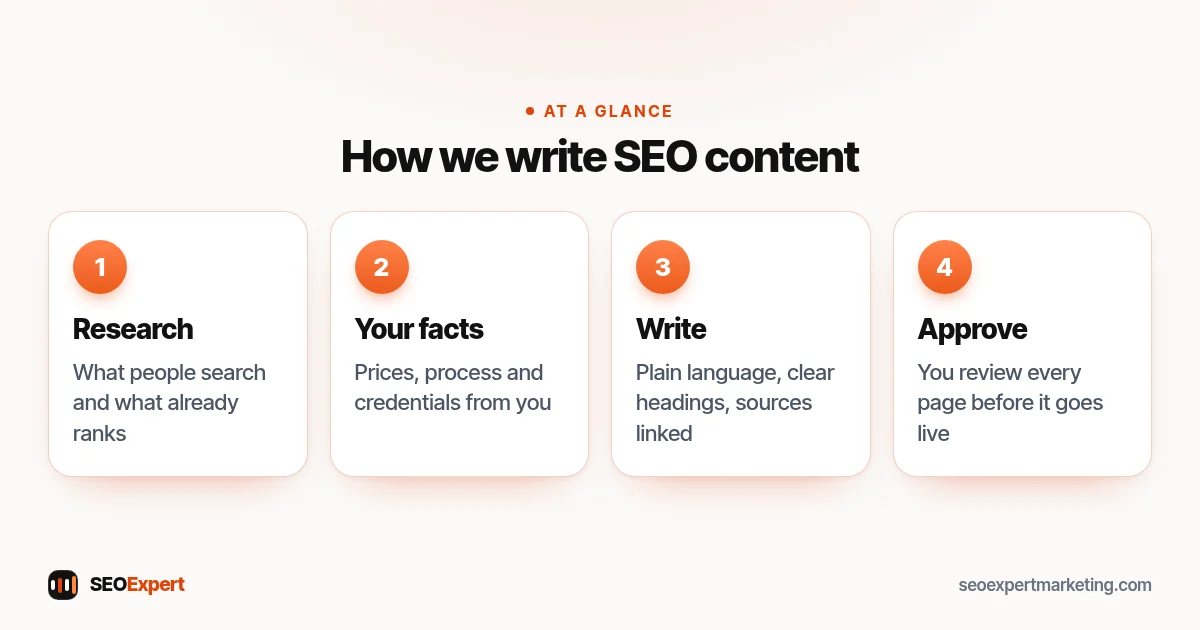
- Research first: we look at what people search, what currently ranks and what's missing. Our keyword research services decide which page targets which topic.
- Your facts, not invented ones: prices, processes, warranties and credentials come from you. If we don't know something, we ask rather than guess.
- Plain language: short paragraphs, clear headings, no jargon your customers wouldn't use.
- Sources linked: any statistic or claim about your industry links to where it came from.
- Your approval: you review every page before it goes live, and for regulated topics such as legal or health content, an expert at your business should check accuracy.
The checks a page passes before it goes live
Every page on this site, this one included, goes through our own checker before it's published. It's a script we wrote and keep updating, and our SEO content writing services follow the same rules for client pages. Its main checks:
| Check | The rule | Why |
|---|---|---|
| Main phrase in the right places | In the title, H1, first paragraph and at least one subheading, but no more than about 1 in 3 subheadings | Tells Google the topic without writing headings for robots |
| How often the phrase repeats | One- or two-word phrases: 0.5 to 1.4% of the words. Three words: 0.3 to 0.8%. Four or more: 0.3 to 0.6% | At 1%, a four-word phrase fills about 4% of the text |
| Title and description | SEO title under 60 characters; meta description 120 to 155 | Longer ones get cut off in results |
| Paragraph length | No paragraph or list item of 120 words or more | Long blocks are hard to read on a phone |
| Internal links | At least 4, only to pages we keep in search, never to the page itself | Every link should lead to a live, useful page |
| Outside sources | 1 to 3, and each must load when the checker opens it | A claim is only as good as its source |
| Claims we can't back up | Promise and proof words are blocked (ranking promises, top-position claims, prizes, certificates, star ratings, reviews we don't have) unless the sentence denies them | Nobody can promise a ranking, so we don't hint at one |
| FAQ answers | 5 to 7 questions; a warning when an answer is under 35 or over 95 words | Long enough to answer, short enough to scan |
After publishing, a second script tests every link on the live page, and an accessibility test runs at phone and desktop width.
This page, before and after (12 November 2026)
The old version of this page failed the checker:
- The phrase "SEO content writing services" appeared 12 times in about 1,200 words (1.00%), well above the 0.6% limit for four words.
- It linked to 2 pages we have set to noindex, one of them from both the text and a related-page card.
- Two FAQ answers were 28 words, under the 35-word mark.
- Our one-off writing jobs at $39 and $179 weren't mentioned anywhere.
This version uses the phrase 9 times in about 1,800 words (0.49%), links only to pages we keep in search, lists both one-off jobs and passes the checker.
What a strong service page includes
We also check every service page against this list. A visitor should find, without scrolling far on a phone:
- What the service is, in one or two plain sentences.
- Who it's for, and the areas you cover.
- How the work happens, step by step.
- What affects the price, or a real price range if you publish one.
- The questions customers usually ask before buying, answered honestly.
- Proof you can back up: credentials, photos of your own work, reviews from real customers.
- One clear way to get in touch.
The same list at a glance:

Keeping content up to date
Prices, services and rules change, and pages with outdated details lose readers' trust. We date guides whose facts change, and we recommend reviewing your key pages at least once a year.
Writing your own pages? Our SEO copywriting guide has nine practical tips.
Do you use AI to write?
Google's guidance focuses on whether content is helpful and accurate, not on how it was produced, and it warns against using automation mainly to manipulate rankings. Whatever tools are involved, every page we deliver is researched, fact-checked against your information and edited for your customers, and nothing goes live without your approval.
What it costs: one page, five pages or a monthly plan
You can buy SEO content writing services as a one-off job or as part of a plan. Prices are in US dollars.
- SEO Page Writing (1 page), $39: one page of up to 1,000 words built around one main keyword, with an SEO title, a meta description, headings, suggested internal links and one round of changes.
- SEO Page Writing (5 pages), $179: five pages of up to 1,000 words each, one main keyword per page, links planned between the five and one round of changes per page. That's $16 less than five single pages.
- Monthly plans: writing is included in all three. SEO Starter at $395 a month includes up to 2 new or improved pages a month; SEO Growth at $795 adds keyword mapping and internal linking; SEO Authority at $1,495 adds content-gap analysis, to find topics competitors cover and you don't. Paid yearly, they cost $295, $595 and $1,095 a month. Monthly plans have no minimum term.
The one-off jobs cover the writing only: uploading, design and photos aren't included, and pages over 1,000 words, legal or medical content that needs a licensed expert, and translation are quoted separately. They're paid once by Remitly at checkout; plans are paid by Remitly, Wise or bank transfer. Not sure which topics come first? A $79 keyword research report maps up to 30 keywords to pages. Compare the packages or see every fixed-price job on our SEO price list.
Who it suits
Our SEO content writing services suit small businesses whose pages are thin, outdated or written years ago, and owners who know their business well but don't have time to write. They don't suit anyone wanting high volumes of generic articles; a few genuinely useful pages beat dozens of filler posts.
A realistic timeline
New and improved pages usually start appearing in Search Console within weeks of being crawled, and build rankings over several months. Articles aimed at competitive topics take longer. On a plan, we report monthly on how each new page performs.