A meta description is the short summary of a page that you write for search results. It sits in your page's code, visitors don't see it on the page itself, and Google may show it under your title in the results. A good one doesn't change your ranking directly, but it can persuade more of the people who see your listing to click. This guide explains what Google does with your meta description, how long it should be, seven simple rules for writing one and examples you can adapt.
What is a meta description?
It's an HTML tag that describes the page in a sentence or two. Google's guide to writing meta descriptions explains that a meta description generally informs and interests users with a short, relevant summary of what a page is about. Google creates the snippet under your title mostly from the page's content, but it sometimes uses your meta description when it gives people a more accurate summary than the page text.
The meta description is one of several HTML tags in a page's head. See our guide to HTML tags for SEO for the others.
Does a meta description affect rankings?
Not directly. Think of it as your advert in the search results: the ranking gets you seen, and the title and snippet persuade people to click. A clear, specific summary can lift the share of people who click your listing, which is the whole point of ranking in the first place.
How long should a meta description be?
Google says there's no length limit, but the snippet is truncated as needed, typically to fit the device width. In practice, most SEO tools suggest around 120 to 155 characters so the key message fits on most screens. Put the most important words first, so nothing vital is cut off.
How to write a meta description: 7 rules
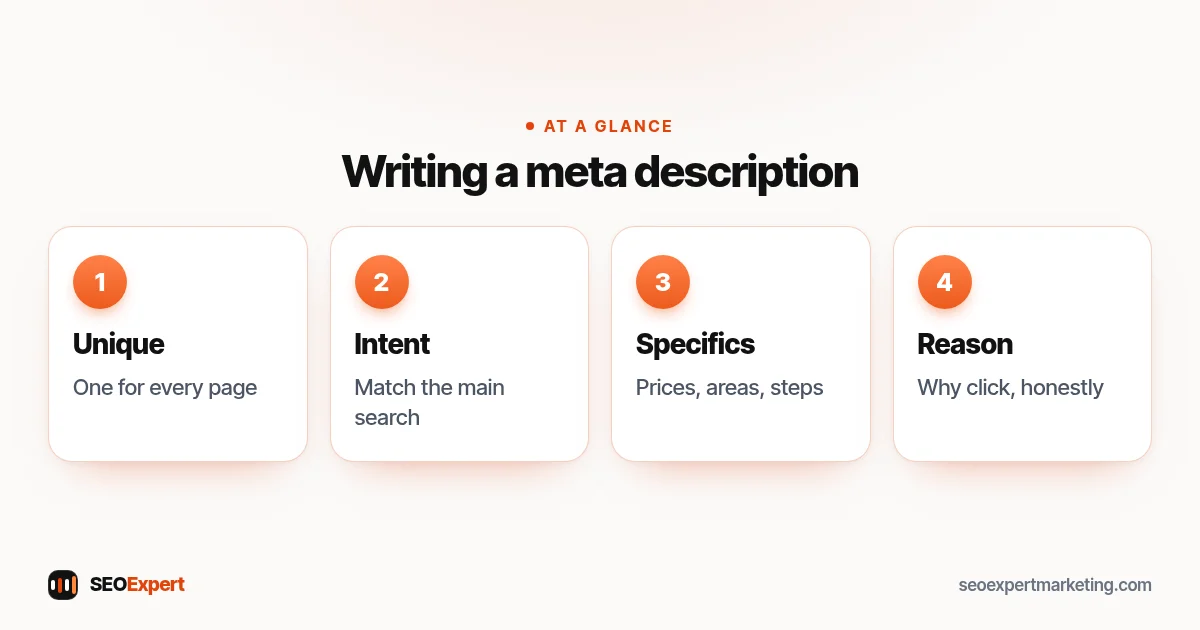
1. Write a unique one for every important page
Google's guide says identical or similar descriptions on every page aren't helpful. Each service page, product and article should have its own summary describing that page, not the business in general.
2. Say what the page offers
Describe what the visitor will find: the service, the area, the price range, the answer to their question. "Emergency boiler repair in Leeds, same-day call-outs, upfront prices" beats "Welcome to our website".
3. Match the search intent
Someone searching "boiler repair cost" wants prices; someone searching "boiler repair near me" wants a local engineer quickly. Write the summary for the main search the page targets. Our guide on how many keywords to target per page explains why each page should have one main job.
4. Include the main phrase naturally
When the words someone searched appear in your snippet, Google may highlight them in bold, which helps your listing stand out. Use the main phrase once, naturally; don't repeat it.
5. Add useful specifics
Prices, opening hours, areas served, delivery times or the number of steps in a guide all help people decide. Google's guide suggests that descriptions can include useful facts about the page rather than a string of keywords.
6. Give a reason to click
End with what the visitor gets: a free quote, a checklist, a same-day visit. Keep it honest. A promise the page doesn't keep leads to quick exits and lost trust.
7. Keep it accurate when the page changes
When prices, services or opening hours change, update the summary at the same time. Outdated details in search results confuse customers before they even reach your site.
Meta description examples
| Page | Weak | Better |
|---|---|---|
| Plumber service page | Welcome to Smith Plumbing, the best plumbers. | Emergency plumber in Bristol: same-day call-outs, fixed call-out fee and 12-month warranty on parts. Call or book online. |
| Dentist page | Dentist, dental, teeth, dentist near me. | Teeth whitening in Calgary from $399. Free consultation, results explained in plain words and evening appointments. |
| Blog article | Read our latest blog post about SEO. | How long does SEO take? Realistic timelines by business type, what slows results down and what to expect month by month. |
| Contact Us page | Contact us. We'd love to hear from you. | Contact our family-run garage in Leicester: call, email or use the booking form. Open Monday to Saturday, 8am to 6pm, with free parking on site. |
These are illustrative examples; adapt them to your own real details.
Why Google sometimes shows different text
Google picks the snippet it thinks best answers each search. If someone searches for something your summary doesn't cover, Google may pull a more relevant sentence from the page instead. That's normal and not a sign of a problem. Write a strong summary for the main search and make sure the page itself has clear, well-written paragraphs that work as snippets for other searches too.
Meta description and title: write them together
The title and description appear together, so plan them as a pair. The title states the topic and main keyword; the description adds detail and the reason to click. Don't repeat the title word for word. Our guide to WordPress SEO titles covers the title side.
How to add a meta description
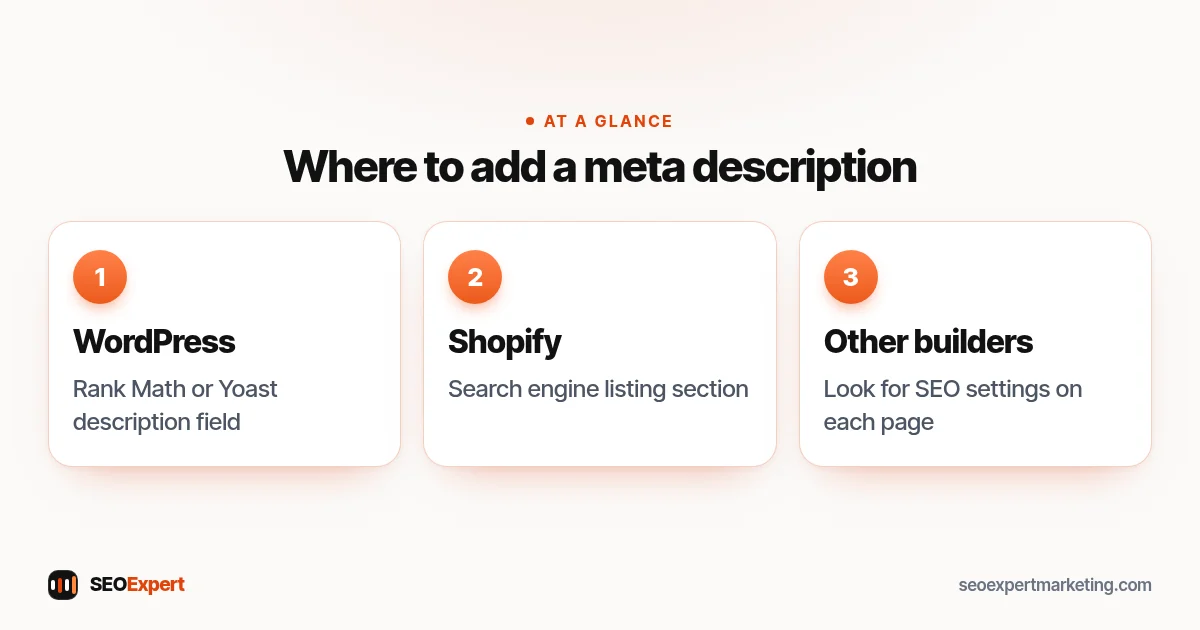
- WordPress: SEO plugins such as Rank Math or Yoast add a description field below the editor or in a sidebar panel.
- Shopify: each product, collection, page and blog post has a search engine listing section where you can edit the description.
- Other builders: look for SEO settings in each page's settings panel.
Where to find the description field on WordPress, Shopify and other builders:
Writing for local searches
Local customers want to know three things quickly: do you do the job, do you cover their area and how do they get in touch. Put the service and the main town or area near the start, add one concrete detail such as opening hours, a price range or response time, and finish with the action, such as call, book or get a quote. Keep the area honest: name the town you're based in or the main area you serve, not a list of every suburb.
Writing for online stores
For product pages, mention the product name, one or two features that matter to buyers, such as size, material or compatibility, and anything that reduces risk, such as delivery times or the returns window. For category pages, describe the range: how many styles, the main brands and price levels. Store platforms often fill this field automatically from the first lines of the product text, which rarely makes a good summary, so write your own for your best sellers first.
Writing for articles and guides
For an article, say what question it answers and what the reader will get: a checklist, a cost range, a step-by-step method. Numbers help people judge depth, such as "seven steps" or "prices from three countries". Avoid teasing without answering; a summary that hides the answer behind vague promises rarely earns trust.
Common meta description mistakes
- The same summary copied across every page.
- Keyword lists instead of sentences.
- Very long summaries where the key point gets cut off.
- Promises the page doesn't keep.
- Leaving important pages blank so Google guesses.
How many pages to start with
You don't need to rewrite every page at once. Start with the ten pages that matter most to the business, usually the home page, main service or product pages and the contact page, then move on to the articles that already get impressions. Ten well-written summaries done properly are worth more than a hundred rushed ones, and the habit becomes quick once you've written a few.
A quick meta description audit
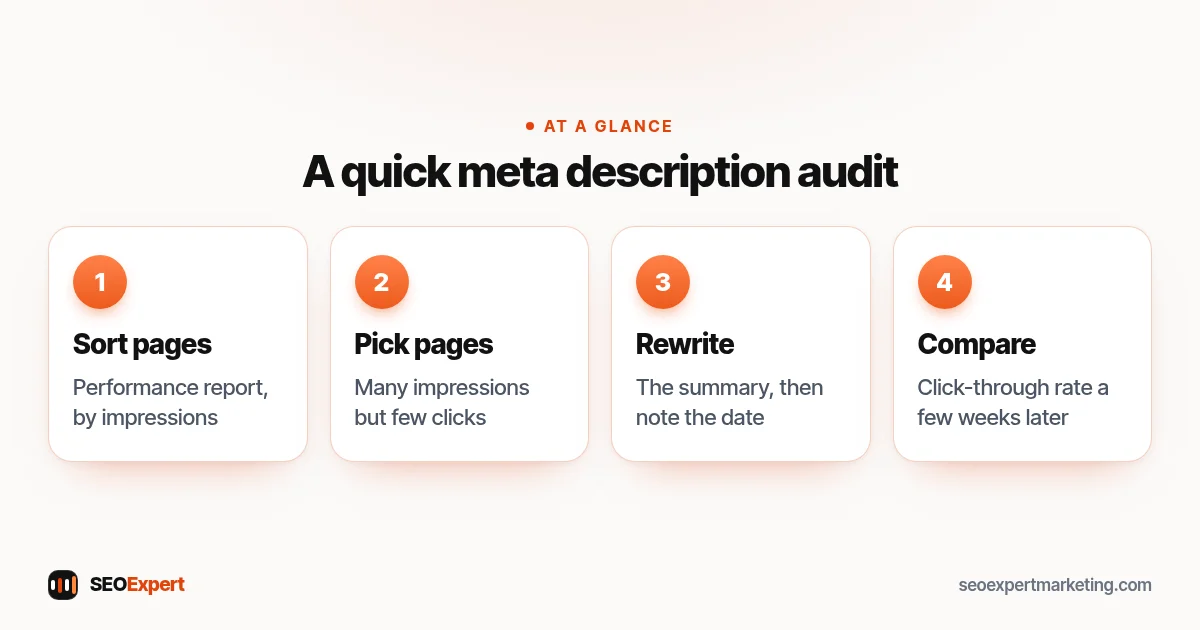
Open Search Console's Performance report, sort your pages by impressions and look at the click-through rate. Pages with many impressions but few clicks are good candidates for a better title and summary. Rewrite the summary, note the date and compare the click-through rate a few weeks later. Our technical SEO audit checklist includes this check.
The quick audit in four steps:
Need help?
Writing titles and search snippets is part of our on page SEO services, and our one-time page writing service covers individual pages. Send your website on WhatsApp for a free review of your search listings.
Meta descriptions: quick answers
What is the ideal meta description length?
Google has no fixed limit but truncates snippets to fit the screen. Around 120 to 155 characters, with the key point first, works well on most devices.
Do meta descriptions help SEO?
Not as a direct ranking factor, but a clear, specific summary can increase the share of people who click your listing.
Why does Google show different text from my summary?
Google chooses the snippet that best fits each search. If your summary doesn't match the search, it may use text from the page instead.
Should every page have a meta description?
Every important page should have its own unique one. Identical summaries across pages aren't helpful in search results.
