
How many keywords should you target for SEO? It's one of the most common questions from business owners, and the honest answer is simpler than most guides make it: one main topic per page, a handful of closely related phrases that naturally belong with it, and as many pages as you have genuinely different topics. This guide explains how many keywords to target per page, across a small business site and in your monthly reports, with examples and the mistakes to avoid.
Why "how many keywords" is the wrong first question
Google doesn't count keywords. Its systems try to understand what a page is about and match it to searches with the same meaning, including searches that use different words. Google's SEO Starter Guide encourages writing naturally for readers, and its spam policies list keyword stuffing as spam. So a better question than how many keywords is: how many distinct topics or search intents does this page serve? The answer should almost always be one.
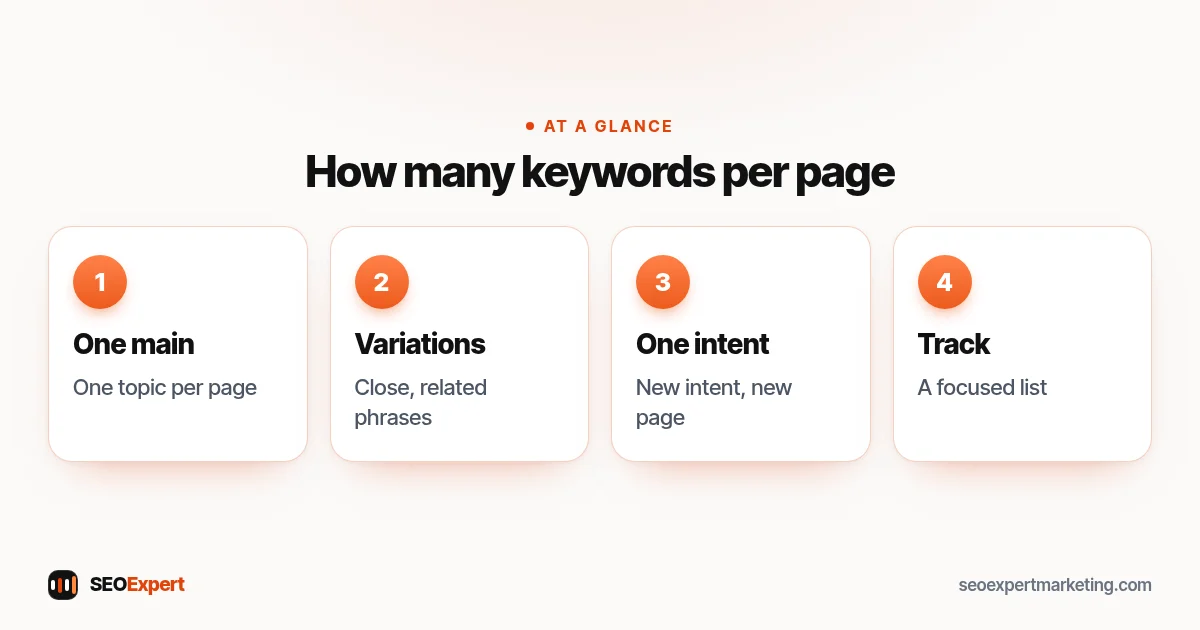
Rule 1: One main keyword per page
Give each page one main search phrase that describes its purpose, such as "boiler repair" or "kitchen fitting cost". Use it naturally in the title, the main heading, the first paragraph and the URL. That tells Google and visitors what the page is about.
Not sure which phrase should be the main one? Our guide to choosing a target keyword walks through it in five steps.
Rule 2: Add close variations, not separate topics
Most pages also rank for many related searches: synonyms, questions and longer versions of the main phrase. A boiler repair page might naturally cover "boiler repair near me", "boiler not working", "boiler engineer" and "boiler repair cost". Include these where they fit, in headings, FAQs and examples. Three to ten closely related phrases is typical, but there's no fixed number; let the content decide.
Rule 3: One page per distinct intent
If two searches need different answers, they need different pages. "Boiler repair" (fix my boiler now) and "new boiler cost" (planning a replacement) are different intents, so they deserve separate pages. Putting both on one page makes it weaker for each.
Rule 4: Don't make two pages chase the same keyword
When two pages target the same search, they compete with each other and Google may switch between them or rank neither well. Keep a simple list of pages and their main phrase, and check it before writing anything new.
Rule 5: Track a focused list
For reporting, track a short list of the searches that matter most to the business, often five to thirty for a small business, and let Search Console show you the rest. Our plans track 5, 15 or 30 phrases depending on the plan; the right number depends on how many services and areas you cover.
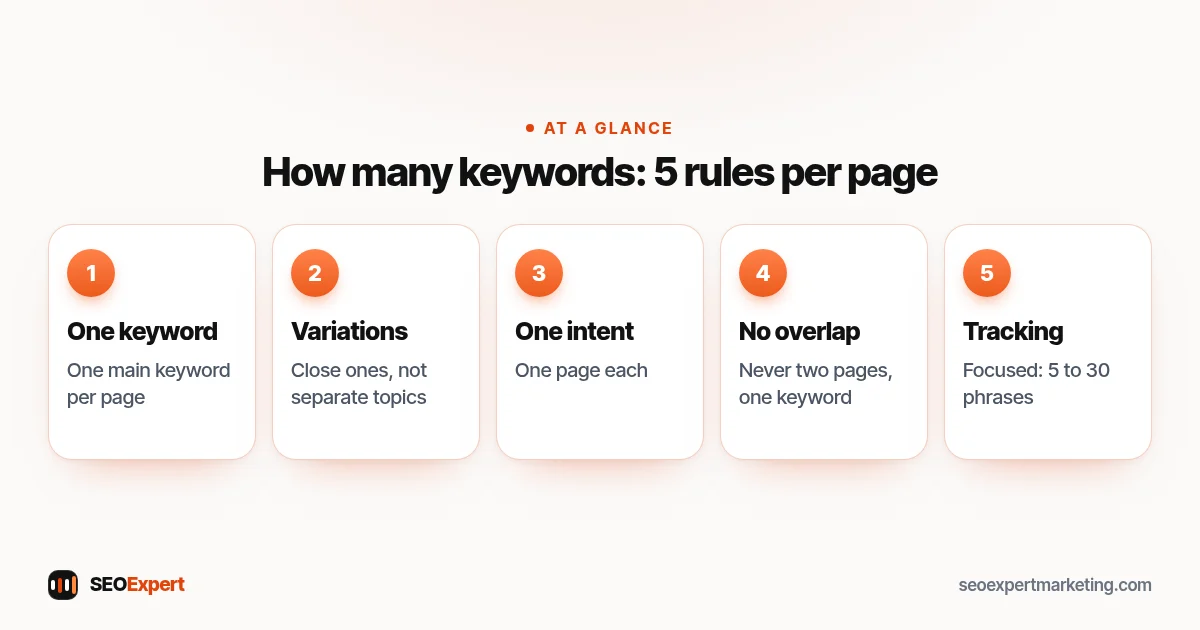
How many keywords per page, in five rules:
How many keywords for a whole site?
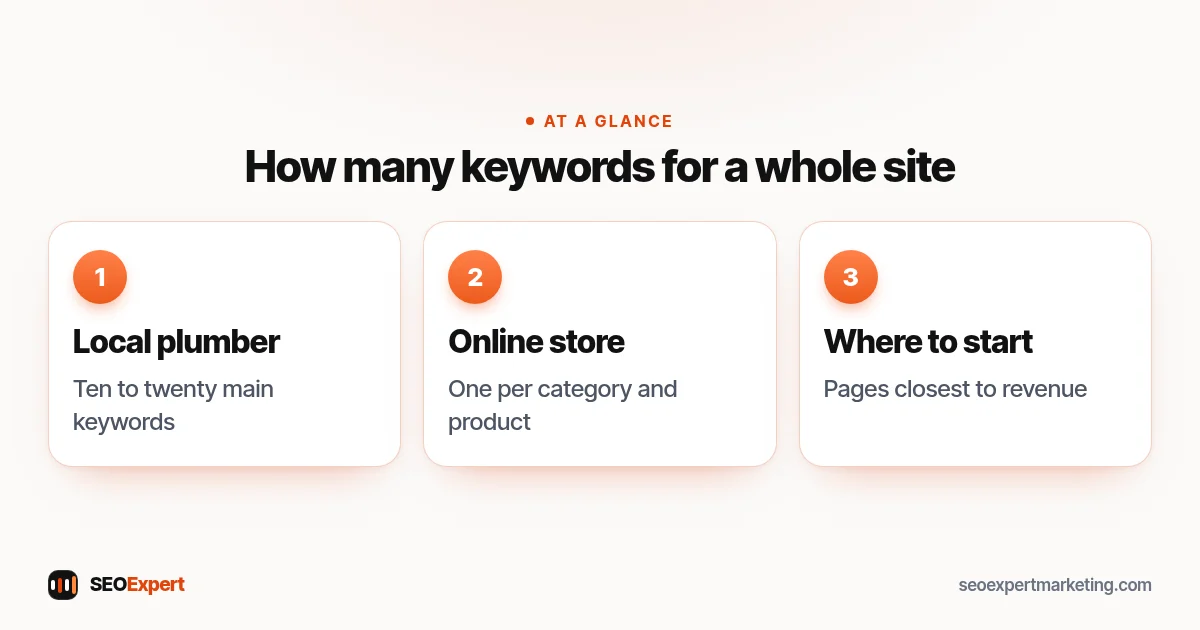
A site needs as many main keywords as it has distinct topics worth a page. For a local plumber, that might be ten to twenty: each main service, a few cost questions and the main areas served. For an online store, it could be hundreds, one per category and product. Start with the pages closest to revenue and grow from there. Our keyword research services build this list for you.
How many keywords a whole site needs, by type of business:
Example: keyword map for a small business
| Page | Main keyword | Close variations |
|---|---|---|
| /boiler-repair/ | boiler repair | boiler not working, boiler engineer, boiler repair cost |
| /boiler-installation/ | new boiler installation | new boiler cost, combi boiler installation |
| /boiler-service/ | boiler service | annual boiler service, boiler service price |
| /blog/boiler-pressure-low/ | boiler pressure low | how to repressurise a boiler |
This is an illustrative example. Each page has one job, and no two pages compete.
How to check which keywords a page ranks for
In Search Console's Performance report, filter by a page and look at the Queries tab. You'll usually see that a single page appears for many searches you never targeted directly. That's normal and good. Use the list to spot questions worth answering on the page, or searches that deserve a page of their own.
How many times should a keyword appear?
There's no magic number or percentage. Use the main phrase where it's natural: title, heading, opening and a few times in the body where it reads well. If a sentence sounds odd because of a keyword, rewrite it. Repeating a phrase to hit a density target reads badly and risks being treated as keyword stuffing.
Common mistakes
- One page trying to rank for every service.
- Dozens of near-identical pages for tiny keyword variations.
- Stuffing lists of keywords or town names into a page.
- Tracking hundreds of keywords nobody looks at.
- Choosing keywords nobody searches for, or that don't bring customers.
How many keywords for local SEO?
Local businesses usually need fewer pages but more care with location. Target each service with its main phrase and let the location come from your Google Business Profile, your address and service areas on the site and, where genuinely useful, a page for each main area. Our guide to local SEO keywords explains the four types of local keyword and how to choose between them.
How many keywords for an online store?
Stores follow the same rules at a larger scale. Each category targets a broader phrase, such as "linen bedding", and each product targets its own specific name and attributes. Filtered views, such as a color or size, usually shouldn't target separate keywords unless people genuinely search for that combination, in which case it can become a proper subcategory. Our guides to category page SEO and product page SEO cover this in more detail.
When to split a page in two
Watch Search Console for a page that appears for two clearly different groups of searches. If a single "heating services" page shows up for both repair searches and installation cost searches, but ranks poorly for both, that's a sign the topics need separate pages, each with its own focus. Splitting a page should always come with internal links between the two and a review of titles, so it's clear which page answers which question.
Putting it into practice
Write a simple keyword map: one row per page, with its main keyword and a few variations. Check it before creating new pages. Review it every few months against Search Console. That's enough structure for most small businesses, and far more useful than chasing a number. Share the map with anyone who writes for your site, so new pages fit the plan instead of competing with old ones. If you'd like help, our SEO consulting can review your keyword map, or ask for a free website review on WhatsApp.
How many keywords: quick answers
How many keywords should I use per page?
One main keyword that describes the page's purpose, plus a handful of closely related phrases used naturally. If a phrase needs a different answer, it needs a different page.
Can one page rank for many keywords?
Yes. Most pages appear for many related searches, often ones you never targeted. Search Console's Queries tab shows them.
How many keywords should a small business track?
Often five to thirty that matter most to the business, alongside Search Console for everything else. Track what you'll actually review.
Is there an ideal keyword density?
No. Use the main phrase where it's natural. Repeating it to hit a percentage reads badly and can count as keyword stuffing.
