
SEO examples help more than definitions. Saying "SEO improves your visibility in search" doesn't tell a business owner what anyone will actually do. So this article walks through four worked SEO examples for common types of small business, a plumber, a dentist, an online store and an accountant, showing the steps we'd take, in what order and why. These are plans for fictional businesses based on how Google describes its systems, not results from real clients. We've labelled them that way on purpose: we're a new agency and we only publish real client results with permission.
What every SEO plan has in common
Each of the SEO examples below follows the same basic shape, drawn from Google's SEO Starter Guide: make sure Google can find and understand the site, create pages that genuinely answer what people search for, earn trust and links, then measure and improve. What changes between businesses is where the biggest opportunity lies.
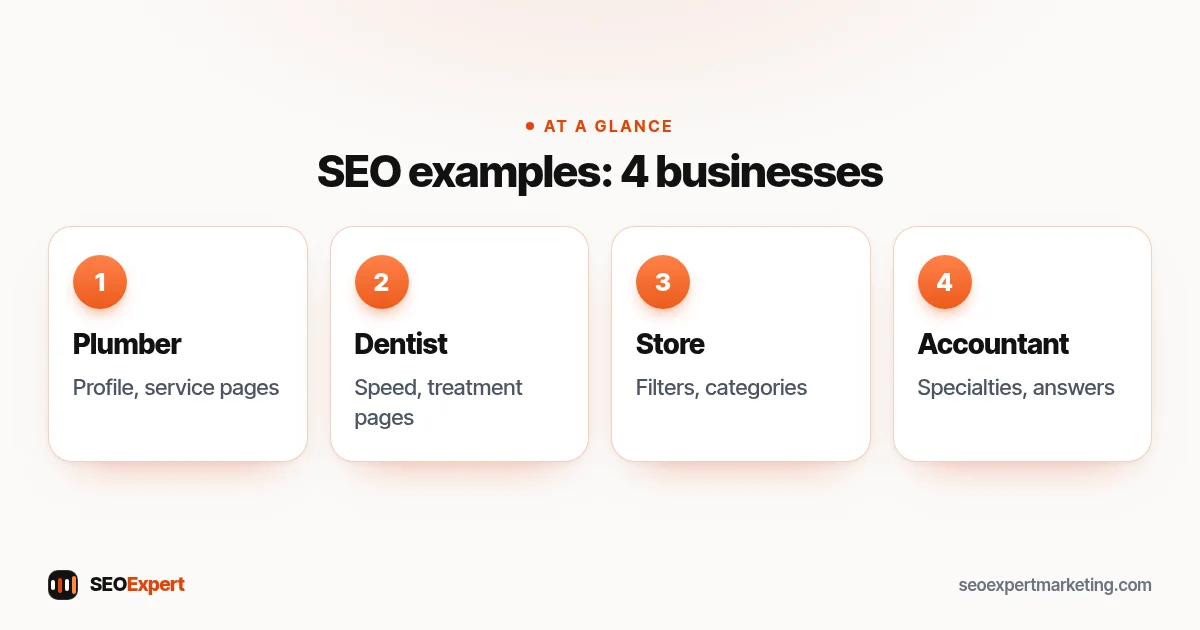
Example 1: a plumber in Austin
Starting point: a five-page website with one "Services" page, a basic Google Business Profile with twelve reviews and no Search Console account.
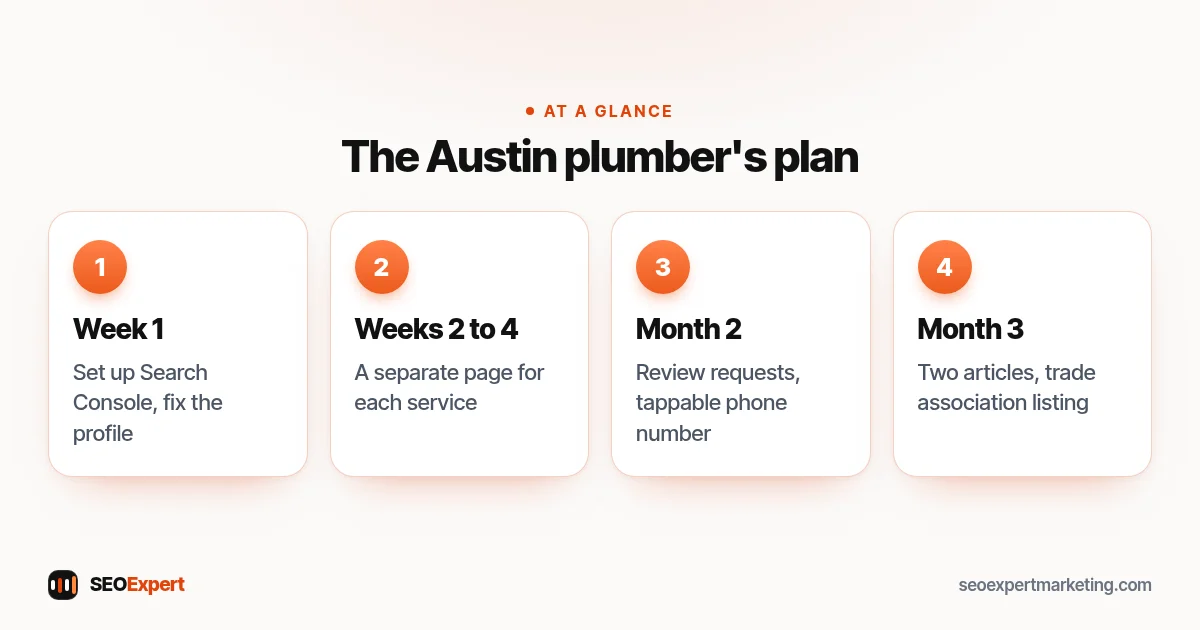
- Week 1: set up Search Console and check indexing. Fix the Business Profile: primary category "Plumber", secondary categories for drain cleaning and water heater services, service area set to the neighborhoods actually covered, services listed with descriptions.
- Weeks 2 to 4: replace the single services page with separate pages for emergency plumbing, water heater repair and installation, drain cleaning and leak detection, each with price guidance, response times and photos of real jobs.
- Month 2: start a review request after every job; reply to every review. Make sure the phone number is tappable on every page.
- Month 3: write two helpful articles answering common questions, such as what to do when a water heater leaks. Get listed with the local trade association and suppliers.
Why this order: for a local trade, Google says local results are based mainly on relevance, distance and popularity. Profile fixes and service pages build relevance fast; reviews build popularity over time. More on this in our SEO for plumbers page.
The plumber's plan from these SEO examples, in order:
Example 2: a dental practice
Starting point: an attractive site with treatment pages that are a few lines each, slow mobile loading because of a homepage video, and good reviews.
- Technical: replace the video with a compressed image, fix mobile speed, check every treatment page is indexed.
- Content: expand the main treatment pages (implants, Invisalign, emergency appointments, check-ups) with what happens, how long it takes, recovery, price ranges and who it suits. Add the dentists' qualifications.
- Local: make the Business Profile services match the treatment pages; add photos of the practice and team.
- Trust: show genuine reviews, a clear new-patient process and accurate information that follows professional rules for health advertising.
Why: health is an area where people want expertise and reassurance before they book, so detailed, accurate treatment pages are the biggest opportunity. See SEO for dentists.
Example 3: an online store selling kitchenware
Starting point: 600 products on Shopify, product descriptions copied from suppliers, filters creating thousands of crawlable URLs and category pages with no text.
- Crawl control: stop filter combinations being crawled, and make sure each product has one canonical URL.
- Categories: build categories around what people search, such as "cast iron pans" and "knife sets", with unique titles and short introductions.
- Products: rewrite descriptions for the top 50 sellers first, add good photos and check product structured data against Google's product documentation.
- Content: buying guides that link to categories, such as how to season a cast iron pan.
Why: for stores, structure and duplicates usually hold back the whole site, so they come first. Our guides to category page SEO and product page SEO go further.
Example 4: an accountant
Starting point: a professional site that ranks for the firm's name only, with generic copy that could describe any accountant.
- Positioning: choose two or three specialties the firm genuinely has, such as contractors and small limited companies, and create a dedicated page for each.
- Questions: turn the questions clients ask every year into helpful pages: deadlines, allowable expenses, the cost of bookkeeping.
- Prices: publish starting prices or ranges; people search for them.
- Local and links: complete the Business Profile, gather reviews and get listed with professional bodies.
Why: professional services win by being specific and genuinely helpful. See SEO for accountants.
What these SEO examples teach
| Business | Biggest opportunity | First step |
|---|---|---|
| Plumber | Google Maps and service pages | Fix the Business Profile |
| Dentist | Detailed treatment pages and speed | Fix mobile speed |
| Online store | Structure and categories | Control filter URLs |
| Accountant | Specialist pages and answers | Choose specialties |
The work differs, but none of these SEO examples involve tricks, bought links or mass-produced pages. They make each business easier to find and easier to choose.
Mistakes these SEO examples avoid
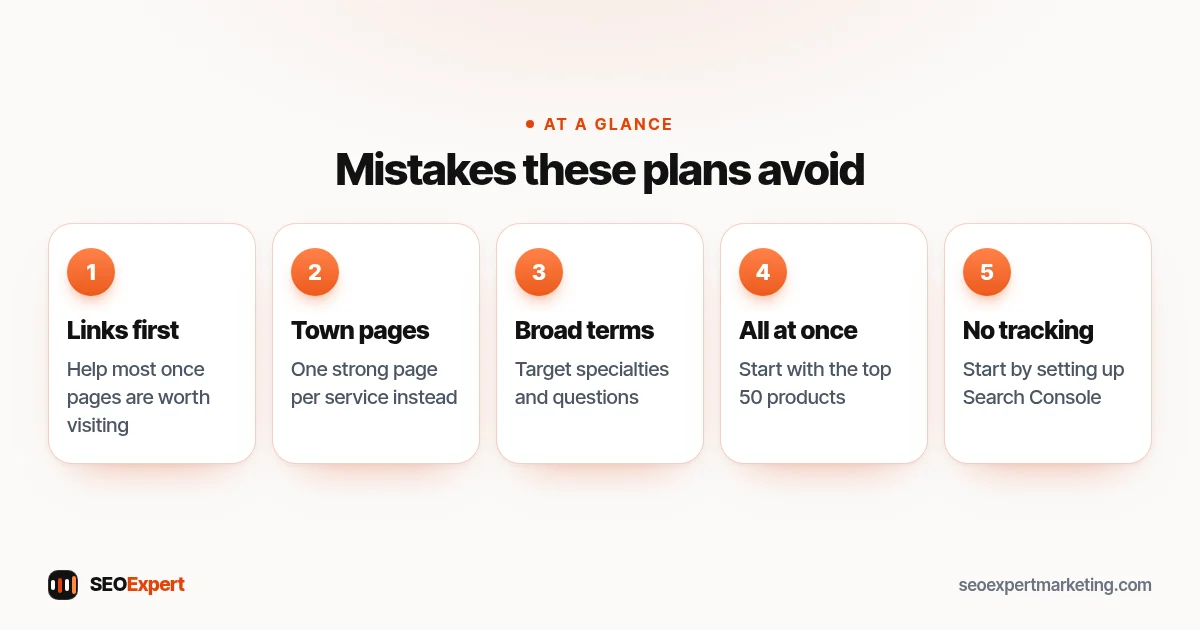
- Starting with links. Links help most once the pages they point to are worth visiting.
- Copy-paste town pages. The plumber plan uses one strong page per service, not one per suburb.
- Chasing broad keywords. The accountant plan targets specialties and questions, not "accountant" alone.
- Rewriting everything at once. The store plan starts with the top 50 products, then continues.
- Ignoring measurement. Every plan starts by setting up Search Console, so progress can be seen.
Five mistakes these SEO examples avoid, and what they do instead:
Adapting the SEO examples to your business
Most small businesses fit one of these four patterns, or a mix. A restaurant looks like the plumber plan with more photos and menus; a law firm like the accountant plan with practice-area pages; a café that also sells beans online combines the local and store plans. Start by asking where customers search for you, on Google Maps, in normal results or in shopping results, and follow the plan that matches. Our industry pages, from SEO for restaurants to SEO for lawyers, give more specific detail.
How long would these take?
For each of the SEO examples above, the first month's work is mostly setup and fixes. Visible movement in Search Console usually starts within the first few months, with steadier growth in enquiries over six to twelve months, depending on competition. Our guide to how long SEO takes explains the typical pattern.
Want an example plan for your business?
Send us your website address on WhatsApp and we'll reply with the main issues we see and a sensible first step, like the plans above, for free. Our SEO services start at $395 a month if you'd like us to do the work.
SEO examples: quick answers
Are these SEO examples real client results?
No. They're worked plans for fictional businesses, based on how Google describes its systems. We'll publish real client results only with permission and real numbers.
What's a simple example of SEO?
Giving each of your services its own clear page with prices, details and photos, so it matches what customers search for. That single change often makes a real difference.
Do SEO examples work the same in every country?
The principles are the same in the USA, UK, Canada and Australia. Searches, competitors and local directories differ, so the details of each plan change.
Which SEO example is closest to my business?
Local trades follow the plumber plan, health and professional services the dentist and accountant plans, and online shops the store plan.
