SEO vs PPC is one of the first decisions a small business faces when it wants more customers from Google. Both put you in front of people who are searching right now, but they work in very different ways. Pay-per-click (PPC) ads, such as Google Ads, show your ad as soon as your campaign is live and you pay for every click. Search engine optimization (SEO) earns free listings in the normal results, but it takes months to build. This guide compares SEO vs PPC on cost, speed, how long results last and trust, then gives a simple way to decide which fits your business, or whether you need both.
SEO vs PPC: the short answer
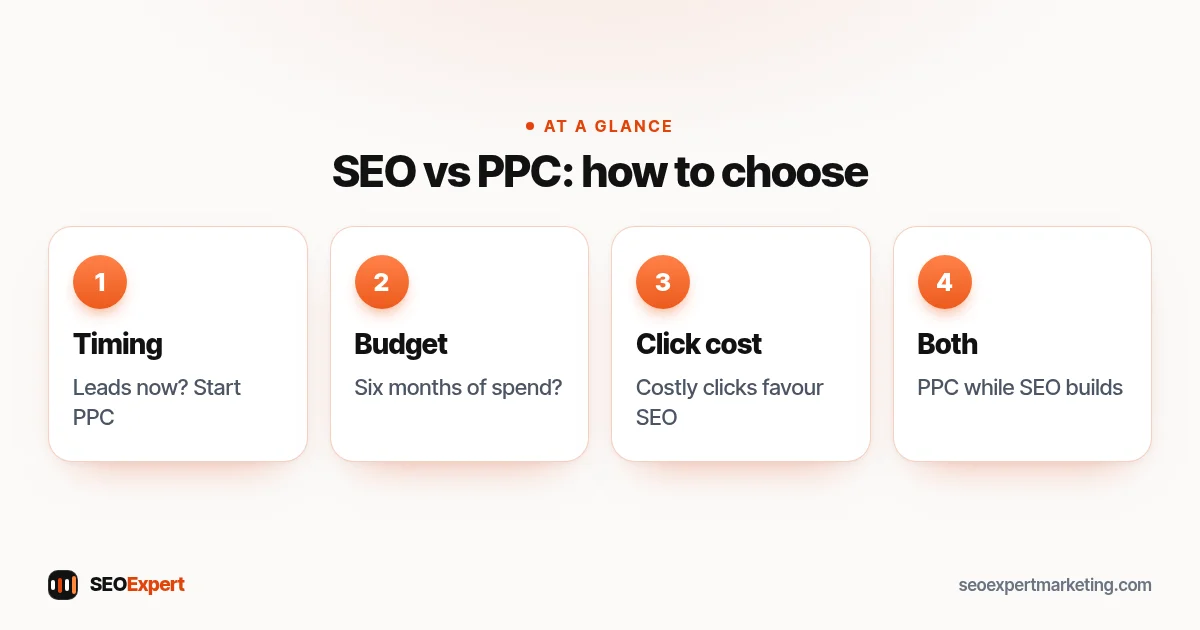
The main difference between SEO and PPC is how you pay: with PPC you pay for every click while your ads run; with SEO you pay for the work, and the clicks from Google's normal results are free. If you need leads this week, PPC is the faster route. If you want a steady flow of enquiries that doesn't stop the day you stop paying, SEO is the better long-term investment. Many small businesses use PPC while SEO is building, then shift budget towards SEO as organic visibility grows. The right mix depends on your budget, your margins, how competitive your market is and how soon you need results.
What is SEO?
SEO means improving your website and online presence so that Google shows your pages in the free, organic results. It covers technical health, useful pages that match what people search for, a complete Google Business Profile for local businesses and links from other relevant websites. Google's SEO Starter Guide describes the basics. You don't pay Google for organic clicks; the cost is the time or the agency fees to do the work.
What is PPC?
PPC means paying for ads that appear above, beside or below the organic results. With Google Ads you choose keywords, write ads and set a budget, and you're charged when someone clicks. Google explains how search results differ from ads: ads appear under an "Ads" label, while search results aren't part of its advertising programs. That means paying for ads doesn't buy you a better organic position.
SEO vs PPC: seven differences that matter
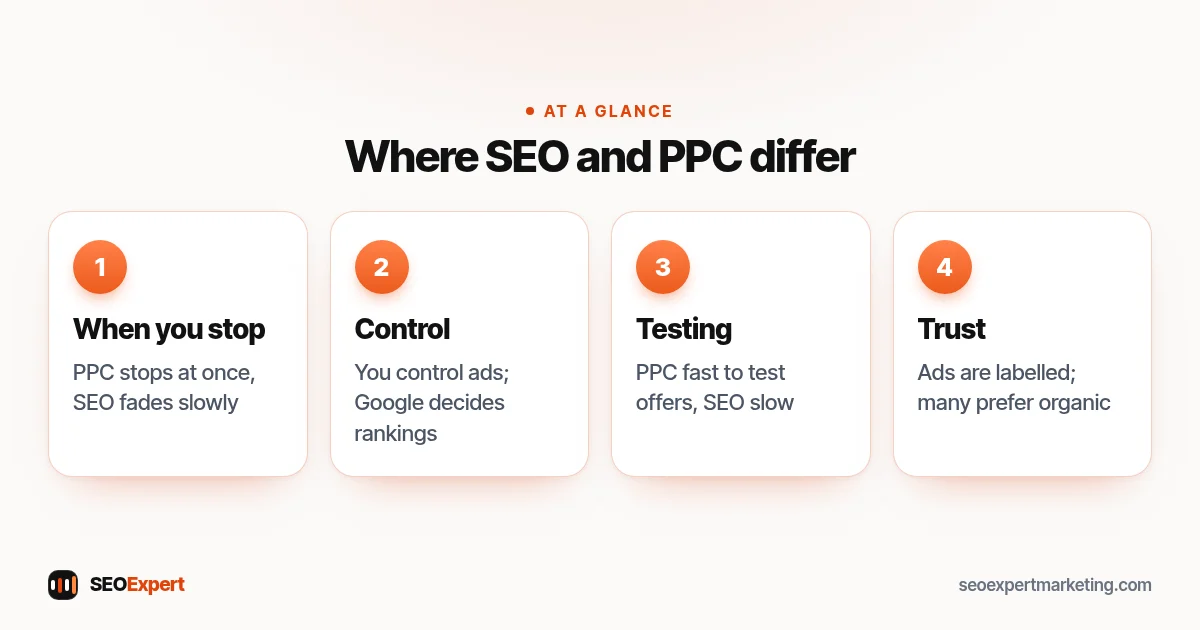
| SEO | PPC | |
|---|---|---|
| Speed | Usually months | As soon as ads are approved |
| Cost per click | No fee to Google | You pay for every click |
| Ongoing cost | Time or agency fees | Ad spend plus management |
| When you stop | Visibility fades slowly | Traffic stops at once |
| Control | Google decides rankings | You control ads and budget |
| Testing | Slow to test messages | Fast to test offers |
| Trust | Many people prefer organic results | Clearly labelled as ads |
1. Speed
PPC wins on speed. Once your ads are approved, they can show the same day. SEO usually takes several months to show steady results, and longer on a new website or in a competitive market. Our guide on how long SEO takes explains the typical stages.
2. Cost
With PPC, every click has a price. Google's help page on actual cost-per-click explains that in the ad auction you pay what's needed to beat the ad ranked below you, so prices rise in competitive trades such as legal services, plumbing or dentistry. With SEO, clicks are free, but the work is not. Our guide on how much SEO costs covers typical prices.
3. How long results last
This is the biggest difference in SEO vs PPC. When a PPC budget runs out, the ads stop and so do the clicks. A page that ranks well through SEO usually keeps bringing visitors for months after the work is done, although it still needs care as competitors improve.
4. Control
PPC gives you control: you choose the keywords, the message, the landing page, the hours and the budget. With SEO, Google decides what ranks. You can make your site the best answer, but no honest provider can promise positions.
5. Testing and learning
PPC is a fast way to learn which services, offers and headlines bring enquiries. Those lessons are valuable for SEO too, because they tell you which pages to build first.
6. Trust and clicks
Ads are clearly labelled, and some people scroll past them to the organic results. Others click ads happily when the ad matches what they need. Both can work; organic results simply don't carry the "Ad" label.
7. Competition
In crowded markets, PPC can become expensive quickly, while SEO takes longer but can reduce what you spend per lead over time. In quieter niches, both can be affordable.
How SEO vs PPC compare on lasting results, control, testing and trust:
When PPC makes more sense
- You need enquiries immediately, for example a new business or a seasonal offer.
- You want to test which services or areas bring the best customers.
- Your website is brand new and won't rank for months.
- You have a short promotion or event with a fixed end date.
When SEO makes more sense
- You want a steady flow of leads that doesn't stop when spending stops.
- Clicks in your trade are expensive and you want to lower cost per lead over time.
- You're a local business that wants to appear in the map results, which PPC alone doesn't build.
- You plan to be in business for years and want an asset you own.
SEO vs PPC for local businesses
For plumbers, dentists, lawyers and other local businesses, SEO vs PPC isn't quite an either-or choice. Local SEO builds your Google Business Profile and your website so you appear in the map pack and organic results for searches in your area. PPC can add an ad on top while that builds. Our local SEO services focus on the organic side; we don't manage ad campaigns.
SEO vs PPC for ecommerce stores
For an online shop, PPC usually means Google Shopping ads: product photos with prices, paid per click and managed through Google Merchant Center. SEO for a shop means well-built category and product pages, clear product descriptions and a fast, crawlable store. There's also a free middle ground: Google's free product listings let products from Merchant Center appear at no cost on the Shopping tab, in Google Images and in other Google results, alongside any paid ads. Google says turning them on doesn't guarantee your products will be shown.
A practical order for most small stores: set up Merchant Center with an accurate product feed and free listings, fix the store's SEO basics, then use Shopping ads for your best-selling or highest-margin products while organic visibility grows. Our Shopify SEO page covers the store side.
Using SEO and PPC together
The two help each other. PPC data shows which keywords convert, so SEO can prioritize those pages. SEO pages often make good PPC landing pages because they are clear and useful. And appearing in both the ads and the organic results for an important search gives you more space on the page. As organic visibility grows, many businesses reduce PPC spend on the searches where they now rank well.
SEO vs PPC costs: an illustrative comparison
Here's a simple, made-up example to show how the two compare over time. It isn't a forecast for your business; real numbers vary widely by trade, location and competition.
Imagine a local business that pays $8 per click on Google Ads and gets one enquiry for every 12 clicks. Each PPC enquiry costs about $96, and that cost stays roughly the same for as long as the ads run. Now imagine the same business spends $795 a month on SEO. In the first few months, SEO may bring few or no extra enquiries, so the cost per lead looks high. If, after six to twelve months, the improved pages bring 20 enquiries a month, the cost per SEO lead falls to around $40, and those pages keep working even in months when less SEO work is needed.
The point isn't the exact figures. It's the shape: PPC costs are steady and immediate, while SEO costs come first and the return builds later. That's why SEO vs PPC often isn't a choice between two options but a question of timing.
How to measure SEO vs PPC fairly
Compare the two on the same measure: cost per enquiry or cost per customer, not clicks. Track calls, form submissions and WhatsApp messages from each channel. In Google Ads, use conversion tracking; for SEO, use Search Console for clicks and your analytics or call tracking for enquiries. Review SEO over at least six months, because judging it after four weeks will always make PPC look better.
How to measure SEO vs PPC fairly, in four steps:

A simple way to decide
Ask three questions. How soon do you need leads? If it's this month, start with PPC. What can you afford each month for at least six months? If the answer is a few hundred dollars, a focused SEO plan often gives better long-term value than a small ad budget spread thin. How competitive are clicks in your trade? If they're expensive, SEO becomes more valuable over time. If you'd like a second opinion on SEO vs PPC for your business, send us your website on WhatsApp for a free review, see our SEO services or compare our SEO packages.
SEO vs PPC: common questions
Is SEO or PPC better for a small business?
It depends on how soon you need leads and your budget. PPC is faster; SEO usually costs less per lead over time and keeps working after you stop paying. Many businesses use both.
Does paying for Google Ads help my organic rankings?
No. Google explains that organic search results aren't part of its advertising programs. Ads and organic results are separate.
How long does SEO take compared with PPC?
PPC ads can show as soon as they're approved. SEO usually takes several months to build steady visibility, longer for new sites and competitive markets.
Can I stop PPC once SEO works?
Often you can reduce it for searches where you now rank well, and keep ads for the most valuable or competitive searches. Review the numbers before cutting anything.
What is the difference between SEO and PPC for an online store?
PPC for a store usually means Shopping ads you pay for per click. SEO improves your product and category pages so they rank in the free results, and Google's free product listings can show your products at no cost, without any guarantee of placement.
