
An SEO agency is a company that helps businesses get found in search engines such as Google, through work on their website, content, local listings and reputation. If you're wondering what an SEO agency actually does all month, what to expect from one and whether you need one at all, this guide explains it plainly. We are an SEO agency ourselves, so we'll be clear about where an agency helps and where you might not need one.
What is an SEO agency?
SEO stands for search engine optimization: improving a website and its presence online so it appears for relevant searches. An SEO agency is a team that does this work for clients. Some are large; many are small teams or specialists in one area, such as local SEO, ecommerce or a particular industry. Freelancers and consultants do similar work on their own; our guide to SEO freelancer vs agency compares them.
What does an SEO agency do?
Google's own guide Do you need an SEO? lists useful services that SEOs and agencies provide, including:
- Review of your site content or structure.
- Technical advice on website development, such as hosting, redirects, error pages and use of JavaScript.
- Content development.
- Management of online business development campaigns.
- Keyword research.
- SEO training.
- Expertise in specific markets and geographies.
- Optimizing for generative AI.
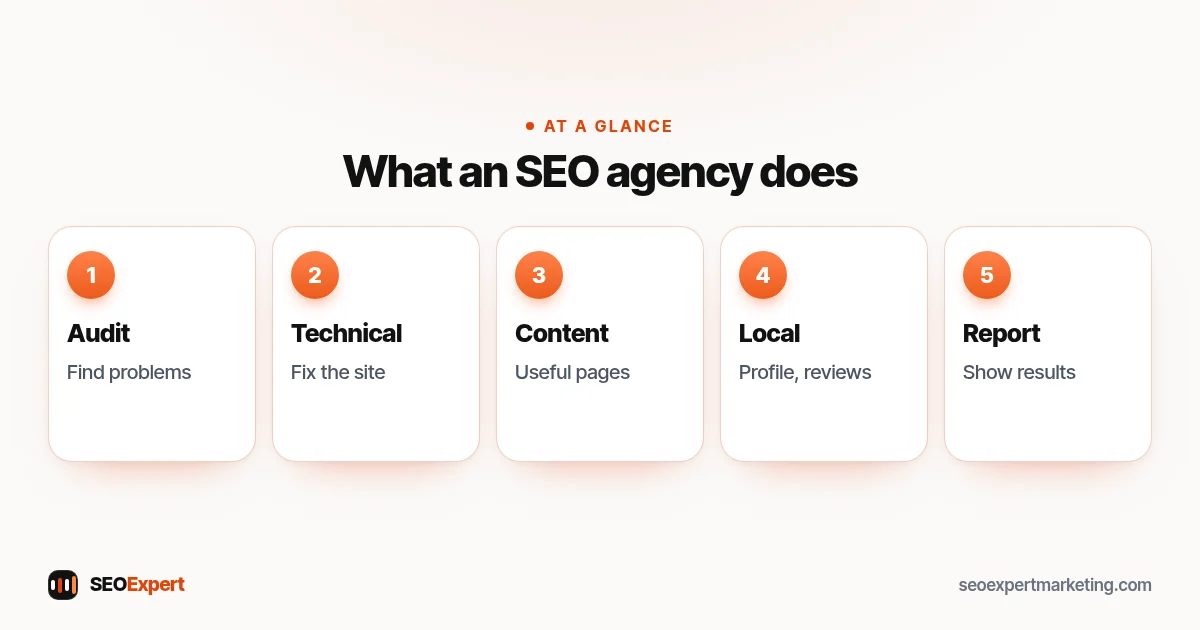
In practice, for a small business, an SEO agency's work usually falls into five areas:
- Audit: finding what's holding the site back, from technical problems to thin pages. See our guide to what an SEO audit is.
- Technical fixes: speed, mobile layout, indexing, redirects and structured data.
- Content: service pages, location pages and helpful guides built around real searches.
- Local SEO: Google Business Profile, listings and reviews for businesses that serve an area.
- Links and reporting: earning genuine links and showing what's working each month.
What an SEO agency can't or shouldn't do
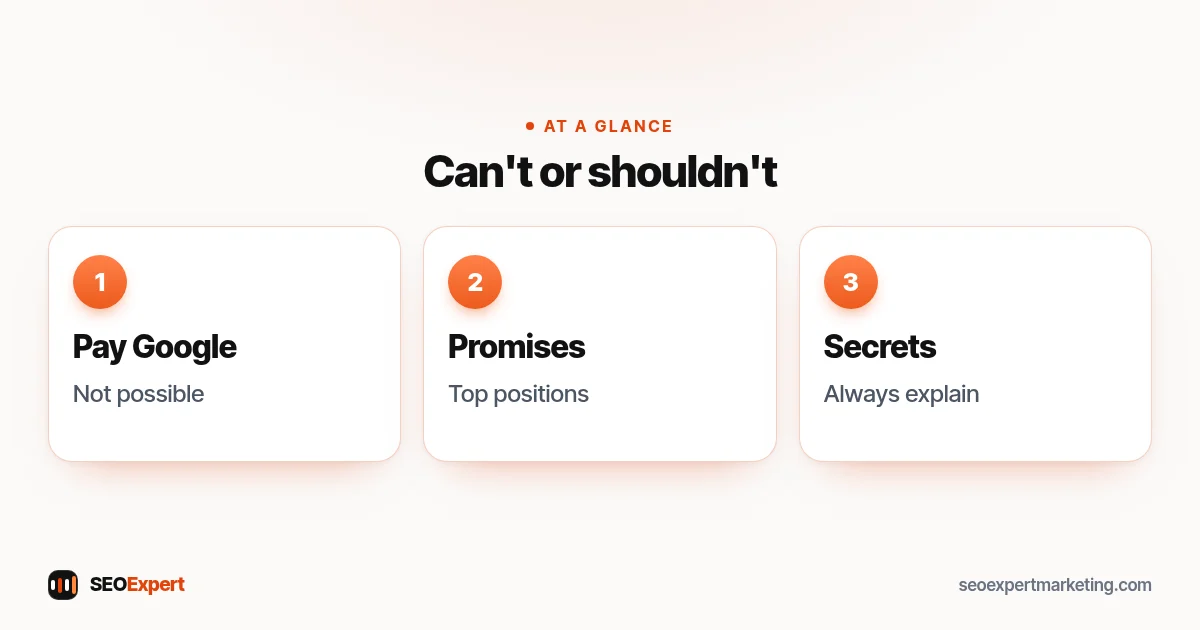
- Pay Google for rankings. Google says it never accepts money to include or rank sites in its search results, and that advertising with Google won't affect your organic presence.
- Promise a top position. Google warns that nobody can promise a top ranking, and to be wary of SEOs that claim a "special relationship" with Google.
- Work in secret. Google advises being careful if a company is secretive or won't explain what it intends to do, and says you are responsible for the actions of companies you hire.
Our guide to white hat SEO explains which methods are safe.
What to expect from an SEO agency in the first months
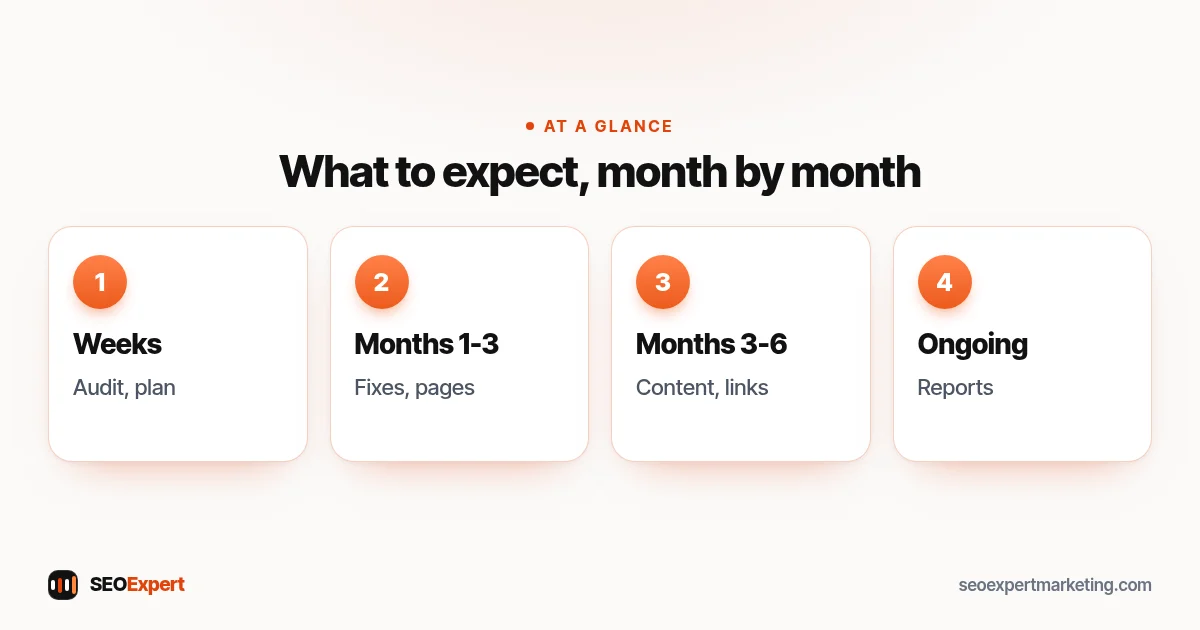
| Period | Typical work |
|---|---|
| First weeks | Access to Search Console and analytics, an audit, keyword research and a written plan |
| Months 1–3 | Technical fixes, improving key service pages, Google Business Profile clean-up, first reports |
| Months 3–6 | New content, local pages, links from relevant sources, adjustments based on data |
| Ongoing | Monthly reports, new content, reviews routine, fixing new issues |
Timelines vary with competition and where you start. Our guide on how long SEO takes explains why results usually build over months.
Do you need an SEO agency?
Not always. Google calls hiring an SEO a big decision: it can improve your site's visibility and save you time, but an irresponsible SEO can damage your site and reputation. Google also points out that Search Console, the official Google Search Central blog and its discussion forum can give you a great deal of information about optimizing your site, and all three are free to use. Google itself says that if you run a small local business, you can probably do much of the work yourself, and recommends starting with its SEO Starter Guide; our guide to DIY SEO shows how.
An SEO agency tends to make sense when you don't have the time, when results matter enough to justify the cost, when the site needs technical work, or when you're redesigning. Google says a great time to hire is when you're considering a site redesign, the earlier the better, or planning to launch a new site, so the site is built to be search-friendly from the start.
Questions to ask before hiring
Google suggests interviewing a potential SEO and asking questions such as:
- Can you show me examples of your previous work and share some success stories?
- Do you follow the Google Search Essentials?
- What kind of results do you expect to see, and in what timeframe?
- How do you measure your success?
- What's your experience in my industry and my area?
- How long have you been in business?
- How can I expect to communicate with you?
- Will you share all the changes you make to my site and the reasoning behind them?
Google also says to check an SEO's business references by asking past clients whether the service was useful, easy to work with and produced positive results. If an agency is new and has no past clients to ask, weigh that, and consider starting with a one-off job before a monthly plan.
Our guide on how to choose an SEO company adds more checks and red flags.
Types of agencies
Not every SEO agency works the same way. Common types include:
- Specialists: focus only on search, sometimes on one area such as local, technical or ecommerce work.
- Full-service digital agencies: offer search alongside ads, social media and web design.
- Industry specialists: work mainly with one sector, such as dentists, lawyers or trades.
- White label providers: do the work behind the scenes for other agencies and web designers.
None is automatically better. Choose based on what your site needs and who will actually do the work.
What you'll need to provide
Good results depend on both sides. Expect to give access to Google Search Console (Google advises giving only read access while an SEO is doing an audit), your analytics, your Google Business Profile and your website, ideally as separate user accounts rather than shared passwords. You'll also need to share what you sell, your prices or price ranges, the areas you serve, photos of your work and answers to customer questions. Quick approvals help a lot: content waiting weeks for sign-off slows everything down.
Reading the contract
- Notice period: how much notice either side must give to stop.
- Minimum term and leaving: whether you're tied in for a set number of months, what you owe if you stop early, and how quickly they'll remove their access and hand over your files and logins.
- What's included: number of pages, hours or tasks each month, and what costs extra.
- Ownership: you should own your website, content, accounts and data, including after you leave.
- Reporting: how often, and what it will show.
- Approvals: what they can change without asking, and what needs your sign-off.
Signs the work is going well
Early on, look for clear explanations, fixes you can see on your site and a plan you understand. Over the following months, look for more of your service pages appearing in search, more enquiries from search, a steady flow of reviews if you're local, and reports that connect the work to results. You should get a list of the work done every month from the start, even before results show. If you can't see what's been done or why, ask, and if the answers stay vague, that's a warning sign.
How much does an SEO agency cost?
It depends on the work, the competition and the agency. Many work on a monthly fee; others offer one-off audits or projects. Our guide to how much SEO costs explains the common models. Our own monthly plans are listed on our SEO packages page; whoever you talk to, compare a few written proposals before you decide.
What a useful monthly report includes
A good report is short and answers three questions: what was done, what changed and what happens next. It should show enquiries from search, the pages and searches bringing visitors, Business Profile activity if you're a local business, and a plain-English summary of the work completed. Rankings can appear, but as supporting detail rather than the headline. If a report runs to many pages of charts with no explanation, ask for a one-page summary. Our guides to the SEO report and the local SEO report show what to look for.
Working well together
The best results come from a working relationship, not a hand-off. Agree one contact on each side, a regular short call or update, and a simple way to approve changes. Tell your provider about anything that affects search: new services, price changes, a move, a new phone number or plans to change your website. Share what customers ask on the phone; those questions often become the most useful pages on your site.
If you decide to do it yourself
Plenty of small businesses start on their own. Set up Search Console and your Google Business Profile, fix the basics on your main pages, ask every customer for a review and check your numbers monthly. Our SEO cheat sheet and local SEO checklist cover the essentials. If you later bring in help, the work you've done won't be wasted.
Red flags
- Promises of top positions or a fixed number of first-page rankings.
- Claims of a special relationship with Google or a "priority submit" to Google.
- Refusing to explain what they'll change on your site.
- Buying links or reviews on your behalf.
- Keeping ownership of your accounts, profile or content.
- Reports full of rankings but nothing about enquiries.
A made-up example: a small accountancy firm gets help
Imagine a three-partner accountancy firm planning a new website. Following Google's advice, it brings in SEO help before the redesign starts. In the first weeks the agency audits the old site, researches what local businesses search for, and plans pages for each service. During the build it makes sure redirects from old pages are in place. Afterwards it sets up the Business Profile properly, starts a review routine and sends a short monthly report focused on enquiries. The firm keeps ownership of every account throughout.
How we work
We're a small agency focused on SEO for small businesses. We explain every change, keep every account in your name, never buy links or reviews and report on enquiries, not just rankings. If you'd like us to look at your site, ask for a free website analysis, or browse our SEO services.
SEO agencies: quick answers
What is an SEO agency?
An SEO agency is a company that helps businesses get found in search engines through work on their website, content, local listings and reputation.
What does an SEO agency do?
Typically: audits, technical fixes, content, local SEO, earning genuine links and reporting. Google's own list includes site reviews, technical advice, content development, keyword research, training and optimizing for generative AI.
What should I expect from an SEO agency?
Access to your data, an audit and written plan in the first weeks, fixes and page improvements in the first months, and clear monthly reports focused on enquiries.
Do I need an SEO agency?
Not always. Many small businesses can handle the basics with free tools like Search Console. An agency makes sense when time, technical needs or a redesign justify the cost.
Can anyone pay Google to rank my site?
No. Google says it never accepts money to include or rank sites in its search results, and that advertising with Google won't have any effect on your site's presence in its search results.
When is the best time to get SEO help?
Google says a great time is when you're considering a site redesign, the earlier the better, or planning to launch a new site.
