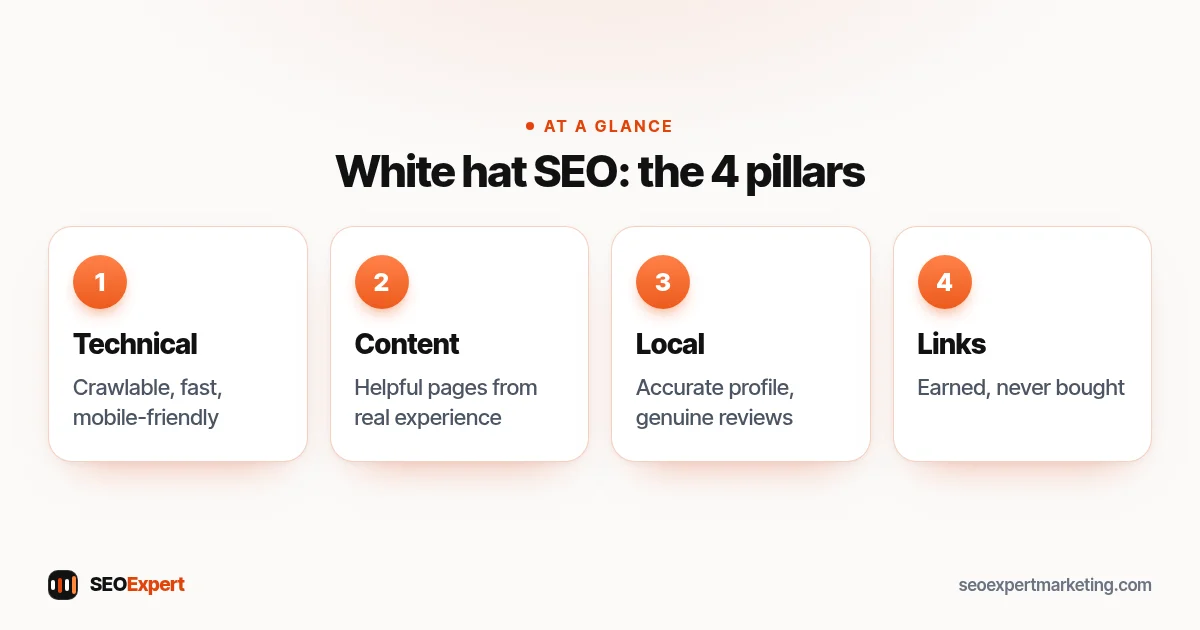
White hat SEO means improving your search rankings in ways that follow Google's rules and genuinely help the people searching: useful pages, a fast and crawlable website, honest local listings and links that are earned rather than bought. Black hat SEO tries to trick search engines with tactics such as bought links, hidden text or mass-produced pages. For a small business, the difference isn't philosophical. White hat SEO builds an asset that keeps working; black hat SEO borrows rankings that can disappear overnight and take your site with them. This guide explains what each looks like in practice and how to tell which one an SEO provider is selling you.
What is white hat SEO?
Google publishes its rules in Google Search Essentials, which has three parts: technical requirements (what Google needs to show a page at all), spam policies (behaviors that can lead to lower rankings or removal) and key best practices (what helps your site appear well). White hat SEO is simply working inside those rules and focusing on what helps searchers.
In practice, white hat SEO covers:
- Technical health: a site Google can crawl and index, that loads quickly and works well on phones.
- Helpful content: pages that answer real customer questions better than the alternatives, written from real experience.
- Clear on-page signals: descriptive titles, headings and internal links, so search engines understand each page.
- Honest local presence: an accurate Google Business Profile and genuine reviews.
- Earned links and mentions: other sites linking to you because your business or content is worth mentioning.
What is black hat SEO?
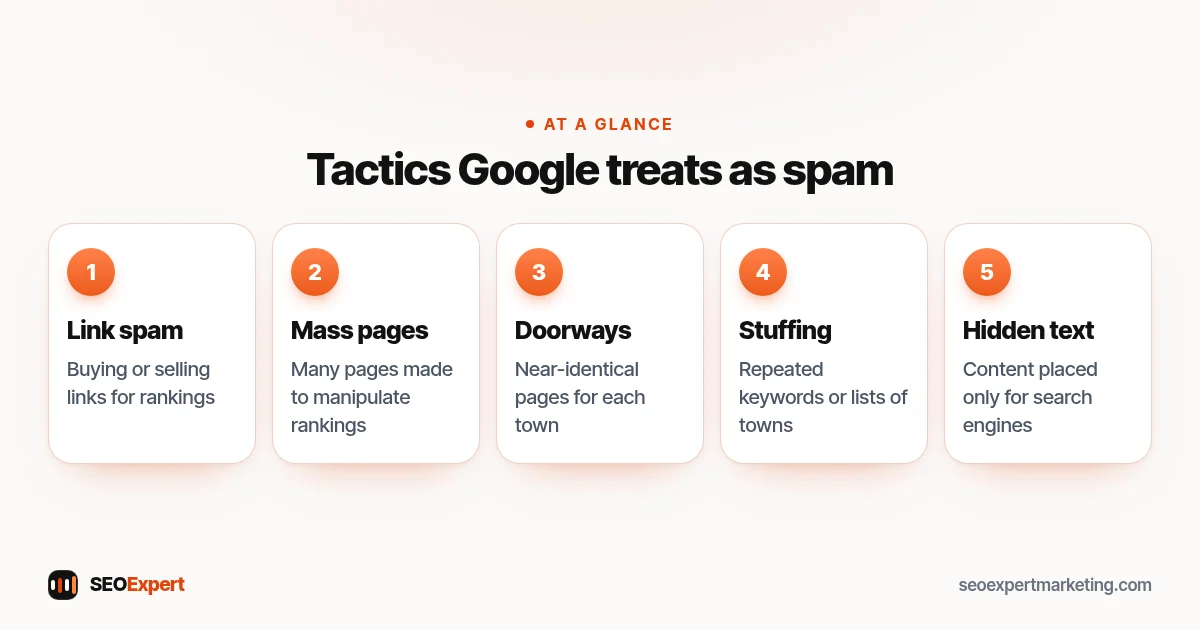
Google's spam policies list the tactics it treats as spam. The ones small businesses are most often sold include:
- Link spam: buying or selling links for ranking purposes, excessive link exchanges, automated link building, low-quality directory or bookmark links, and paid articles with links that pass ranking credit.
- Scaled content abuse: generating many pages, by people or tools, mainly to manipulate rankings rather than help readers.
- Doorway abuse: near-identical pages created for each town or keyword that funnel visitors to the same place.
- Keyword stuffing: filling pages with repeated keywords or lists of towns.
- Hidden text and links: content placed only for search engines, such as white text on a white background.
- Cloaking and sneaky redirects: showing search engines different content from what visitors see.
- Expired domain abuse: buying an old domain to exploit its reputation for unrelated content.
Google says sites that violate these policies may rank lower or not appear in results at all, through automated systems and, where needed, human review that can lead to a manual action.
Five tactics that fall outside white hat SEO, from Google's spam policies:
White hat SEO vs black hat SEO: side by side
| Area | White hat SEO | Black hat SEO |
|---|---|---|
| Links | Earned from partners, press, associations, useful content | Bought, swapped in bulk or auto-generated |
| Content | Written for customers, from real experience | Mass-produced, copied or stuffed with keywords |
| Location pages | Only where there's something real to say | Copy-paste pages for every town |
| Reviews | Asked from real customers | Fake, bought or incentivized |
| Speed of results | Gradual, builds over months | Sometimes quick, often short-lived |
| Risk | Low | Lower rankings, removal or a manual action |
White hat SEO is the foundation of organic SEO: unpaid visibility built the way Google intends.
Much of today's link advice comes from the Google Penguin update of 2012, which targeted bought and automated links.
What about grey hat SEO?
"Grey hat" usually describes tactics that aren't clearly banned today but sit close to the line, such as aggressive link exchanges, lightly rewritten content or paid guest posts without labels. Our view is simple: if the main purpose of a tactic is to manipulate rankings rather than help a reader, assume it's on the wrong side of the line, because Google's policies are written around that purpose.
For the basics of links, nofollow and sponsored tags, see our guide to what a backlink is.
Paid links and sponsorships: the white hat way
Paying for advertising or sponsorships is a normal part of business, and Google doesn't forbid it. Its spam policies say paid links are fine as long as they're qualified with attributes such as "nofollow" or "sponsored" link attributes, so they don't pass ranking credit. If you sponsor a local event and get a link, that's legitimate marketing; just make sure it's labeled. What breaks the rules is paying for links specifically to raise your rankings.
White hat SEO and AI-written content
Many businesses now use AI tools to help write pages. Google's guidance on AI-generated content says it rewards high-quality content however it's produced, but that using automation, including AI, to generate content with the primary purpose of manipulating rankings breaks its spam policies. The white hat SEO approach is the same as for any writing: use tools to help, but make sure every page is accurate, checked by someone who knows the subject and genuinely useful to the reader. Publishing hundreds of unedited AI pages to cover every possible keyword is exactly what the scaled content abuse policy describes.
White hat SEO for a small business: a practical plan
- Fix the foundations. Make sure Google can crawl and index your important pages, and your site is fast and easy to use on a phone. Our technical SEO services page lists the checks.
- Build one strong page per service. Explain what's included, prices or price guidance, the areas you cover and how to get in touch.
- Answer customer questions. Turn the questions customers ask you every week into helpful pages and articles; our SEO content writing page shows how we approach this.
- Tidy up your local presence. Complete your Google Business Profile and ask every happy customer for a review. See our guide to Google Business Profile optimization.
- Earn links honestly. Partners, suppliers, associations, local press and genuinely useful content. Our link building services page explains our outreach approach.
- Measure and improve. Use Search Console to find pages close to page 1 and improve them first.
In regulated sectors the stakes are higher. Our guide to financial services SEO shows how white hat SEO works with compliance.
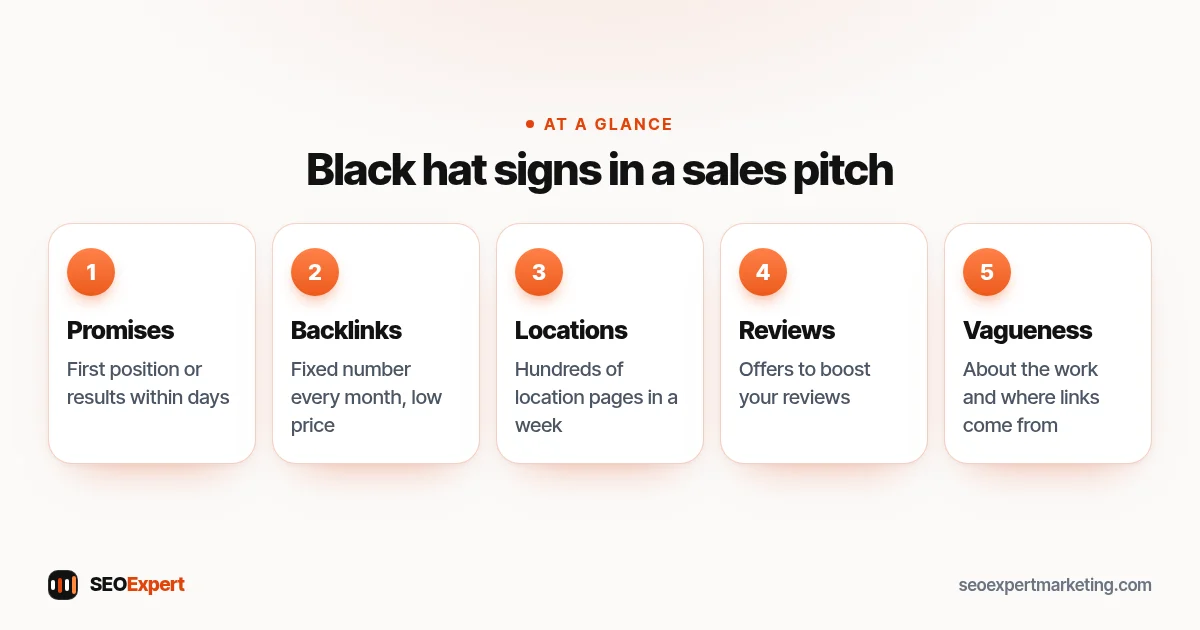
How to spot black hat SEO in a sales pitch
- Promises of first position or results within days.
- A fixed number of "high authority backlinks" every month for a low price.
- Hundreds of location pages generated for you in a week.
- Offers to "boost" your reviews.
- Vague answers when you ask exactly what they'll do and where links come from.
- Reports full of "domain authority" scores but no list of work done.
Our article on small business SEO mistakes covers more of these traps.
Worried a competitor could do the opposite to you? Our guide to negative SEO explains the real risks.
Five signs a sales pitch is selling black hat SEO:
Why we only do white hat SEO
We're a small agency, and our own site is built the same way we work for clients: real pages, real sources and no shortcuts. White hat SEO is slower at the start, but the work keeps paying off, it doesn't need undoing when Google updates its systems, and it never puts your business at risk. If you'd like to know whether anything on your site could be holding you back, ask for a free website review on WhatsApp.
White hat SEO: quick answers
Is white hat SEO slower than black hat SEO?
At the start, often yes, because earning links and building helpful pages takes time. But black hat gains are frequently short-lived and can be wiped out by Google's automated systems or a manual action, so over a year or more white hat SEO is usually the faster route to lasting results.
Can Google penalize my site for an agency's black hat SEO?
Yes. Google judges the site, not who did the work. If an agency built spammy links or doorway pages for you, your site carries the consequences, which is why it's worth asking exactly what any provider will do.
Are guest posts white hat?
A genuinely useful article written for a relevant site's readers is fine. Guest posts written mainly to place keyword-rich links, especially when paid for, are listed as link spam in Google's policies.
How do I recover from black hat SEO?
Remove or fix the spammy content and links, check the Manual actions report in Search Console, and if there's a manual action, fix the issue and request a review. Then rebuild with white hat SEO. Recovery can take months.