The Google Penguin update was a change to Google's ranking systems designed to fight link spam: links bought, swapped or built by software to push pages up the results. It launched in 2012, hit many sites hard and changed how the whole industry thought about links. Today Google Penguin is no longer a separate update, but its lessons still decide which link building is safe and which is risky. This guide explains what Penguin was, how it changed, what "Penguin SEO" means now and what a small business should actually do.
What was the Google Penguin update?
Google announced the change on April 24, 2012, in a post called "Another step to reward high-quality sites". The post said the update targeted webspam, from keyword stuffing to link schemes meant to push sites higher than they deserved. Google said it affected about 3.1% of English queries to a degree that a regular user might notice, and more in languages with heavier spam.
The name "Penguin" came later, but it stuck. Google's own guide to its ranking systems now describes the Penguin system simply as one that was designed to combat link spam, announced in 2012 and made part of Google's core ranking systems in 2016.
What Google Penguin targeted
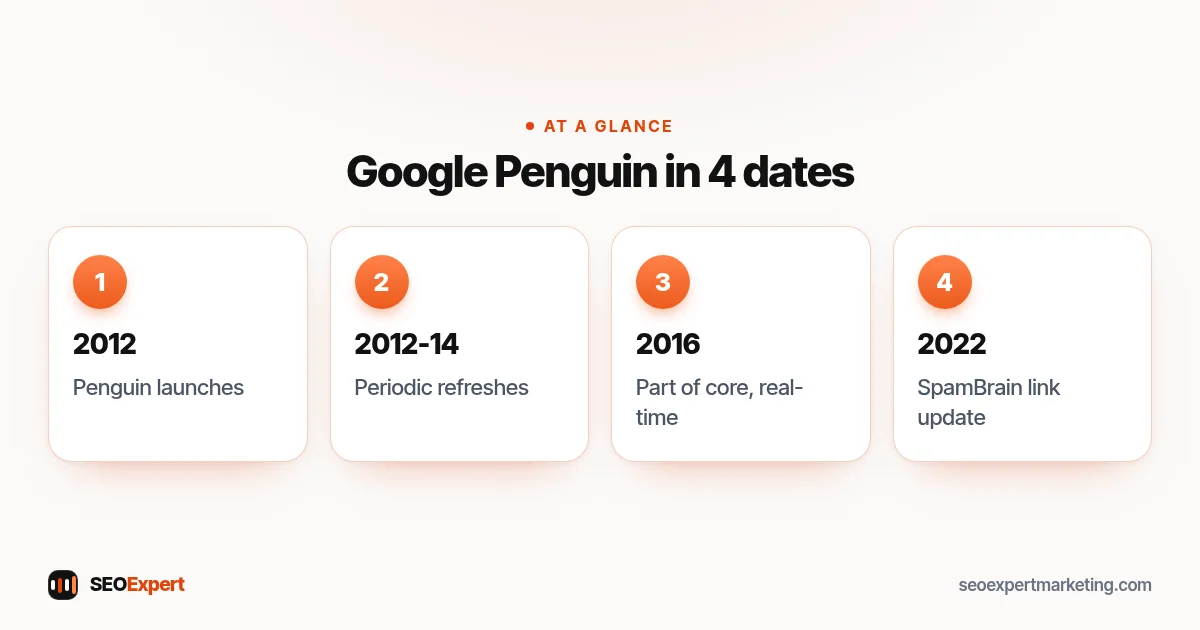
Before 2012, many sites ranked by collecting large numbers of low-quality links. Google Penguin was built to stop that from working. The main targets were:
- Paid links that passed ranking credit, bought from link sellers or blog networks.
- Link networks: groups of sites built only to link to each other or to clients.
- Exact-match anchor text repeated again and again, such as hundreds of links all saying "cheap plumber London".
- Automated links from software that posted to forums, comments and profiles at scale.
- Low-quality directories and article sites that existed only to host links.
- Keyword stuffing and other tricks on the page itself.
If you're new to how links work, our guide to what a backlink is explains the basics first.
A short history of the Penguin updates
| When | What changed |
|---|---|
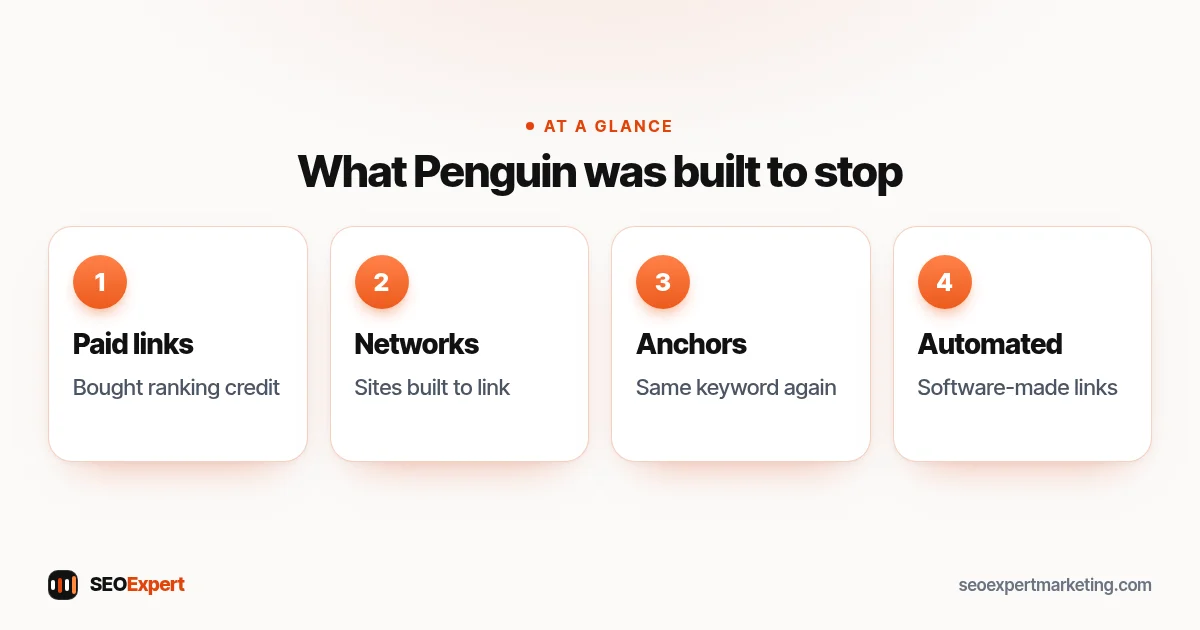
| April 2012 | First Google Penguin launch: about 3.1% of English queries noticeably affected |
| 2012 to 2014 | Several data refreshes and updates. Sites hit had to wait for the next refresh to recover |
| September 2016 | Penguin becomes part of the core algorithm: real-time and more granular |
| December 2022 | Link spam update: Google uses its AI system SpamBrain to neutralize unnatural links |
The big problem with the early versions was timing. Penguin's data only changed when Google refreshed it, so a site that cleaned up its links could wait many months before seeing any recovery.
Penguin 4.0: real-time and more granular
On September 23, 2016, Google announced that Penguin is now part of our core algorithm. Two things changed:
- Real-time. Penguin's data was now refreshed in real time, so changes typically took effect shortly after Google recrawled and reindexed a page. Google also said it would not comment on future refreshes.
- More granular. Penguin now devalued spam by adjusting rankings based on spam signals, rather than affecting the ranking of the whole site.
In plain words: since 2016, Google mostly ignores spammy links rather than punishing the whole site for them. That made life much safer for honest businesses that had picked up a few junk links they never asked for.
Many sellers still promise to raise link scores fast. Our guide to what page authority is explains what those scores mean.
Is Google Penguin still active?
Not as a named update. There are no more "Penguin updates" to watch for. Its job is done inside Google's core ranking systems, and Google lists Penguin among its retired systems because it was folded into those core systems.
Link spam is still fought, though, and more strongly than before. On December 14, 2022, Google announced a link spam update using SpamBrain, its AI-based spam-prevention system. Google said SpamBrain could detect both sites buying links and sites used to pass outgoing links, and that the update would neutralize the impact of unnatural links. In other words, the Penguin idea lives on in newer systems.
What "Penguin SEO" means today
People search for "penguin SEO" or "SEO penguin" when they want to know whether their link building is safe. The answer comes down to a few simple rules:
- Earn links, don't buy them. Paid placements should carry a sponsored or nofollow tag. Our page on white hat SEO explains the safe way to handle sponsorships.
- Relevance beats volume. A few links from real, related local or industry sites are worth more than hundreds from random ones.
- Let anchor text be natural. Most people link with your business name, your web address or plain words. A profile full of exact keyword anchors looks built, not earned.
- Avoid shortcuts. Link networks, automated tools, "1,000 links for $20" offers and private blog networks are exactly what Penguin was built to defeat.
- Build pages worth linking to. Helpful guides, price pages, local resources and real expertise attract links on their own.
How to tell if old link spam is holding you back
Because modern systems mostly ignore bad links, true "Penguin penalties" are rare now. Still, if your site has a history of bought links or an old SEO company built links in bulk, a quick check is sensible:
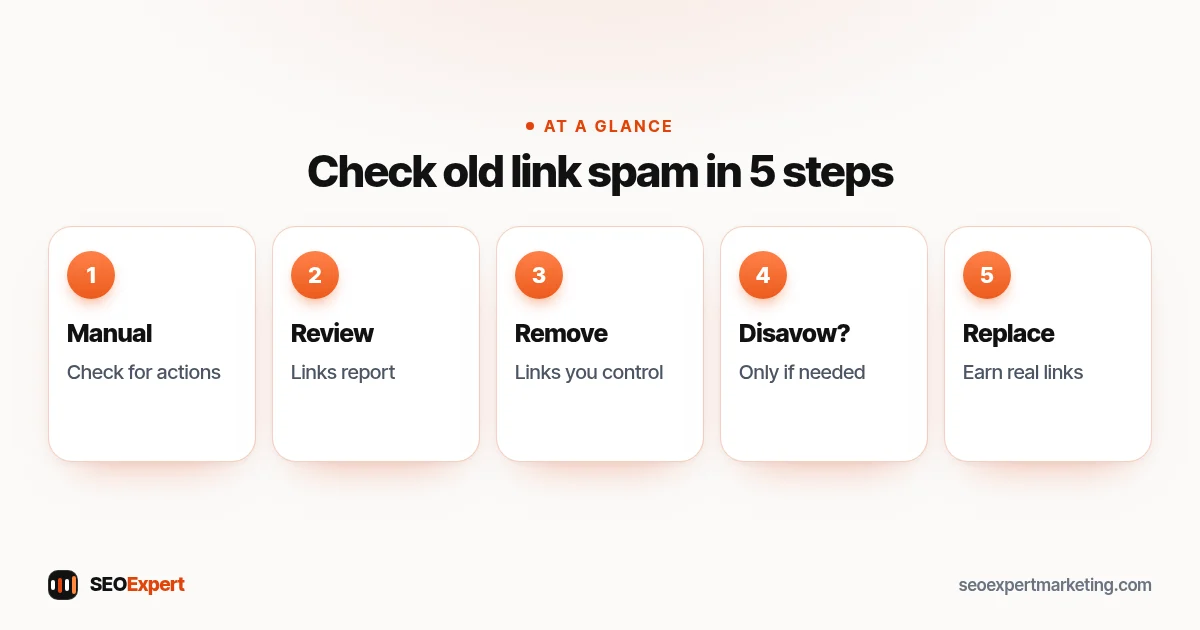
- Look for a manual action. In Search Console, open Security and Manual actions. A message about unnatural links is a human review, not an algorithm, and needs a clean-up and a reconsideration request.
- Review your links. Open the Links report and look at top linking sites and link text. Lots of unrelated sites or the same keyword anchor over and over is a warning sign.
- Remove what you control. Paid links, swaps and listings your old agency created can often be removed by asking the site owner.
- Disavow only if needed. Google says most sites never need its disavow tool. It's for a large number of artificial links tied to a manual action, or one that is likely.
- Replace with real links. Clean-up alone doesn't build trust. Earn new links from genuine local and industry sources.
If a sudden drop worries you, our guide to negative SEO explains how to check whether spammy links are really the cause.
How Google Penguin changed link building
Before Google Penguin, link building was often a numbers game. Agencies sold packages of hundreds of directory submissions, article placements and blog comments, and many of them worked for a while. After the 2012 launch, sites that had relied on those packages saw rankings fall, and the industry had to change direction.
The methods that survived are the ones that look like normal business activity: being featured by local news, being listed by suppliers and trade bodies, writing guest articles that real readers value, sponsoring community events and publishing resources that others want to cite. Google Penguin didn't end link building; it ended link building that only existed for search engines. That shift is still the best test today: would this link make sense if Google didn't exist?
Google Penguin and local businesses
Local businesses were hit hard by the first Google Penguin update because many had bought cheap link packages with their town name and service in every anchor, such as "plumber Manchester" repeated hundreds of times. The safe local alternative is simple and usually cheaper: accurate business listings, a strong Google Business Profile, links from local organisations you're genuinely part of and pages that answer local questions well. Our guide to SEO ranking factors shows how links fit with relevance, distance and prominence for local results.
Common Google Penguin myths
- "Any bad link will get my site penalized." Since 2016 Google mostly devalues spammy links instead of punishing the whole site.
- "I must disavow every low-quality link." Google says most sites never need the disavow tool.
- "Google Penguin updates still roll out on set dates." Penguin works inside the core systems now; there are no separate Penguin dates to track.
- "Nofollow links are worthless." They don't pass ranking credit in the usual way, but they can still bring visitors and attention.
- "Links don't matter any more." They still matter. Only the manipulative kind stopped working.
Penguin vs Panda: what's the difference?
The two are often mentioned together because both had animal names and both arrived in the early 2010s. Panda, announced in 2011, focused on content quality: thin, copied or low-value pages. Penguin, announced in 2012, focused on link spam and manipulation. Both became part of Google's core ranking systems, Panda in 2015 and Penguin in 2016. For a business owner the practical message is the same: helpful content plus honest links.
Worked example: a roofing company's old links
A roofing company hired a cheap SEO service years ago. Its Links report shows dozens of links from foreign-language blogs and article sites, nearly all with the anchor "roof repair company". There is no manual action in Search Console.
The sensible plan: don't panic and don't disavow everything. Since 2016, Google mostly ignores links like these. Ask the old provider for a list of links they bought and remove any that can be removed. Then put the time into links that help: the local roofing association, supplier "find an installer" pages, a community sponsorship and a useful guide to roof repair costs in the area. Review the Links report again in three months.
Lessons small businesses can take from Penguin
- There is no safe shortcut to links. What worked cheaply before 2012 became a liability overnight.
- Google prefers to ignore manipulation rather than reward it, so money spent on spammy links is usually wasted.
- Your local citations, partners and community activity are a natural, safe source of links.
- Strong internal linking helps every link you earn work harder across your site.
- Be wary of anyone who promises a set number of links per month at a low price.
Questions to ask any link building provider
- Where will the links come from? Ask for example sites. They should be real, relevant and have their own readers.
- Do you pay for links? If the answer is yes, and the links aren't tagged as sponsored, walk away.
- What anchor text will you use? Mostly brand names and natural phrases is the right answer.
- Will I get a list of every link? You should always be able to see and check the work.
- What happens if a link disappears? A good provider explains how lost links are handled.
Want links built the safe way?
Our link building services earn links from real, relevant websites, with no paid links, networks or automated tools. To start, ask for a free website analysis and we'll review your current links and suggest safe next steps.
Google Penguin: quick answers
What is the Google Penguin update?
Google Penguin was a change to Google's ranking systems, launched in April 2012, designed to combat link spam such as bought links, link networks and over-optimized anchor text.
Is Google Penguin still active?
Not as a separate update. Since September 2016 Penguin has been part of Google's core ranking systems, working in real time, and newer systems such as SpamBrain now fight link spam too.
What does penguin SEO mean?
It usually means link building and SEO that stay safe under Google's link spam rules: earned, relevant links with natural anchor text and no paid or automated links.
Can Penguin still penalize my whole site?
Since 2016 Google says Penguin devalues spam by adjusting rankings based on spam signals, rather than affecting the whole site. A manual action for unnatural links is a separate thing, shown in Search Console.
What is the difference between Penguin and Panda?
Panda (2011) focused on low-quality content. Penguin (2012) focused on link spam. Both are now part of Google's core ranking systems.
Do I need to disavow links because of Penguin?
Usually not. Google says most sites never need the disavow tool; it's meant for many artificial links linked to a manual action, or one that is likely.
