SEO ranking factors are the signals Google uses to decide which pages to show, and in what order, for a search. You'll find lists online claiming hundreds of them, many based on guesswork. This guide sticks to what Google itself publishes: its explanation of how Search ranks results and its guide to ranking systems. We group the SEO ranking factors into eight areas, explain what each means for a small business and list the myths worth ignoring.
What Google says about ranking
Google says its algorithms look at many factors and signals, including the words of your query, the relevance and usability of pages, the expertise of sources, and your location and settings. Its ranking systems guide names specific systems, such as link analysis and PageRank, freshness systems, the reviews system, spam detection systems and RankBrain. No one outside Google knows the exact weights, and they vary by search. What we do know is enough to decide where to spend your time.
The 8 areas of SEO ranking factors
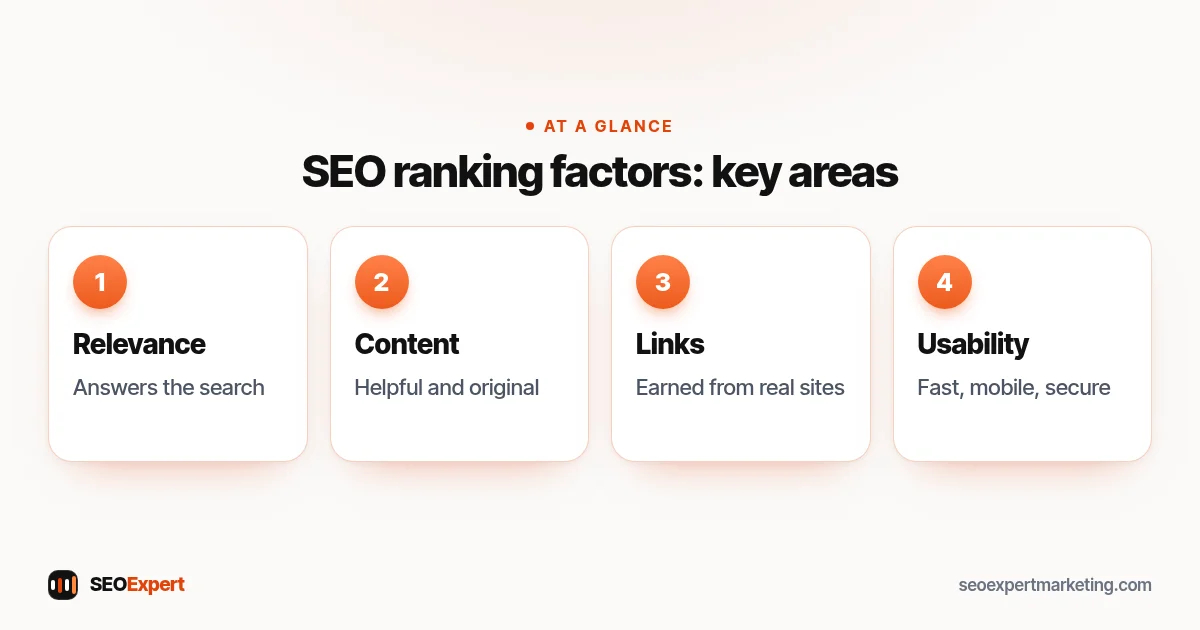
1. Relevance to the search
The most basic of all SEO ranking factors: does your page match what the person is looking for? Google looks at the words on the page, headings and titles, but its systems also understand meaning and synonyms. Practical step: give each service or topic its own page that clearly answers the search, in the words customers use.
2. Helpful, reliable content
Google's guidance on creating helpful, reliable content asks whether content is original, written with real expertise and first-hand experience, and leaves visitors satisfied. Pages written mainly to rank, rather than to help people, tend to do poorly. Practical step: write from your own experience, with real prices, examples and specifics.
3. Links from other sites
Link analysis and PageRank are still among Google's ranking systems. Links from relevant, trusted sites signal that others find your content worth referencing. Bought or manipulative links break Google's spam policies. Practical step: earn links from partners, associations, local press and genuinely useful content.
4. Usability and page experience
Google says its systems consider the usability of pages. Fast loading, a good mobile experience, security (HTTPS) and no intrusive pop-ups all contribute. Practical step: check Core Web Vitals in Search Console and test your site on a phone.
5. Freshness, where it matters
For some searches, such as news or "best ... 2026", newer content is more useful, and Google's freshness systems reflect that. For many evergreen topics, it matters less. Practical step: keep time-sensitive pages, like prices, up to date; don't change dates without changing content.
6. Location and context
For many searches, especially local ones, where the searcher is matters a lot. Google says local results are based mainly on relevance, distance and popularity. Practical step: complete your Google Business Profile and make your service areas clear on your site.
7. Technical access
Not a ranking factor in the usual sense, but a precondition: if Google can't crawl and index a page, it can't rank. Practical step: check the page indexing report in Search Console and fix blocked or excluded pages.
8. Spam signals
Google's spam detection systems demote or remove pages that break its spam policies, such as keyword stuffing, cloaking, link schemes and scaled low-value content. Practical step: avoid any tactic designed mainly to manipulate rankings. Our guide to white hat SEO explains the line.
SEO ranking factors for local businesses
Local results in Google Maps follow their own mix. Relevance comes from your categories, services and website; distance from where the searcher is; popularity from reviews, links and mentions around the web. Our guide to local SEO tactics turns this into a step-by-step plan.
Ranking always starts with the words someone types. Our guide to what a search query is explains how Google reads them.
Links still count, but only honest ones. Our guide to the Google Penguin update explains how Google treats link spam.
SEO ranking factor myths
| Myth | Reality |
|---|---|
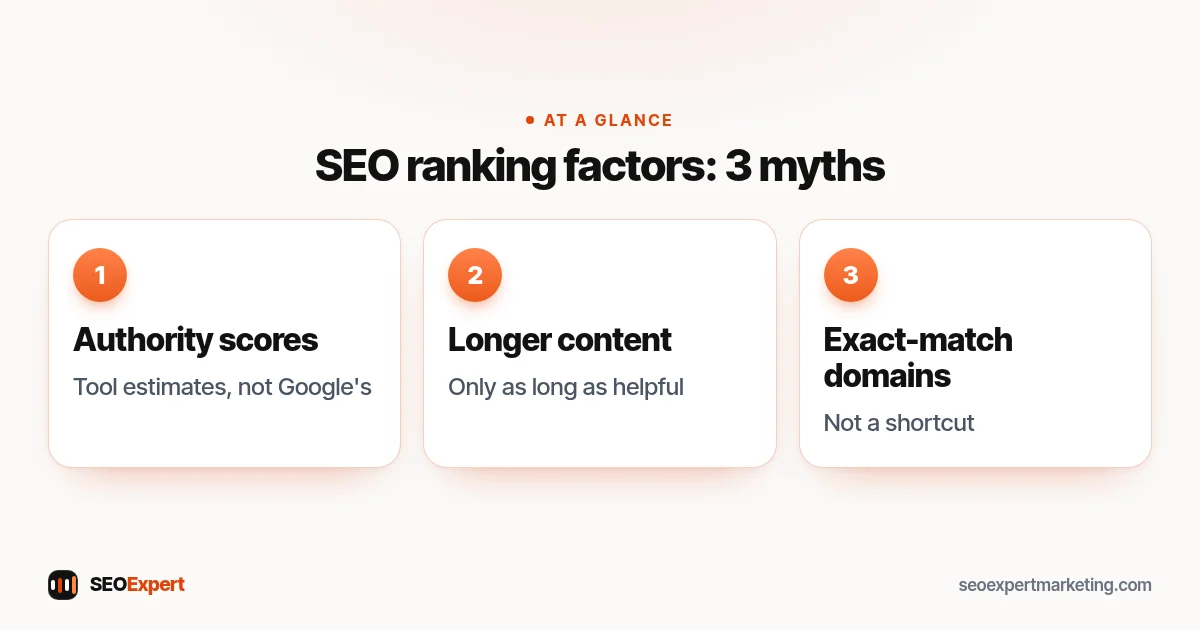
| Third-party "authority" scores are used by Google | They're estimates made by tool companies, not Google metrics |
| Longer content always ranks higher | Content should be as long as it needs to be helpful, no longer |
| An exact-match domain is a shortcut to rankings | Google has an exact match domain system to stop low-quality sites benefiting from their domain name |
| Posting every day boosts rankings | Frequency matters less than usefulness |
| Keyword density must hit a set percentage | Write naturally; stuffing is spam |
Three myths about SEO ranking factors:
How ranking factors change over time
Google updates its ranking systems many times a year, including several larger core updates. Some systems have been retired or folded into others; for example, Google's guide lists the helpful content system, Panda and Penguin among retired systems whose work is now handled by core ranking systems. What hasn't changed is the direction: Google keeps trying to reward relevant, helpful, trustworthy pages and to reduce spam. That's why chasing individual SEO ranking factors is less useful than building a genuinely good site. Businesses that focus on helping customers tend to gain from updates over time, while those relying on tricks tend to lose.
How to see which factors affect you
Search Console is the best free tool for seeing which SEO ranking factors affect your own site. The Performance report shows which searches you appear for and where; the page indexing report shows technical access; the Core Web Vitals report shows usability; and the Links report shows which sites link to you. Look at pages that get impressions but rank on page 2 or 3: they're relevant enough to appear, so improving content, internal links or speed on those pages often brings the quickest gains.
Where small businesses should focus
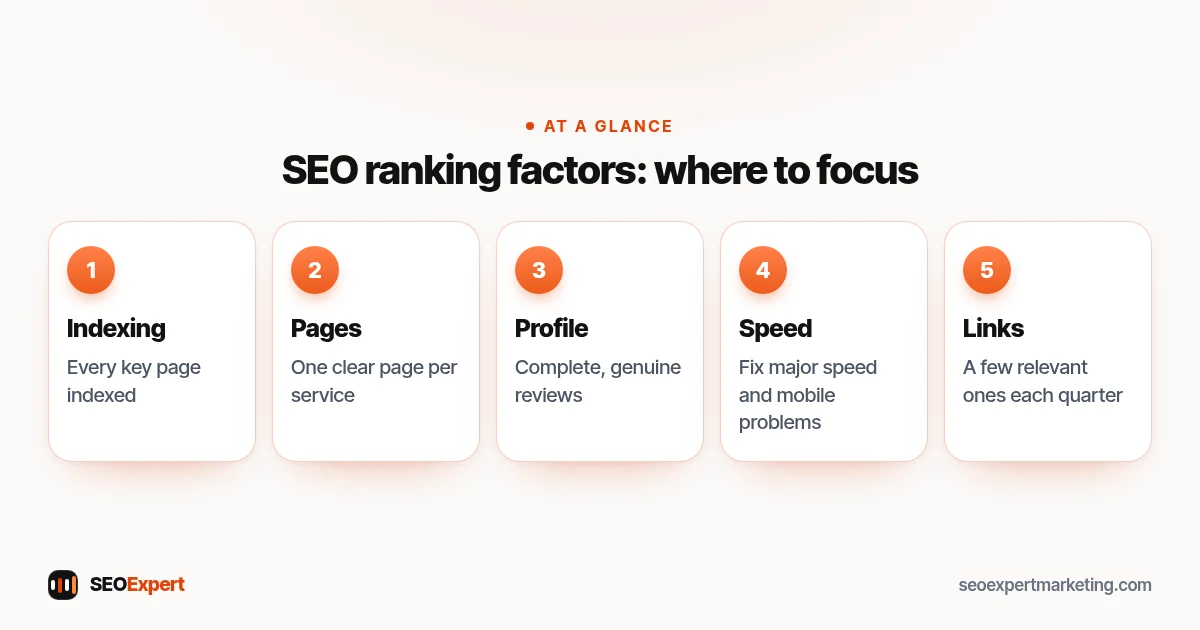
You can't work on every SEO ranking factor at once, so start where the gains are biggest for a small site:
- Make sure every important page is indexed.
- Give each service its own clear, helpful page.
- Complete your Google Business Profile and gather genuine reviews.
- Fix major speed and mobile problems.
- Earn a few relevant links each quarter.
Our technical SEO audit checklist covers step one and four in detail, and our article on how long SEO takes explains what to expect once the work is done.
Where small businesses should focus among the SEO ranking factors:
Example: which factors to fix first
Here's an illustrative example, not a client result. An electrician's site has one "Services" page, a slow homepage slider, eight reviews and no links beyond a few directories. Looking at the SEO ranking factors in order, relevance comes first: separate pages for rewiring, EV charger installation and fault finding. Next, usability: replacing the slider fixes the slow mobile load. Then popularity: a review request after each job and a listing with the local trade association. None of this is secret; it's simply the factors Google describes, applied in a sensible order.
Want to know which SEO ranking factors are holding your site back? Our technical SEO services start with a review, and you can ask for a free one on WhatsApp.
SEO ranking factors: quick answers
How many ranking factors does Google use?
Google says it looks at many factors and signals but doesn't publish a full list or weights. Lists claiming an exact number are guesswork.
What is the most important SEO ranking factor?
Relevance: whether your page genuinely answers the search. After that, content quality, links and usability matter, with location for local searches.
Is page speed a ranking factor?
Page experience, including speed, is part of what Google considers. It rarely outweighs relevance and quality, but a slow site also loses visitors who do find it.
Are social media likes a ranking factor?
Google doesn't list social signals among its ranking systems. Social media can still bring visitors and help people discover content worth linking to.