
To outsource link building means paying an agency, freelancer or specialist to earn links to your website from other sites. Done well, it saves you hours of research and outreach and brings links from sites your customers read. Done badly, it buys you spam links that Google ignores or acts against. This guide explains what a link building campaign includes, how to outsource it safely, what to ask a provider and the red flags to walk away from.
What does it mean to outsource link building?
Link building is the work of getting other websites to link to yours. Outsourcing it usually means one of these:
- A link building agency: a company that only does link work, usually through outreach or digital PR.
- An SEO agency: link work as one part of a wider plan with technical fixes and content.
- A freelancer: one person doing outreach for you, often cheaper but with less capacity.
- White label providers: companies that do the work behind the scenes for other agencies, which resell it under their own name.
- Help with a do-it-yourself plan: you keep the relationships and hire someone for research or outreach admin.
Whoever you choose, your site is the one affected by the links they build, so it pays to understand how they'll be earned.
What is a link building campaign?
A link building campaign is a planned piece of work, over weeks or months, to earn links to specific pages for a specific goal. A typical campaign has six parts:
- Goal and target pages: for example, links to a new guide or to your main service page.
- Something worth linking to: a useful guide, a local resource, original photos or simple data from your own work.
- A prospect list: relevant sites that might link, such as resource pages, local organizations, suppliers and industry blogs.
- Outreach: short, personal emails explaining why the page helps their readers.
- Follow-up: one polite reminder, then moving on.
- Tracking: a list of every live link, with the date and the page it points to.
Common campaign types include resource page link building, broken link building (suggesting your page to replace a dead link), digital PR built around a story or data, and asking for links from suppliers, partners and associations you already work with.

Should you outsource link building?
| Question | Outsource | Do it yourself |
|---|---|---|
| Time | Saves your hours | Takes a few hours a week |
| Skill | Experienced outreach and prospect research | You learn as you go |
| Relationships | Built by the provider | Built by you, and they last |
| Cost | Fees for the provider's time | Mostly your time |
| Risk | Depends on the provider's methods | You control every link |
Many small businesses do both: they ask suppliers, partners and local organizations themselves, since those relationships are theirs, and outsource the slower prospect research and outreach. Our guide on how to get backlinks lists the links you can usually earn on your own.
What Google says about paid links
Google's spam policies define link spam as creating links primarily to manipulate search rankings. Their examples include buying or selling links for ranking purposes, which covers exchanging money, goods or services for links; excessive link exchanges; using automated programs or services to create links; and links with optimized anchor text in articles, guest posts or press releases distributed on other sites.
Google also says buying and selling links is a normal part of the economy of the web for advertising and sponsorship purposes, and it's not a violation of its policies as long as those links are marked with rel="nofollow" or rel="sponsored". Its guide to qualifying outbound links explains the sponsored value.
In practice: paying a provider for their time to research and pitch isn't the same as buying a link. If money, a product or a service goes to the linking site in exchange for the link, that link is a paid link and should be marked as sponsored. A provider who sells links that pass ranking credit is selling a risk to you.
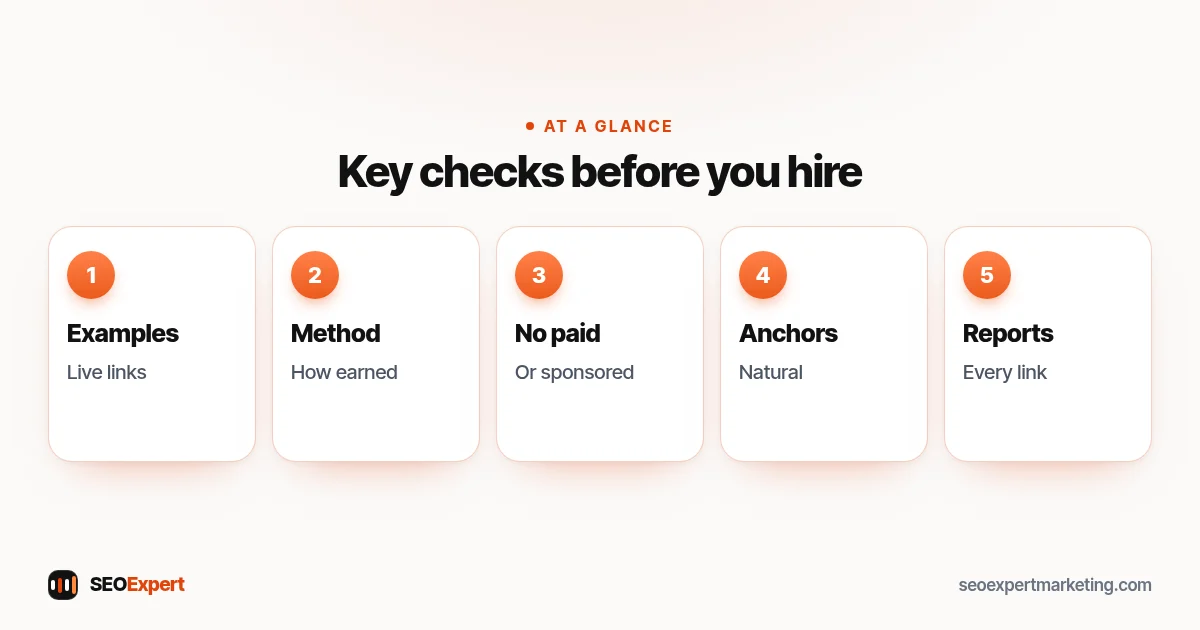
How to outsource link building safely: 7 checks
- Ask for real examples. Request live links they've earned recently and look at the sites: real businesses or publications, relevant to the topic, with content people would read.
- Ask how links are earned. A good provider explains its method and can show a sample outreach email.
- Ask whether anyone is paid for links. "Editorial fees", "admin fees" or "placement fees" paid to the linking site mean paid links. Ask for it in writing that any payment to a linking site is shown to you first and the link is marked sponsored.
- Be wary of fixed menus. Ready-made lists of placements on sites sorted by a third-party score often point to link networks that sell to anyone.
- Agree on anchor text. Most links should use your brand name, the page title or plain words. With earned links the linking site usually picks the words, so a provider who promises exact keyword anchors is probably writing or paying for the placement.
- Agree on reporting. You should get every live link, the page it points to, the date and whether it's marked nofollow or sponsored.
- Keep ownership. Any guide, data or image created for the campaign belongs to you, and outreach should never claim a relationship that doesn't exist.
Which pages to build links to
Not every page attracts links. Other sites link to pages that help their readers: detailed guides, local resources, checklists, tools and original data. Service and product pages earn links mainly from partners, suppliers, associations and listings. A common approach is to earn links to your most useful guides, then link from those guides to the matching service pages, so visitors and search engines can follow the path. Our guide to internal linking shows how to connect them.
Before any outreach starts, make sure the target page deserves the attention: accurate, up to date, fast on a phone and clearly better than what already exists on the topic. Outreach for a weak page wastes everyone's time.
What a good outreach email looks like
Good outreach is short, personal and about the other site's readers. For example: "Hi Sam, I read your list of brewing resources for new tea drinkers. We've just published a guide to brewing temperatures with a chart from our own tastings, which might be useful to your readers. Here's the link if you'd like to take a look. Thanks, Priya."
Before you outsource, ask to see a sample email like this. Be wary of templates that flatter, push hard, offer money for a link or pretend to be a reader. If outreach goes out in your business's name, you should approve the wording first.
Questions to ask a link building agency
- Which of my pages would you build links to first, and why?
- What will you create or use to earn the links?
- Who sends the outreach, from which email address, and in whose name?
- Do you pay any site to publish a link? If so, is it marked sponsored?
- How many links do you expect, over what time, and what happens if fewer go live?
- What will the monthly report show?
- Can I stop at any time, and do the links stay if I do?
Our guide on how to choose an SEO company covers more questions for any SEO provider.
Red flags to walk away from
- Promises of a fixed number of links from high-authority sites within days.
- Links that disappear when you stop paying, which means they were rented, not earned.
- Links from sites that publish anything for a fee, on any topic.
- Private blog networks, link exchanges or "link wheels".
- Exact-match keyword anchors in every link.
- Refusal to share the live links or the outreach method.
If links like these already point to your site, our guide to Google Penguin explains how Google handles link spam today.
How much does it cost to outsource link building?
Prices vary widely with the provider, your industry and the type of links. Common models are a monthly retainer for ongoing outreach, a fixed price per campaign, or a price per live link. Per-link pricing is easy to compare but can push providers towards quantity over relevance, so ask how they choose sites. Whatever the model, compare written proposals that name the method, the target pages and the reporting.
Our own Link Building Outreach product costs $149 for 3 links earned through outreach from real, relevant websites, delivered within 2 to 4 weeks, with no paid links and any sponsored placement labelled. If fewer than 3 are live after 4 weeks, outreach continues at no extra cost.
Working with a provider month to month
Agree a simple routine at the start. You approve the target pages and the outreach wording; the provider logs every site contacted and every live link in a sheet you can see at any time. Once a month, check a few of the links yourself: is the page live, is the link still there, and is it on a site you'd be happy to be associated with? If a provider stops, links already earned usually stay, because the other sites' owners added them by choice, not as a rental; owners can still edit or remove pages, so keep checking.
How to measure a link building campaign
- Live links: how many went live, on which sites and pages.
- Relevance: whether those sites cover your topic or area.
- Referral visits: people clicking through, visible in your analytics.
- Search performance: impressions, clicks and positions for the target pages over the following months, in Google Search Console.
- Enquiries: calls, forms or sales from those pages.
Search Console's Links report shows your top linking sites and top linked pages, so you can check that new links have been found. It isn't a complete list of every link, and it doesn't show whether a link is nofollow. Links can take weeks to be found and longer to make a difference, so judge a campaign over months, not days.

Link building for local businesses
A local business rarely needs a big outreach campaign. The most useful links usually come from places you already have a relationship with: suppliers, trade associations, local business groups, events you sponsor (ask the organizer to mark that link rel="sponsored") and local news. Accurate listings on directories your customers use help too, but skip bulk directory packages, because Google's spam policies list low-quality directory links as link spam; see our guide to local SEO citations. If you hire help as a local business, ask the provider to focus on your area and industry rather than national sites with no connection to you.
A made-up example: an online tea shop
Imagine a small online tea shop that wants more visitors to its brewing guides. It hires a freelancer for three months of outreach. Together they choose one target page, a detailed guide to brewing temperatures for different teas, and add a simple chart made from the shop's own tastings. The freelancer finds food blogs, tea clubs and cooking resource pages that list brewing guides, and sends short personal emails. Every live link is logged in a shared sheet.
One blog asks for a fee to publish; the shop declines, because the link would be paid. After three months the shop has a handful of relevant links, more referral visits to the guide and a clear picture of which sites were worth contacting.
Want help earning links?
Our outreach goes to real, relevant sites. We use no paid links, label any sponsored placement and send you a list of every live link. Ask for a free website analysis to see which of your pages would benefit most, or see our link building services.
Outsourcing link building: quick answers
Is it safe to outsource link building?
Yes, if the provider earns links through outreach and doesn't pay sites for links that pass ranking credit. Ask for live examples, the method and full reporting before you start.
What is a link building campaign?
A planned piece of work to earn links to specific pages: a goal, something worth linking to, a list of relevant sites, outreach, follow-up and a log of every live link.
How do I outsource link building?
Choose a provider, agree the target pages, method, anchor text approach and reporting in writing, and check the live links they send each month.
Does Google allow paid links?
Paid links are allowed for advertising or sponsorship when they're marked with rel="sponsored" or rel="nofollow". Buying links that pass ranking credit is link spam under Google's spam policies.
How long does a link building campaign take?
Outreach usually runs for weeks or months. New links can take weeks to be found and longer to affect rankings, so judge results over months.
What should a monthly links report include?
Every live link, the site and page it's on, the page it points to, the date and whether it's marked nofollow or sponsored, plus changes in traffic to the target pages.
