Resource page link building means earning links from pages that exist to list helpful resources on a topic, such as a council's "local services" page, a charity's "useful links" page or a trade association's list of guides. If you have a genuinely useful page, asking to be added is one of the most natural ways to earn a relevant link. This guide explains resource page link building step by step: finding the right pages with Google's own search operators, creating something worth listing, writing a short request, and using broken link building, a close cousin, the honest way.
What is a resource page?
A resource page is a page that links out to helpful information for its readers. Examples:
- A local council or community group listing services for older residents.
- A university or college page of guides for students.
- A trade association's "useful resources" for its members.
- A charity's list of guides on money, health or housing.
- A school's links for parents about safety or study.
These pages want to be useful. If your guide genuinely helps their readers, adding it helps them too. That's what makes resource page link building different from asking random sites for links. Our guide to what a backlink is explains why relevance matters so much.
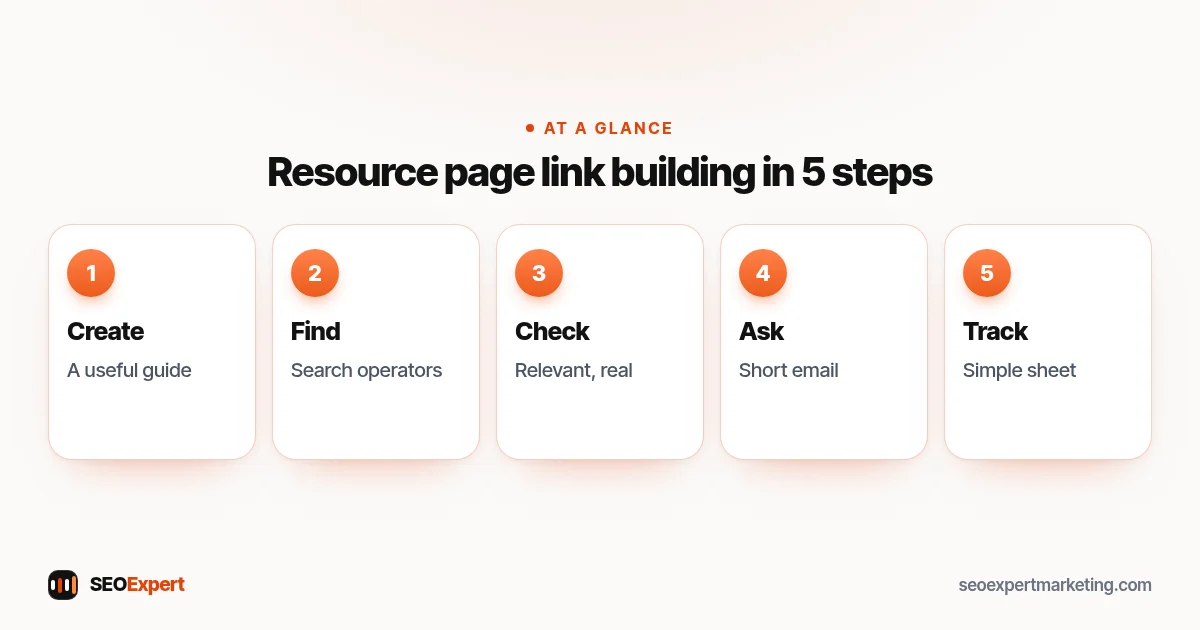
Step 1: Create something worth listing
Resource pages rarely link to sales pages. They link to useful guides, tools and checklists. Good candidates for a small business:
- A clear guide to a local process, such as how to get planning permission for an extension.
- A seasonal checklist, such as preparing a home for winter.
- A price guide explaining what affects the cost of a common job.
- A safety guide, such as what to do if you smell gas, written carefully and pointing to official advice.
- A glossary of terms in your trade.
Keep it free to read, without a form in the way, and make sure it's accurate and up to date. Our guide to SEO content strategy explains how to choose topics like these.
Step 2: Find relevant resource pages
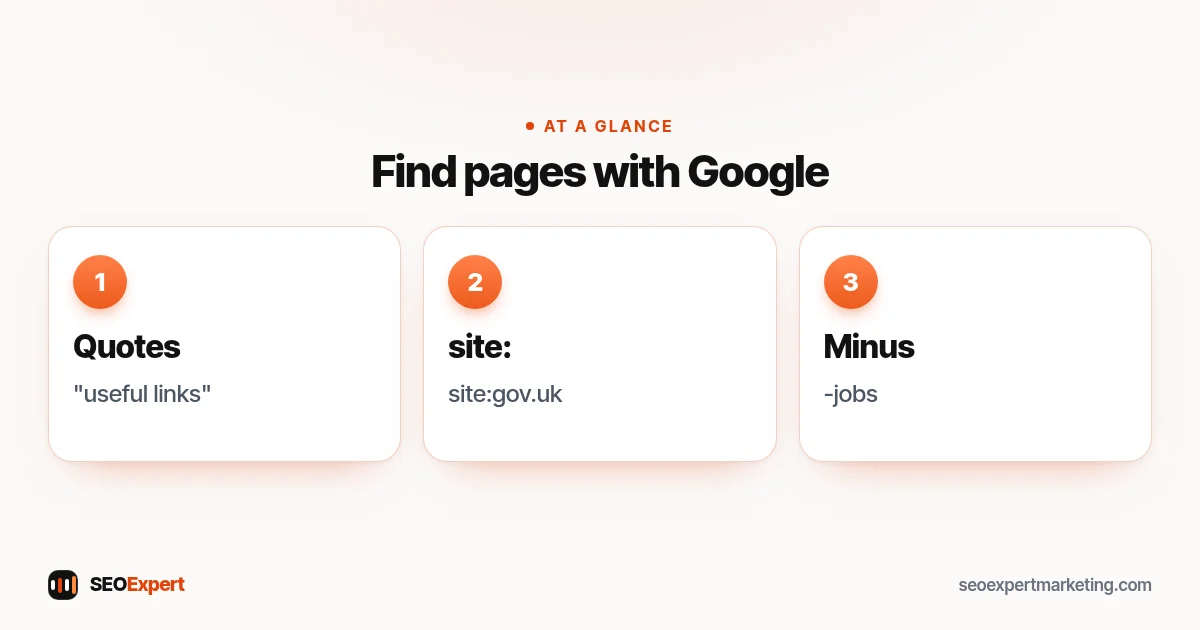
Google's help on refining web searches lists operators that make this much easier: quotes for an exact phrase, site: to search one site or domain, and a minus sign to leave words out. Combine them with your topic:
- "useful links" home maintenance
- "helpful resources" small business accounting
- "resources" first time buyers site:gov.uk
- "useful links" older residents [your town]
- "resources for parents" online safety -jobs
Look for pages that are clearly maintained, relevant to your guide and written for real readers. Skip pages that are long lists of unrelated links: these are often low-quality link directories, which Google's spam policies list as a source of link spam.
Step 3: Check each page before you ask
Careful checks are what keep resource page link building safe and worthwhile:
- Relevance: would their readers actually benefit from your guide?
- Quality: is it a real organisation with real visitors?
- Freshness: are the links on the page still working? One or two dead links is a chance to help (see Step 5), but a page full of them is probably no longer looked after.
- Contact: is there a person or team to contact?
- No swaps: if they'll only list you in return for a link back, a free product or a service, think twice. Google's spam policies also list exchanging goods or services for links, and excessive link exchanges, as link spam.
- No payment: if they ask for money to list you, it becomes a paid link. Google's spam policies list buying or selling links that pass ranking credit as link spam.
Step 4: Write a short, useful request
Keep it brief and about their readers, not your business:
Hi [name], I noticed your page of resources for first-time homeowners. We've written a free guide to preparing a home for winter, covering heating, gutters and frozen pipes, with links to official safety advice: [link]. It might be useful for your readers. Thanks for considering it. [Your name, business]
Send one email, and perhaps one polite follow-up a week or two later. Never pressure, demand a link, or offer money, products or services in return. Use the contact address the organisation publishes, say clearly who you are and include your business details, and if anyone asks you not to email again, stop and note it. Rules on unsolicited email differ by country, such as the UK's PECR and GDPR or the US CAN-SPAM Act, so check your regulator's guidance before you start.
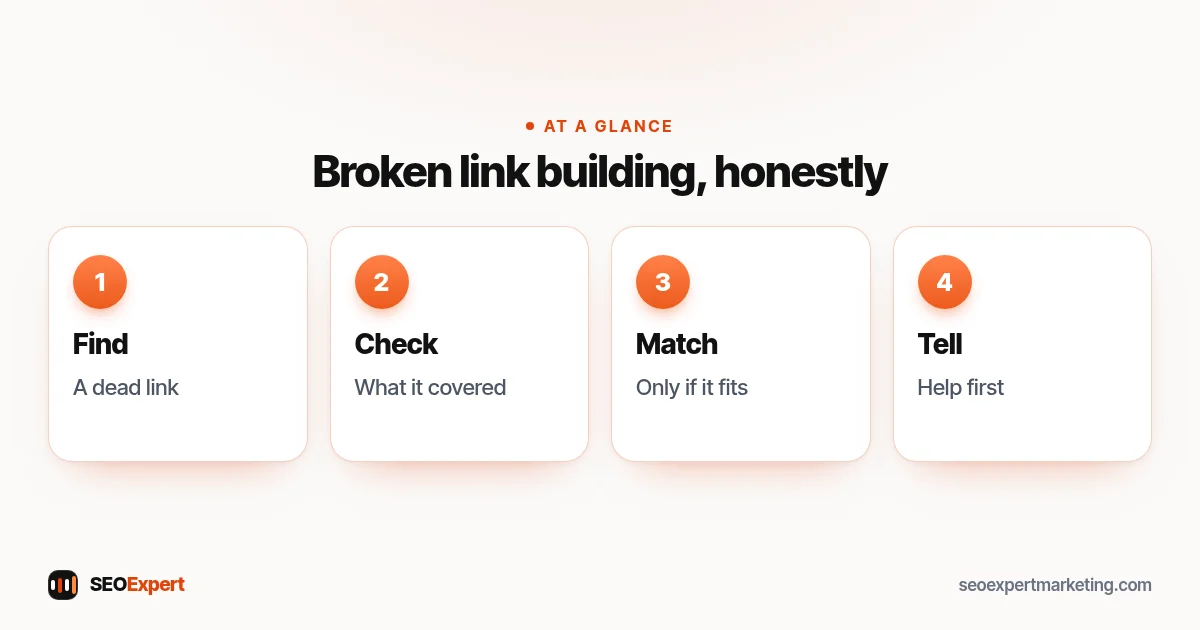
Step 5: Broken link building, the honest way
Broken link building is a related method: you find a link on a resource page that no longer works, and let the owner know, suggesting your page as a replacement if it genuinely covers the same topic. It helps the site owner fix their page, which is why it's often welcome.
- Check the outbound links on relevant resource pages for ones that no longer load.
- See what the dead page used to cover, for example using an internet archive.
- Only suggest your page if it truly fits that gap.
- Tell them about the broken link first, then mention your page as one option.
Our guide on how to get backlinks covers related methods, including fixing broken links to your own site.
Step 6: Track what you send
For resource page link building, a simple spreadsheet is enough: the page, the contact, the date, the guide you suggested and the outcome. Check accepted links occasionally to make sure they still work. Search Console's Links report shows a sample of the sites that link to you, straight from Google, though Google says it isn't a complete list; our Google Search Console guide shows where to find it.
Which guides tend to get listed
Resource page owners usually look for content that saves their readers time or helps them make a safe decision. Guides that explain a process step by step, checklists people can print, plain-English explanations of local rules, and honest cost guides are all good candidates. Pages that mainly promote a service, hide useful information behind a form or repeat what's already everywhere rarely get added. Before you start resource page link building, ask yourself whether you'd add your own guide to the page if you ran it.
Keeping your guide worth linking to
Once a guide is listed, its value depends on staying accurate. Add a "last reviewed" date, update it when prices, rules or seasons change, and keep the address the same so existing links keep working. If you ever have to move it, use a 301 redirect. An outdated guide can be quietly removed from a resource page, while a well-kept one can stay listed for years.
How resource page link building fits with other link building
It works best alongside the relationships you already have: suppliers, trade associations, local groups and partners. Those connections often lead to resource pages you'd never find by searching. Combine it with local press, sponsorships of real community events and expert comment. A sponsorship is paid, so ask for any link you get from it to be marked rel="sponsored", and avoid anything else that involves paying for links that pass ranking credit. Our guide to white hat SEO explains where the line is, and our guide to the Google Penguin update shows what happened to sites that crossed it.
What results to expect
Resource page link building is slow and selective. Many requests get no reply, and that's normal. A handful of relevant links from trusted local or industry organisations is a good result, and those links can also send real visitors. If someone offers you hundreds of resource page links quickly, they're almost certainly low-quality or paid.
Resource page link building for local businesses
Local resource pages are often the most valuable for a small business: council and community pages, local charities, school and parent groups, and local business associations. A plumber's winter guide, an accountant's guide to tax deadlines for sole traders or a dentist's guide to children's teeth can all fit. Make sure the guide is genuinely useful without a sales pitch, and link from it to your relevant service page.
Resource page link building ideas by business type
| Business | Guide idea | Resource pages to look for |
|---|---|---|
| Plumber or heating engineer | Preparing a home for winter | Council, housing association and community pages for residents |
| Accountant | Key tax dates for sole traders | Local business groups, enterprise centres, college business courses |
| Dentist | Looking after children's teeth | Schools, parent groups, children's charities |
| Garden landscaper | Planting for wildlife in small gardens | Wildlife groups, allotment societies, community gardens |
| Driving instructor | What to expect on a driving test day | Colleges, youth services, parent groups |
In each case, resource page link building works because the guide helps the page's readers first and mentions the business second.
How long resource page link building takes
Expect weeks, not days. Page owners are often volunteers or busy staff who update their pages a few times a year. Send your requests, note them, and check back after a month or two. Resource page link building is best treated as a steady background task rather than a campaign with a deadline.
A simple weekly routine
- Spend twenty minutes searching for new resource pages with the operators above.
- Check three or four pages properly and note the contact address or form each organisation publishes.
- Send two or three short, personalised requests.
- Follow up once on requests from a fortnight ago.
- Note any new links and check that older ones still work.
Done consistently, this kind of resource page link building builds a small set of relevant links month by month without any risky shortcuts.
Common mistakes
- Pitching a sales page instead of a useful guide.
- Sending the same template to hundreds of unrelated pages.
- Paying to be listed, which turns it into a paid link.
- Suggesting your page as a replacement for a broken link on a different topic.
- Letting your guide go out of date after it's been listed.
- Offering a link back in return, or asking for particular link wording. Let the owner describe your guide in words that suit their readers.
Want help earning links the honest way?
Our link building services include resource page link building with real, relevant organisations, built around guides worth linking to. To start, ask for a free website analysis.
Resource page link building: quick answers
What is resource page link building?
It's earning links from pages that list helpful resources on a topic, by creating a genuinely useful guide and asking the page owner to consider adding it.
How do I find resource pages?
Use Google's search operators: quotes for exact phrases like "useful links", site: to search certain sites, and a minus sign to exclude words, combined with your topic or town.
What is broken link building?
Finding a link on a relevant page that no longer works, telling the owner, and suggesting your page as a replacement only if it genuinely covers the same topic.
Is resource page link building safe?
Yes, if the links are earned. If a site asks for payment to list you, it's a paid link: Google's spam policies count paid links that pass ranking credit as link spam, and a paid link is only acceptable when it's marked rel="sponsored" or rel="nofollow".
How many links can I expect?
It's slow and selective. A few relevant links from trusted organisations is a good result.
What makes a guide worth listing?
It's free to read, accurate, up to date, genuinely useful to the page's readers and not a sales pitch.
