
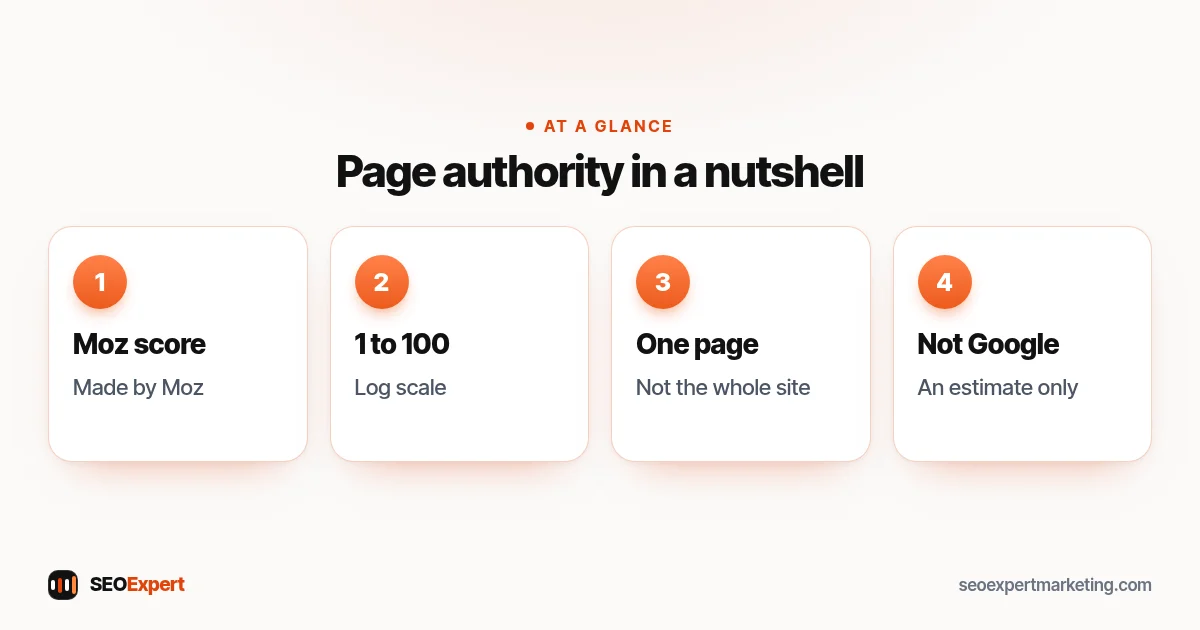
Page authority is a score from 1 to 100 that estimates how well a single web page is likely to rank in search results. It was created by Moz, an SEO software company, and it is not a number Google uses. Many SEO tools, sales pitches and reports mention page authority, so it's worth knowing what the score means, how it's worked out, what a "good" score looks like and why it shouldn't be your main goal. This guide explains it in plain English.
What is page authority?
According to Moz's own definition, Page Authority (PA) is a score developed by Moz that predicts how well a specific web page will rank on search engine result pages. Scores range from one to 100, and a higher score means a greater predicted ability to rank. Moz says it is based on data from its own web index and takes dozens of factors into account, including linking URLs and linking root domains.
The key word is predicts. It is a third-party estimate. It tries to imitate what search engines might value, mostly based on links, but it doesn't measure anything Google itself reports.
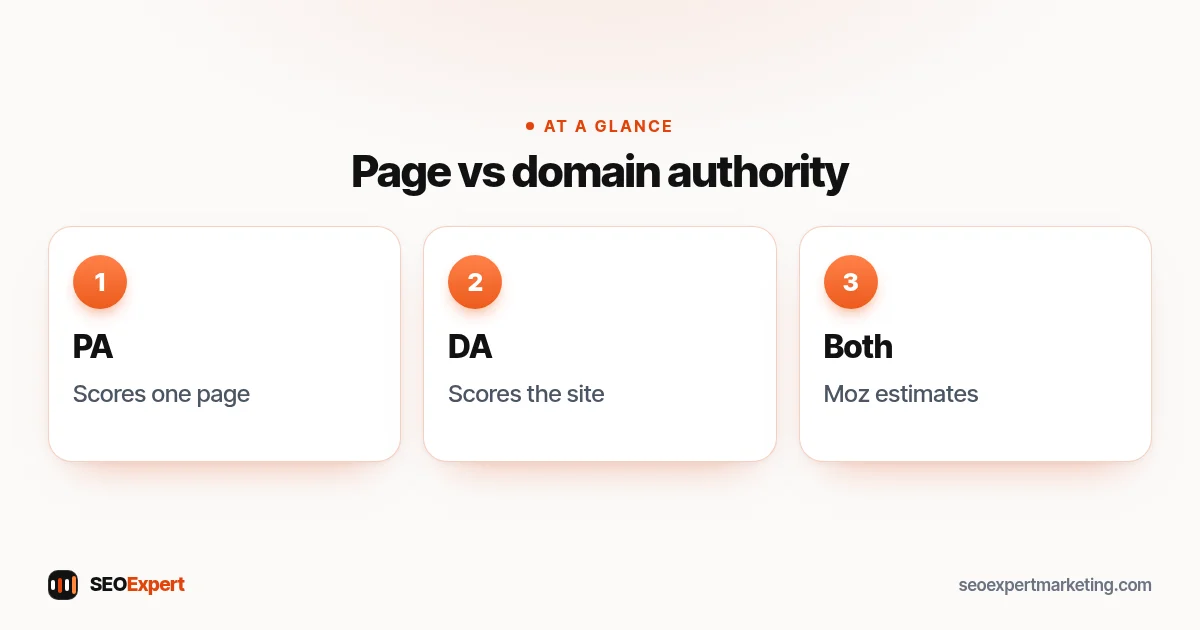
Page authority vs domain authority
| PA | DA | |
|---|---|---|
| What it scores | One single page | A whole website (domain) |
| Scale | 1 to 100 | 1 to 100 |
| Made by | Moz | Moz |
| Main inputs | Links to that page, among other factors | Links to the whole domain, among other factors |
| Used by Google? | No | No |
Moz's page on Domain Authority says plainly that, unlike Google's ranking algorithms, Domain Authority is not a direct ranking factor; it's a comparative metric. The same applies to PA. Other tools have similar scores under different names, such as URL Rating in Ahrefs and Authority Score in Semrush. They are all estimates, and they won't match each other.
How page authority is calculated
Moz says PA uses a machine learning model to find the combination of signals that best correlates with rankings across the many search results it tracks. In simple terms:
- Moz crawls the web and builds its own index of pages and links.
- It looks at many signals for each page, especially how many links point to it and from how many different websites.
- Its model compares those signals with real search results and produces a score that best matches which pages tend to rank.
- The model is updated over time, so a score can change even when nothing on your page has changed.
Moz also says the score is on a 100-point logarithmic scale. That means it is much easier to move a page from 20 to 30 than from 70 to 80. Small, new pages usually start low, and that's normal.
What is a good page authority score?
There is no universal "good" number. PA is a comparative score, so it only makes sense next to the pages you compete with for the same search. A local plumber's service page with a PA of 15 can rank first in its town if the competing pages score 10 to 20 and the page answers the search better. A national news site's pages may sit at 50 or more, and that tells you nothing about your local search results.
The useful question is not "Is my score high?" but "How do my pages compare with the pages that rank for my target searches, and what do those pages have that mine don't?" Our guide to SEO competitor analysis shows how to make that comparison.
Does Google use page authority?
No. It is Moz's metric. Google's own guide to its ranking systems describes the systems Google uses, such as its core ranking, spam detection and reviews systems, and third-party scores like PA or DA are not part of them. Google does look at links, along with relevance, content quality, usability and many other signals, which is why a page with many good links often has both a higher PA and better rankings. But the score itself doesn't cause rankings. Our guide to SEO ranking factors explains what Google actually describes.
Other link metrics you'll see in SEO tools
- Referring domains: the number of different websites linking to a page or site. Often more telling than the total number of links, since one site can link many times.
- Spam Score: a Moz estimate of how many features a site shares with sites Moz has seen penalized. A warning light, not proof.
- Trust Flow and Citation Flow: Majestic's scores for link quality and link quantity.
- URL Rating and Domain Rating: Ahrefs' link-strength scores for a page and a whole site.
- Authority Score: Semrush's combined score, which mixes link data with traffic estimates.
Every tool crawls a different slice of the web, so numbers for the same page will differ. Pick one tool, use it consistently and treat every score as a clue to look at the real links behind it.
How to check page authority
- Moz Link Explorer: enter a URL to see its PA and the links Moz has found. A free Moz account gives limited checks.
- MozBar: a browser extension that shows PA for pages and search results as you browse.
- Other tools: Ahrefs and Semrush show their own similar scores. Don't mix numbers from different tools.
Alongside any score, always look at the actual links. Google Search Console's Links report shows which sites link to your pages, straight from Google. Our guide to what a backlink is explains how to read it.
How to improve page authority (the right way)
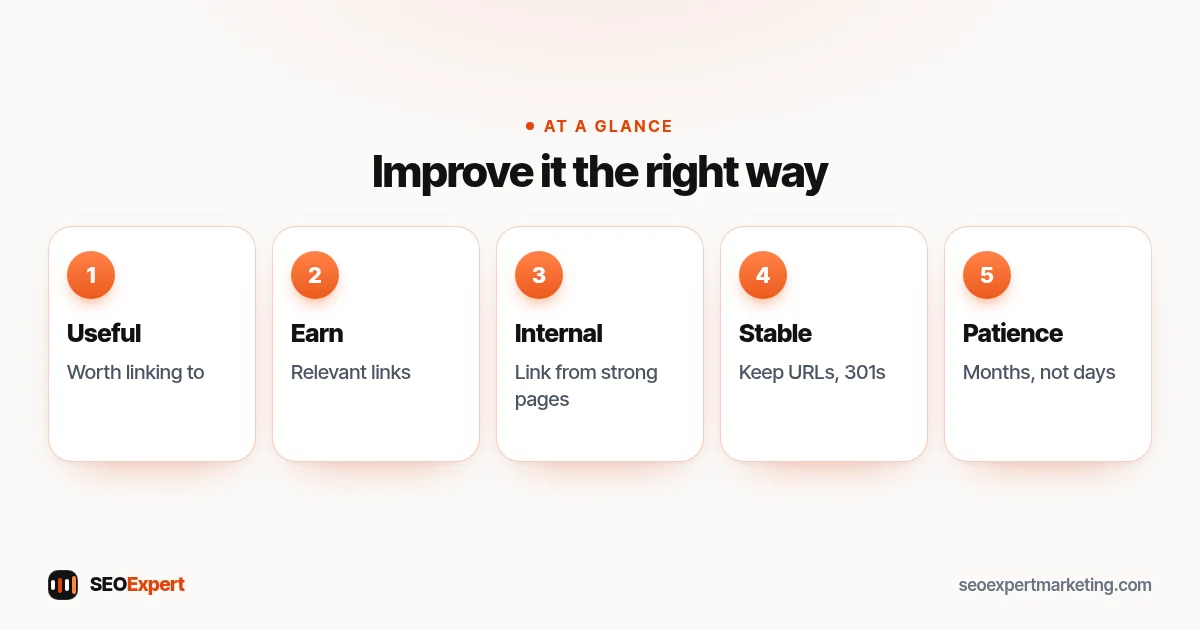
Because the score mostly reflects links, the ways to raise it are the same as the ways to build a page that deserves to rank. Done honestly, they help real rankings too:
- Make the page worth linking to. Clear prices, useful guides, local resources and original photos or data attract links naturally.
- Earn relevant links. Local news, trade associations, suppliers, partners and community groups. Our link building services focus on exactly these.
- Link to the page from your own site. Internal links from strong pages help both people and search engines find it. See internal linking for SEO.
- Keep URLs stable. If you must move a page, use a 301 redirect so links to the old address still count.
- Be patient. New links take time to be found by both Google and the tools.
What not to do to raise page authority
- Don't buy links. Buying links that pass ranking credit breaks Google's spam policies. Our guide to the Google Penguin update explains what happened to sites that did.
- Don't chase the number. Some sellers offer to "boost DA" or PA quickly with spammy links. The score may rise, but rankings and trust won't.
- Don't judge a link only by its score. A relevant local link from a site with a modest score can be worth far more than a high-scoring site with no connection to your business.
Is page authority still useful?
Yes, as a rough guide. PA is handy for:
- Comparing pages that compete for the same search, to see roughly how much link strength you're up against.
- Spotting your strongest pages, so you can link from them to pages that need help.
- Tracking long-term trends in the same tool, over months rather than days.
- Screening link ideas, together with relevance and real traffic.
It is not useful as a target in itself, as proof of SEO success or as a promise in a sales pitch. Real results are measured in Search Console clicks, impressions and positions, and above all in enquiries and sales.
Worked example: two competing pages
A dentist's "teeth whitening" page has a PA of 12. The page ranking first in the town has 21. Looking closer, the leading page has links from a local magazine and a wedding planning site, and it lists prices, aftercare advice and real before-and-after photos. The dentist's page has none of those. The plan isn't "raise PA by 9". It's to add prices and photos, link to the page from the home page and treatment list, and ask a local wedding blog that already mentions the practice to link to the page. If rankings improve, the score will probably follow, but that's a side effect, not the goal.
Page authority for local businesses
Local businesses often worry when an SEO tool shows low scores. For most local searches, that worry is misplaced. Google's local results lean heavily on relevance, distance and prominence, which includes your Google Business Profile, reviews and how well known you are locally. A small trades business can rank well in the map and in the normal results with modest link scores, as long as its pages clearly match the search and its business details are consistent across the web.
Where links do help a local business, the best ones are local and relevant: the town's chamber of commerce, a local news story, a supplier's installer list, a club you sponsor. These rarely come from high-scoring national sites, and they don't need to. Our guide to local SEO citations covers the listings side.
How to read page authority in an SEO report
If an agency or freelancer reports on these scores, ask three questions. Which tool is it from, and is it the same tool every month? Is the change big enough to matter, or within normal ups and downs after a model update? And what happened to the things that actually matter: clicks, enquiries and positions for your target searches? A report that leads with authority scores and says little about enquiries is focusing on the wrong thing. Our guide to SEO reports shows what a useful monthly report includes.
Page authority myths
- "Google ranks pages by PA." It doesn't. It's Moz's estimate.
- "A higher score always beats a lower one." Relevance and quality often win.
- "My score dropped, so I've been penalized." Scores change when Moz updates its model or its index.
- "You need a PA of 30 to rank." There's no fixed threshold; it depends on your competitors.
Want help building pages that deserve to rank?
We don't sell PA or DA boosts. We build pages that answer real searches and earn honest links. To start, ask for a free website analysis and we'll compare your key pages with the ones you compete against.
Page authority: quick answers
What is page authority?
Page authority (PA) is a score from 1 to 100, created by Moz, that predicts how well a single web page is likely to rank. It's a third-party estimate, not a Google metric.
What is a good page authority score?
There's no universal good score. It is comparative, so judge it against the pages that rank for the same search, not against big national sites.
Does Google use page authority?
No. It is Moz's metric. Google uses its own ranking systems, which look at links among many other signals, but not Moz's score.
What is the difference between page authority and domain authority?
PA scores one page; DA scores a whole website. Both are Moz scores from 1 to 100.
Why did my page authority change?
Moz updates its model and index over time, and links can be gained or lost, so scores can move even if you changed nothing.
How can I increase page authority?
Make the page worth linking to, earn relevant links, link to it from your own strong pages and keep its URL stable. Never buy links.
