
Financial services SEO is the work of getting a financial firm found on Google by the people who need it: savers, borrowers, business owners and families looking for advice, insurance, mortgages or accounting help. It follows the same basics as any SEO, but with two big differences. Google holds money topics to a higher standard of trust, and much financial marketing, often including your website, is regulated. This guide explains financial services SEO in eight practical steps for small and mid-sized firms, with the trust and compliance points built in from the start.
Why financial services SEO is different
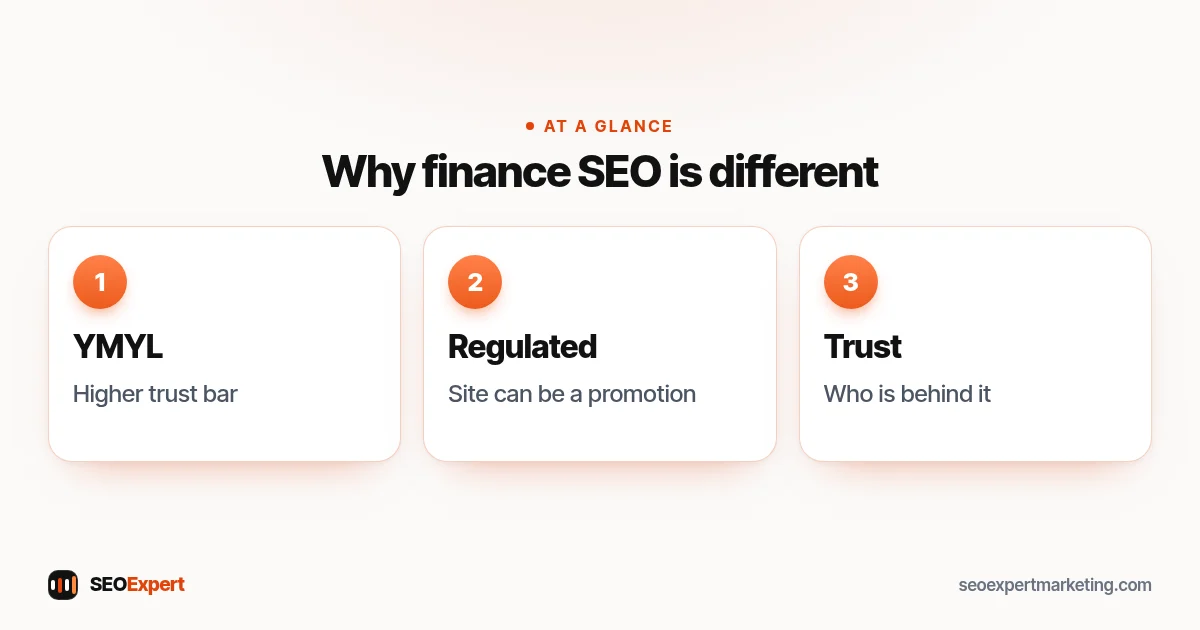
Google treats money topics as "Your Money or Your Life"
Google's guide to creating helpful, reliable, people-first content says its systems give even more weight to content that aligns with strong E-E-A-T (experience, expertise, authoritativeness and trustworthiness) for topics that could significantly impact the health, financial stability or safety of people. Google calls these "Your Money or Your Life" topics, or YMYL. Pensions, mortgages, investments, insurance and tax all fall into this group, so thin or anonymous content is unlikely to do well.
Your website can be a regulated promotion
In the UK, the Financial Conduct Authority's page on financial promotions and adverts says promotions can take the form of a website or a social media post, and that they must be clear, fair and not misleading, whatever the media type. The FCA regulates advertising for most financial services, including loans, investments, savings, insurance, pensions and mortgages.
In the US, SEC-registered investment advisers follow the SEC's Marketing Rule (advisers registered with a state follow that state's rules), and broker-dealers follow FINRA's Rule 2210 on communications with the public, which covers websites. Banks, credit unions, mortgage firms and insurance agents have their own regulators and advertising rules, and accountants follow the publicity rules of their professional body or state board. Other countries have their own rules. Financial services SEO has to work inside these rules, not around them.
Who this applies to
- Financial advisers and planners
- Mortgage and insurance brokers
- Accountants, bookkeepers and tax advisers (see our SEO for accountants page)
- Credit unions, building societies and small banks
- Lenders and finance brokers for businesses
The details differ by service and country, but the approach below works for all of them.
Financial services SEO in 8 steps
1. Put compliance into your content process
Agree a simple workflow with whoever handles compliance: who drafts, who reviews, who approves and how records are kept. Build it in before you publish, because rewriting live pages after a review is slower and riskier. Keep copies of approved pages and the date they were approved. This isn't legal advice; your compliance team or adviser decides what your rules require.
2. Show who is behind the advice
For YMYL topics, people and search engines want to know who wrote the content and why they're qualified. Add author names and short bios with genuine qualifications and experience, your firm's regulatory status and registration number where it applies, a clear About page and full contact details. Only list qualifications and memberships people actually hold. If your firm is a FINRA member serving retail investors, Rule 2210 also requires a clear link to BrokerCheck on your main page for them and on any page profiling your registered people, so build it into every adviser bio.
3. Create a page for each service and audience
A single "Our services" page rarely ranks. Give each main service its own page, such as retirement planning, first-time buyer mortgages, business insurance or small business accounting, written for the people who need it. Explain who it suits, how the process works, how you're paid and what happens at the first meeting. Our guide to B2B vs B2C marketing helps if you serve both businesses and individuals.
4. Get your local presence right
Many people choose a local adviser, broker or accountant. Set up a verified Google Business Profile for each real office, use your real business name only, choose the most specific category and keep contact details and customer-facing hours accurate (Google says businesses that work only by appointment shouldn't list hours). Google treats financial planners and insurance agents as individual practitioners, so an adviser who meets clients at the office can have a profile of their own. Our guide to Google Business Profile optimization covers every field.
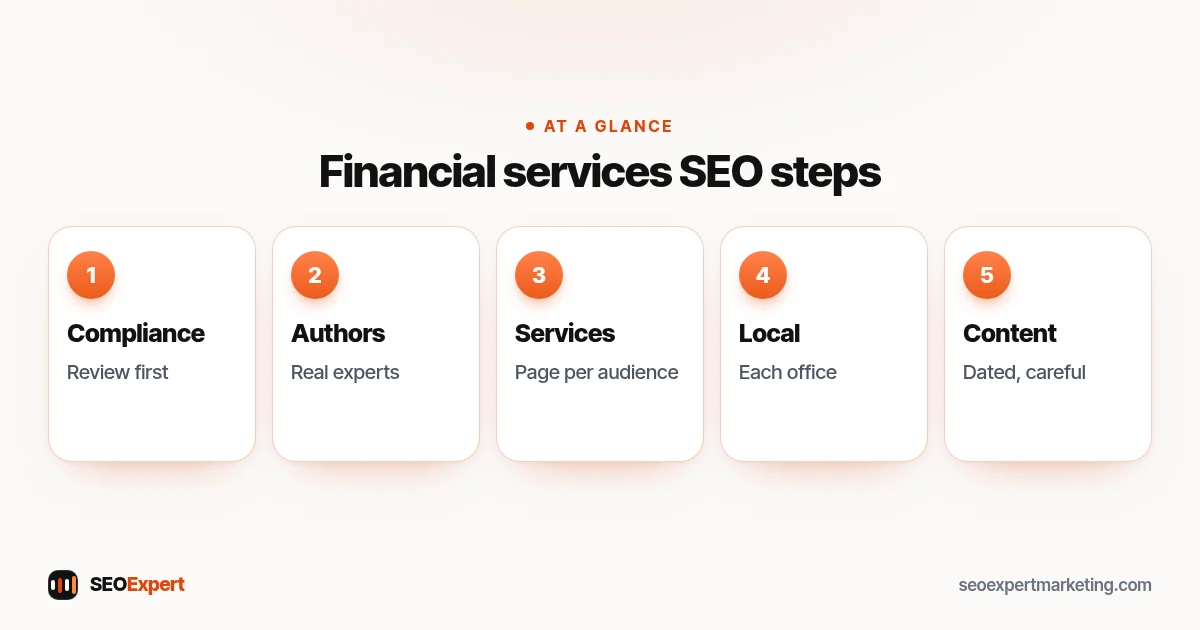
5. Publish helpful, careful educational content
Guides that answer real questions, such as how a remortgage works or what to bring to a first pension review, build trust and attract people early in their research. Keep them general and educational unless your compliance process allows more, add a visible "last reviewed" date, include any risk warnings your rules require, and review them when rules, rates or tax years change. Our guide to SEO content strategy shows how to plan these around your services.
6. Choose keywords that match your services and region
Customers search for the service and their situation, often with a place: "mortgage broker [town]", "financial adviser for retirement", "small business accountant near me", "life insurance for over 50s". Check volumes for your region with Google's Keyword Planner and your Search Console data, and give each main service its own page. Only add a town page where you genuinely serve clients and have something specific to say: Google's spam policies count pages targeted at different cities that funnel visitors to one page as doorway abuse. Our guide to choosing a target keyword explains how.
7. Make the site technically trustworthy
HTTPS on every page, a fast site on phones, clear privacy and complaints information, and contact forms that don't ask for sensitive financial details. Use secure portals for documents, not email or web forms. Accessible design matters too: many clients are older or reading on small screens. Our SEO cheat sheet lists the technical basics.
8. Handle reviews and reputation carefully
Reviews help people choose a local firm, but financial regulators may have rules about how client feedback can be used in marketing. Check what your regulator allows before showing client comments on your website. Your regulator's rules may also cover how you ask for, reply to or share Google reviews, so check them before you start. Google's own rules say never offer rewards for reviews and don't ask only happy clients. Reply politely without confirming that the reviewer is a client or mentioning anything about their affairs. Our guide on how to get Google reviews explains Google's side.
What to focus on, by type of firm
| Firm | Typical searches | Pages that matter most |
|---|---|---|
| Financial adviser or planner | Retirement planning, pension advice, inheritance planning, plus a place | One page per planning need, adviser profiles, fees explained |
| Mortgage broker | First-time buyer mortgage, remortgage, buy-to-let, plus a place | One page per mortgage type, how the process works, fees |
| Insurance broker | Business insurance by trade, landlord insurance, life cover | Pages by customer type, how claims support works |
| Accountant | Small business accountant, self assessment help, bookkeeping | Services by business type, price ranges where allowed |
| Credit union or small bank | Savings accounts, loans, branch hours | Product pages, branch pages, eligibility |
Whatever the firm, financial services SEO works best when each page serves one clear need for one clear audience.
Building authority the right way
Links and mentions from trusted sources help, but in finance the source matters even more. Good options include professional bodies and trade associations you genuinely belong to, local business groups, partners such as solicitors or estate agents who refer clients to you, and local or trade press asking for expert comment. Avoid paid links, link networks and guest posts on unrelated sites: they add risk and little value. For a regulated firm, every mention should be accurate about who you are and what you're authorised to do. This is the slow, safe side of financial services SEO, and it compounds over time.
Working with an SEO agency in a regulated sector
If you hire help, ask how they handle compliance. A good agency for financial services SEO will send content for your sign-off before publishing, keep a record of approved versions, avoid claims about returns or outcomes, write under named experts from your firm and never buy links or reviews. If an agency promises fast rankings or wants to publish without your review, walk away.
Content to avoid in financial services SEO
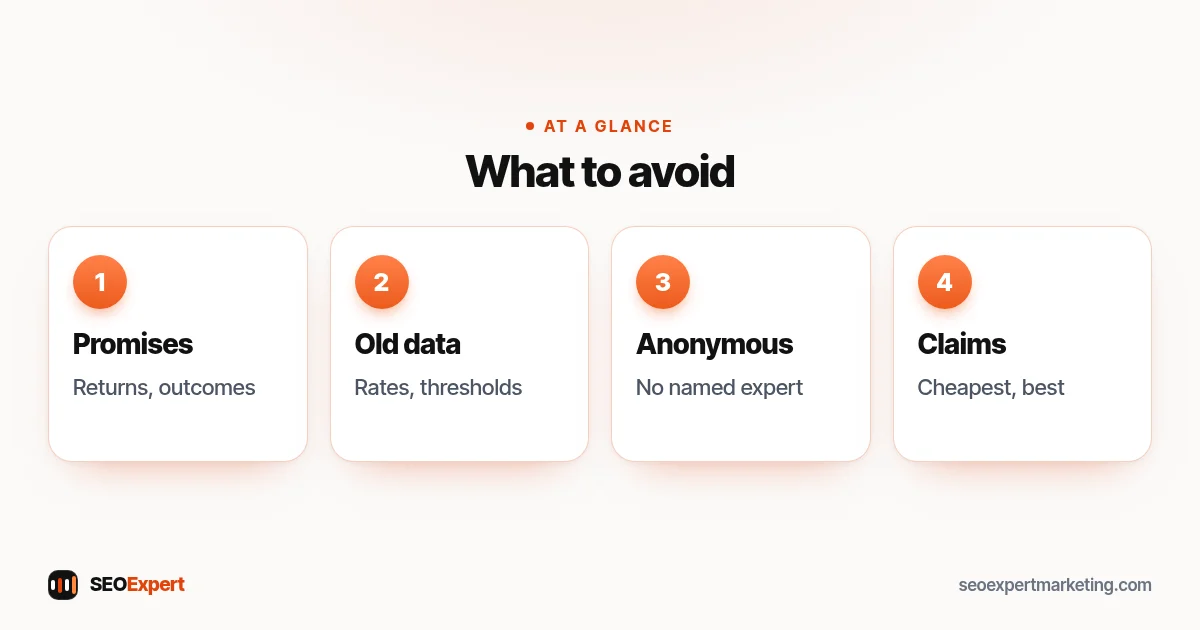
- Promises of returns, rates or outcomes you can't back up or aren't allowed to make.
- Out-of-date rate tables, tax thresholds or rules.
- Anonymous articles with no named, qualified author.
- Copied or mass-produced content that adds nothing, including unchecked AI text.
- Comparison claims such as "the cheapest" or "the best" without evidence.
- Keyword-stuffed business names on your Google Business Profile.
Measuring financial services SEO
Traffic is only a starting point. Track the enquiries and booked consultations that come from search, which pages they started on and how many became clients. Search Console shows which searches and pages bring visitors; your enquiry forms and phone tracking show what happens next. Ask for consent before using analytics or advertising cookies where the law requires it, keep ad and tracking tags off login, application and upload pages, never pass form answers to analytics or ad tools, and check whether your phone tracking records calls before you switch it on.
Example: an independent mortgage broker
Imagine a two-adviser mortgage broker covering one county. Its website has one services page, no adviser profiles and a blog post about rates from two years ago. The plan: adviser profiles with genuine qualifications and the firm's regulatory status; separate pages for first-time buyers, remortgages and buy-to-let, each approved by compliance; a Business Profile with the right category and accurate contact details; a reviewed and dated guide to the mortgage process; and removal of the outdated rate post. Progress is measured by booked appointments from search, not page views.
How long does financial services SEO take?
Usually months rather than weeks, especially in competitive areas, because trust signals, content and reviews build up over time and compliance reviews add steps. Quick improvements often come from fixing the Business Profile, splitting service pages and adding clear author and firm details. Be wary of anyone who promises fast rankings for money keywords.
Financial services SEO and AI search
People increasingly ask AI assistants and Google's AI features about money questions. The same principles apply: clear, accurate, well-sourced content from named, qualified people, consistent business details across the web and pages that answer real questions. Keep facts current, because outdated figures are a bigger risk in finance than in most topics.
Want help with financial services SEO?
Our SEO services work with your compliance process, not around it: service pages, local presence, careful educational content and the technical basics. To start, ask for a free website analysis.
Financial services SEO: quick answers
What is financial services SEO?
Financial services SEO is getting a financial firm found on Google by people who need its services, with extra attention to trust, expertise and the advertising rules that apply to financial firms.
Why is SEO harder for financial services?
Google treats money topics as Your Money or Your Life (YMYL) and gives more weight to content with strong expertise and trust, and financial marketing, which can include websites, is often regulated.
Is a financial firm's website a financial promotion?
Often, yes. The UK FCA says promotions can take the form of a website or social media post. In the US, the SEC's Marketing Rule covers advertisements by SEC-registered investment advisers, and FINRA Rule 2210 covers broker-dealer communications, including websites. Check with your compliance team.
What content works for financial services SEO?
Clear service pages for each audience, named authors with genuine qualifications, and careful, dated educational guides that answer real questions and follow your rules.
Can financial firms use client reviews in marketing?
It depends on your regulator. Check what's allowed before showing client comments on your website. Google reviews on your Business Profile must follow Google's own rules, and your regulator's rules may also apply to how you ask for or share them.
How long does financial services SEO take?
Usually months, because trust, content and reviews build up over time and compliance reviews add steps. Profile fixes and clearer service pages can help sooner.
