B2B vs B2C marketing comes down to who buys from you. B2B (business-to-business) means selling to other businesses; B2C (business-to-consumer) means selling to people for their own use. The difference changes almost everything about your marketing: who makes the decision, how long it takes, what they search for and what convinces them. This guide explains B2B vs B2C in plain English, the seven differences that matter most, the strategies that work for each, and how your SEO should change depending on which one you are.
B2B vs B2C: the definitions
The Cambridge Dictionary defines B2B as business arrangements or trade between different businesses, rather than between businesses and the general public. It defines B2C as the sale of goods or services directly to customers for their own use, rather than to businesses.
- B2B examples: a commercial cleaning company serving offices, an accountant for small firms, a wholesaler supplying shops, an IT support company, a builder working for property developers.
- B2C examples: a hairdresser, a dentist, a restaurant, a domestic plumber, an online clothes shop.
- Both: many small businesses serve both, such as an electrician doing home rewires and shop fit-outs, or a bakery selling to the public and to cafés.
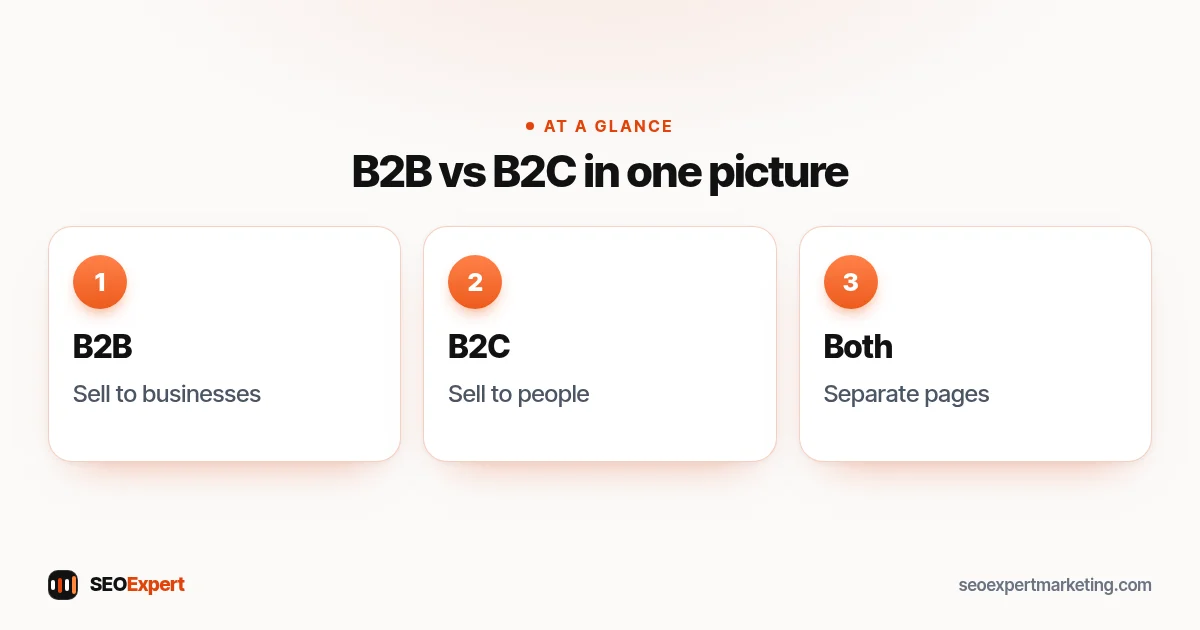
B2B vs B2C at a glance
| B2B | B2C | |
|---|---|---|
| Who buys | A business, often several people decide | One person or a household |
| Why they buy | To solve a business problem, save money or earn more | For their own needs, wants or comfort |
| Decision time | Often weeks or months | Often minutes to days |
| Order value | Usually higher, often repeat contracts | Usually lower per sale, but many local services rely on repeat visits |
| What convinces them | Expertise, proof, clear terms, reliability | Convenience, price, reviews, trust |
| Typical next step | Quote request, call or meeting | Call, booking or buying online |
These B2B vs B2C patterns are typical, not rules. A homeowner choosing a builder for an extension may take months, and an office ordering printer paper may decide in minutes.
The 7 B2B vs B2C differences that matter most
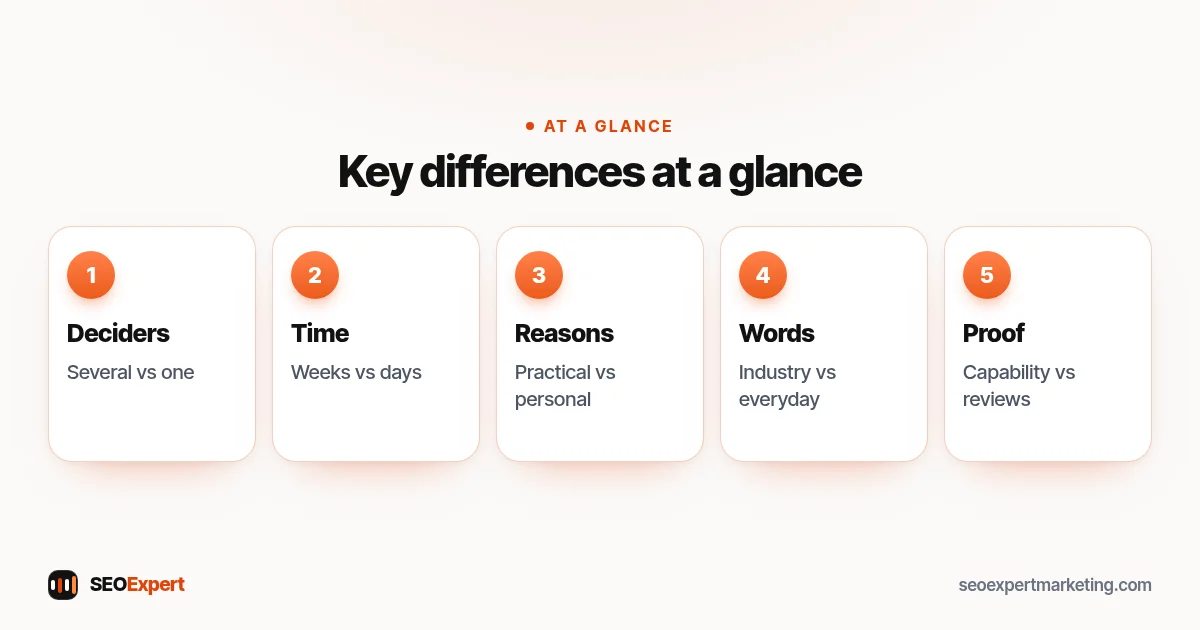
1. The number of decision makers
In B2C, one person or a couple usually decides. In B2B, the person who finds you may not be the person who signs: for example, a manager researches, a finance director approves and the owner has the final say. Your marketing has to answer each of their questions. A simple way to do that: a one-page summary of what you provide, how pricing works, your terms and your insurance, which the person who found you can forward to whoever approves and signs. Put the same details on your service page.
2. The length of the buying process
B2C purchases are often quick, especially for urgent jobs. B2B purchases usually involve comparing suppliers, asking for quotes and checking terms. That means B2B marketing needs to stay helpful over a longer period: useful guides, clear proposals and follow-ups.
3. Emotional vs practical reasons
Both audiences are people, and both feel emotions. But B2C decisions often lean more on feelings and convenience, while B2B buyers usually have to justify the choice to others with practical reasons: cost, risk, time saved and reliability.
4. The language customers use
A homeowner might search "emergency electrician near me". A facilities manager might search "commercial electrical maintenance contract". The words differ, and so should your pages. Our guide to choosing a target keyword shows how to match each page to one main phrase.
5. Search volume and value
B2C phrases usually have more searches. B2B phrases usually have fewer searches but a higher value per customer, so a B2B page that brings two good enquiries a month can be worth more than a B2C page with far more visits.
6. The proof people need
B2C customers often lean heavily on reviews and photos. B2B buyers usually also want evidence of capability: the types of clients you serve, the standards you work to, insurance, clear service levels and examples of similar work, shared with permission.
7. The channels that work
B2C businesses often get many of their enquiries from Google search, Google Maps, recommendations from past customers, Facebook and Instagram. B2B businesses often add LinkedIn, referrals, trade associations and direct outreach. Our guide on how to create a LinkedIn business page covers the first of those.
B2C marketing strategies for small businesses
- Local SEO and Google Maps: a complete Google Business Profile and service pages for each main job.
- Reviews: ask every customer, follow Google's rules and reply to all reviews. Our guide on how to get Google reviews explains how.
- Clear prices and quick booking: "from" prices, online booking or a tap-to-call button.
- Social media with real photos: before and after shots, your team, seasonal offers.
- Fast replies: answer calls, messages and form enquiries quickly. People with an urgent job often contact several businesses and book whoever gets back first, so return missed calls promptly.
- Email or text reminders: for services people need again, such as servicing or check-ups.
- Local keywords: the service plus the town, as covered in our guide to local SEO keywords.
B2B marketing strategies for small businesses
- Service pages written for buyers: what you provide, for which types of business, how it works, service levels and how to get a quote.
- Helpful guides: answer the questions buyers ask while comparing suppliers, such as "what's included in a commercial cleaning contract".
- Proof of capability: sectors you serve, accreditations you genuinely hold, insurance and examples of work shared with clients' permission.
- LinkedIn: a company page and active personal profiles for the people clients deal with.
- Referrals and partnerships: accountants, property managers and other suppliers who serve the same clients.
- A simple follow-up routine: many B2B enquiries need a reminder or two before they decide.
How SEO differs for B2B vs B2C
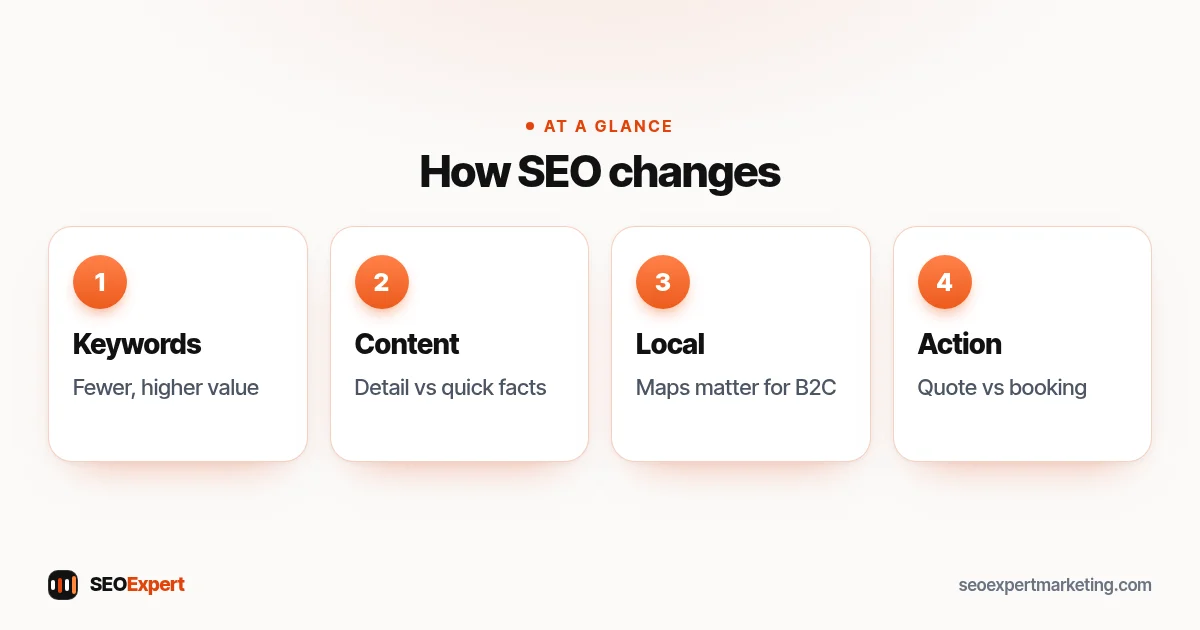
| B2B SEO | B2C SEO | |
|---|---|---|
| Keywords | Industry, service and problem terms; usually fewer searches, higher value | Service plus location, "near me", price; usually more searches |
| Content | Detailed service pages, guides, comparisons, FAQs for buyers | Clear service pages, prices, photos, short FAQs |
| Local results | Matter for local suppliers, less for national ones | Often the main source of enquiries |
| Conversion | Quote form, call or meeting | Call, booking or online purchase |
| Measuring | Qualified enquiries and contracts won | Calls, bookings and sales |
Whichever you are, the same rule applies: write for real people. Google's guide to creating helpful, reliable, people-first content asks questions such as whether you have an existing or intended audience that would find the content useful if they came directly to you, and whether your content clearly demonstrates first-hand expertise and a depth of knowledge. Those questions work for B2B and B2C alike. Our guide to SEO content strategy shows how to plan pages for each audience.
B2B vs B2C content: what to write
The B2B vs B2C split shows clearly in the content each audience reads. B2C visitors usually want quick answers: what you do, how much it costs, when you can come and what other customers say. Short service pages, a price guide and a handful of FAQs often do the job. B2B visitors tend to read more before they get in touch. They want to know how you work, what's included, who they'll deal with and what happens if something goes wrong. Longer service pages, guides comparing options and a clear explanation of your process suit them better. Whichever side you're on, answer the real questions your customers ask on the phone.
B2B vs B2C websites: what each needs
- B2C websites need a fast phone layout, a tap-to-call button, prices or price ranges, real photos, reviews and simple booking.
- B2B websites need clear service descriptions, the sectors or types of business you serve, how quotes and contracts work, who the team are, and an easy quote form that asks for the details you need.
- Both need accurate contact details, fast loading and honest information. Many of the same technical basics apply, as our one-page SEO cheat sheet shows.
If you're not sure where to focus, list your last 20 customers, what each one was worth and whether they came back. Count the value as well as the number: when you weigh up B2B vs B2C work, a few business contracts can be worth more than many one-off home jobs, or the other way round.
Measuring B2B vs B2C results
Measure what matters for each. For B2C, count calls, bookings and online sales, and watch which service pages bring them. For B2B, count qualified quote requests and contracts won, and note how long each enquiry takes to turn into work. Traffic alone can mislead, especially in B2B, so judge each page by the enquiries and work it brings, not by its visits. Ask every new customer how they found you, and keep a simple record.
In regulated sectors the same split applies, with extra rules. See our guide to financial services SEO.
If you sell B2B and B2C
Many small businesses sit on both sides of the B2B vs B2C line, and a common mistake is a single page trying to talk to everyone. A better structure:
- Separate pages for domestic and commercial customers, each with its own keywords, examples and contact options.
- Clear navigation, such as "For homes" and "For businesses", so visitors pick the right path straight away.
- Different calls to action: "Book a visit" for homeowners, "Request a quote" for businesses.
- Proof that fits each audience: reviews for homeowners, sectors served and service details for businesses.
Example: a cleaning company that does both
Imagine a cleaning company that serves homes and offices from one "Our services" page. Homeowners have to read about contract terms and out-of-hours office cleaning, and office managers have to scroll past oven cleaning prices. The company splits the page in two. The domestic page targets "house cleaning" plus the town, shows prices from an hourly rate, has reviews and a booking button. The commercial page targets "office cleaning" plus the town, explains what's included, the hours they can work, how keys and alarms are handled and the sectors they serve, with a quote form. Each page now speaks to one audience.
Common mistakes with B2B vs B2C marketing
- Using consumer-style offers and urgency on business buyers who need detail.
- Writing B2C pages in heavy jargon that homeowners don't use.
- Judging B2B pages on traffic instead of qualified enquiries.
- No follow-up after a B2B quote.
- Copying national competitors' strategies when most of your customers are local.
- Claiming accreditations or clients you can't show.
Want help marketing to the right audience?
Our SEO services build pages for the customers you actually want, whether they're homeowners, businesses or both, and track the enquiries that come from them. To start, ask for a free website analysis.
B2B vs B2C: quick answers
What is the difference between B2B and B2C marketing?
B2B marketing sells to other businesses, usually with several decision makers and a longer buying process. B2C marketing sells to people for their own use, usually with quicker, more personal decisions.
What does business to consumer mean?
Business to consumer (B2C) means selling goods or services directly to people for their own use, rather than to businesses.
What are good B2C marketing strategies for a small business?
Local SEO and a strong Google Business Profile, genuine reviews, clear prices and booking, social media with real photos, and reminders for repeat services.
Is SEO different for B2B vs B2C businesses?
Usually, yes. B2B keywords usually have fewer searches but higher value, and pages often need more detail for buyers who compare suppliers. For local businesses, B2C SEO often leans more on local results, reviews and quick contact.
Can a business be both B2B and B2C?
Yes, many are. Give each audience its own pages, keywords, proof and contact options instead of one page for everyone.
Which channels work best for B2B?
For many small B2B firms: Google search, LinkedIn, referrals, trade associations and a simple follow-up routine after quotes.
