
Content marketing for small business means creating useful articles, videos, emails and posts that answer your customers' questions, so they find you, trust you and get in touch when they're ready to buy. You don't need a big team or a big budget. You need one clear goal, a few formats you can keep up, and a simple way to reuse and measure what you make. This guide gives you a nine-step plan, an example month, the email rules to follow and ideas for different types of business.
What is content marketing?
The Content Marketing Institute defines content marketing as "a strategic marketing approach focused on creating and distributing valuable, relevant, and consistent content to attract and retain a clearly defined audience — and, ultimately, to drive profitable customer action." In plain words: instead of only telling people to buy, you help them first, and that help becomes a reason to choose you.
For a small business, that content can be a guide on your website, a short video of a job, a monthly email to past customers, a Google Business Profile update or a written answer to a question people ask on the phone. It overlaps with SEO but is wider. An SEO content strategy plans the pages you want found in search; content marketing also covers how you share those pages by email, on social media and in person.
Why content marketing suits small businesses
- It builds on itself. A helpful guide published this year can still bring visitors next year; an ad stops the day you stop paying.
- It answers questions before the call. Customers who've read your price guide or process page arrive better informed, which can make sales conversations shorter.
- It shows expertise you already have. You know your trade; content puts that knowledge where customers can see it.
- It keeps past customers in touch. A monthly email or a seasonal checklist reminds people you exist when they next need you, or when a friend asks them for a recommendation.
It has downsides too. It takes time, results usually build over months rather than weeks, and it rarely helps a business that needs customers this week. If you need enquiries now, paid ads may fit better while your content builds; our guide to SEO vs PPC compares the two.
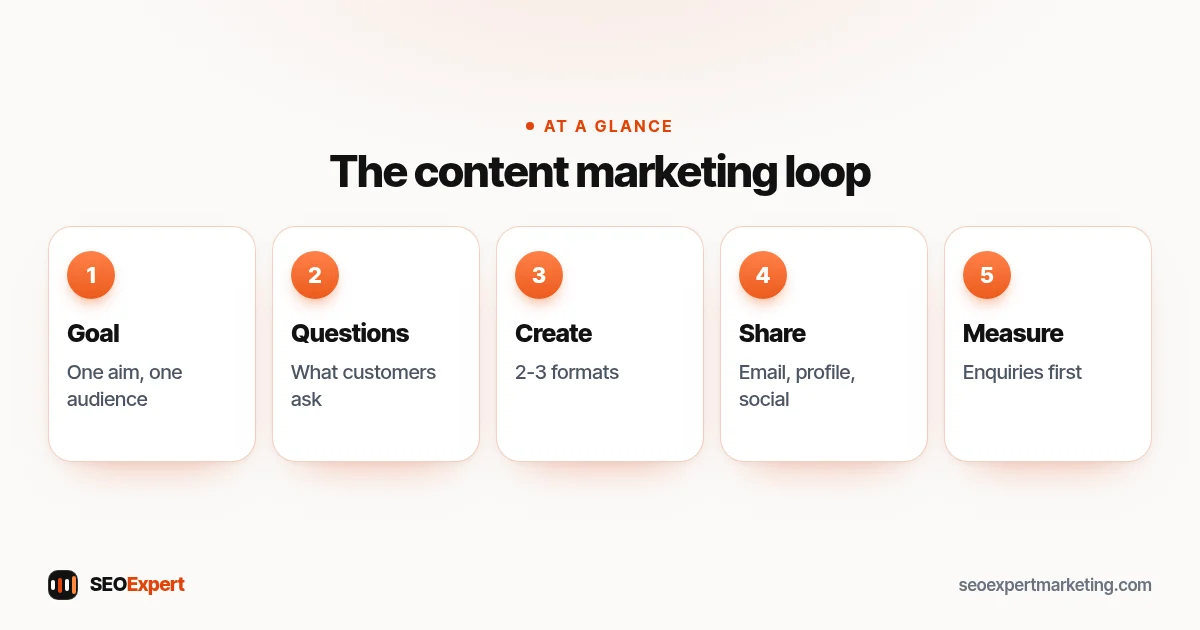
A 9-step content marketing plan for small business
Step 1: Pick one goal and one audience
Write down one goal for the next six months, such as more quote requests for one service, more bookings in a quiet season or more repeat orders from past customers. Then describe one audience in a sentence: who they are, what problem brings them to you and what makes them hesitate. "Homeowners in our town with an old boiler, worried about the cost" is far more useful than "everyone". If you sell to both businesses and consumers, our guide to B2B vs B2C marketing explains how the content differs.
Step 2: Collect the questions customers already ask
The best content marketing topics are usually sitting in your inbox. For two weeks, note every question customers ask by phone, email, chat and in person. Add the questions in your reviews, the searches shown in Google Search Console and the "People also ask" boxes in Google. Then check demand with keyword research. Questions about price, timing, process and choosing between options tend to come from people close to buying, so start there.
Step 3: Choose two or three formats you can keep up
| Format | Best for | Where it lives |
|---|---|---|
| Website guides and FAQ answers | Being found in search; answering detailed questions | Your website |
| Email newsletter | Repeat customers and referrals | Your email list |
| Short videos | Showing your work and your team | Your site, YouTube, social media |
| Business Profile updates | Local customers who find you on Google Maps | Your Google Business Profile |
| Social media posts | Staying visible with people who already know you | The platforms your customers use |
| Project write-ups (before and after) | Showing the work you do | Your website and social media |
Pick the content marketing formats that match your goal and your strengths. A plumber who's comfortable on camera might choose short videos and website guides; an accountant might prefer guides and a monthly email. Doing two formats well every month beats doing six badly for three weeks.
Step 4: Build on your own website first
Social media platforms can change their rules or how many people see your posts, and you don't own your followers. Your website and your email list are yours. Make your website the home of your content marketing, then share each piece elsewhere, so every post, email and video points people back to a page with your services and contact details. Link each guide to the matching service page, and link related guides to each other; our guide to internal linking shows how.
Step 5: Write from real experience
Google's guidance on helpful, reliable, people-first content asks whether your content clearly demonstrates first-hand expertise and a depth of knowledge, and whether a reader will leave feeling they've learned enough to help achieve their goal. It also lists warning signs, such as producing lots of content on many different topics in the hope that some of it performs well, or mainly summarizing what others have to say without adding much value.
Small businesses have an advantage here: you do the work. Use your own photos, real prices or price ranges, the mistakes you see customers make and the steps you actually follow. Put a real name on articles where readers would expect a byline; Google says fabricating creator profiles, such as made-up names or false credentials, is a form of deception. Our guide to SEO copywriting covers how to write pages that read well and rank.
Ask customers before using photos or videos of their home, garden or car in your content marketing, and leave out house numbers, number plates and faces unless they agree. Clinics should get a patient's written consent before sharing any patient photo or story, and check their regulator's rules.
Step 6: Share it where your customers already are
- Email: send new guides to customers who've agreed to hear from you.
- Google Business Profile: share a short update that links to the guide; see our ideas for Google Business Profile posts.
- Social media: post one tip from the guide with a photo or short clip, not just a link.
- After calls and visits: send the link that answers the question someone asked, or leave a printed copy of the key points.
Short videos are an easy start: see our guide to video marketing for small business.
Step 7: Repurpose every main piece
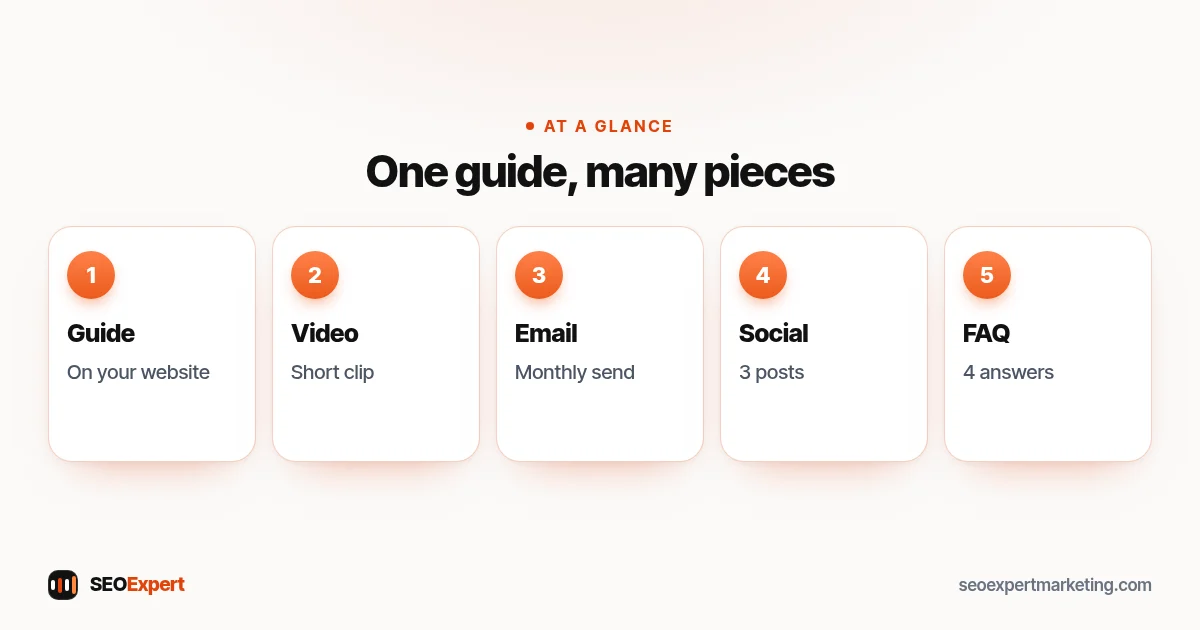
Repurposing means turning one piece into several. A single guide on how to choose a new boiler could become a two-minute video, a monthly email, three social posts, a Business Profile update and four FAQ answers on your service page. Each version should suit its platform rather than being copied and pasted. This is how a small team keeps content marketing going without writing something new every day.
Step 8: Measure what matters
Track three levels. First, reach: visits, video views and email opens (treat opens as a rough guide, because some email apps load messages automatically and count them as opened). Second, engagement: clicks to your service pages, replies and shares. Third, and most important, enquiries and sales: calls, forms and bookings that started with your content marketing. Add campaign tags (UTM parameters) to the links in your emails and social posts so Google Analytics shows where visits came from, use Search Console to see which searches find your guides, and ask every new customer how they heard about you. Our guide to the SEO report shows a simple monthly format.
Step 9: Update, combine and prune
Every few months, review what you've published. Update guides with new prices, rules or photos; combine thin posts that answer the same question into one stronger page; and remove pieces that are out of date and can't be fixed. Use a 301 redirect to the closest matching page when you merge or remove a page that has visitors or links; if nothing similar exists, let the old address return a 404 instead of sending everyone to your home page. Two near-identical posts can compete with each other, which our guide to duplicate content explains.
How much time does small business content marketing take?
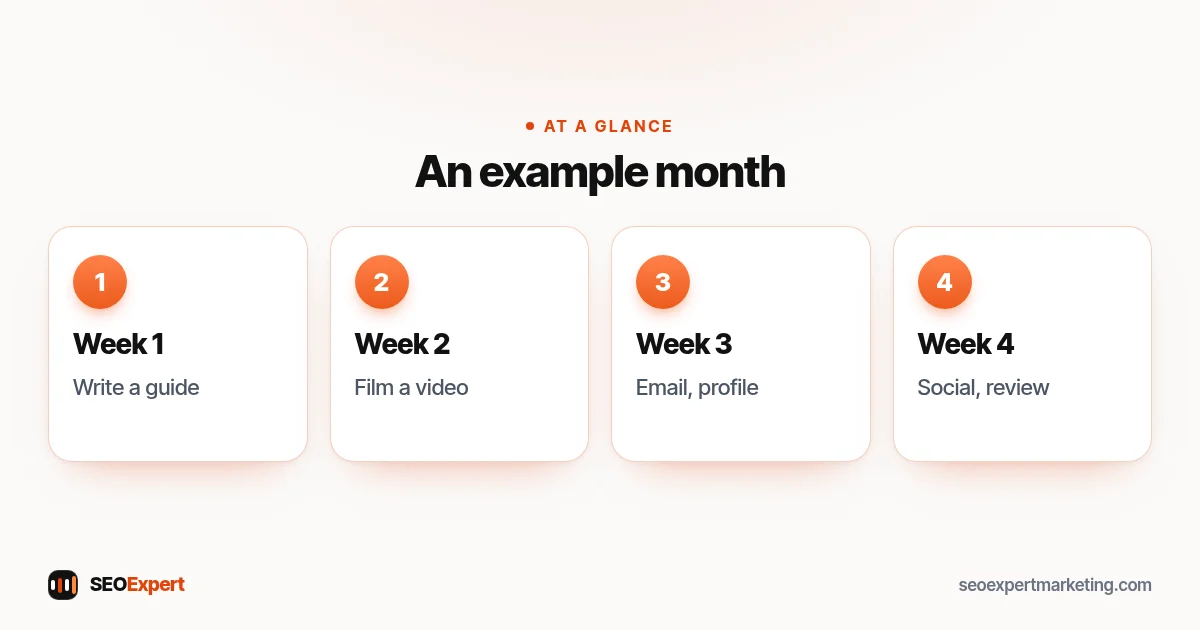
There's no fixed rule, but a realistic start for one person is a few hours a week. Here is an example month. It's an illustration to plan around, not a benchmark:
| Week | Main task | Time (approx.) |
|---|---|---|
| Week 1 | Write or update one website guide | 3–4 hours |
| Week 2 | Film one short video from the guide and post it | 1–2 hours |
| Week 3 | Send the monthly email; post a Business Profile update | 1–2 hours |
| Week 4 | Social posts from the guide; check the numbers; plan next month | 1–2 hours |
That's one main piece a month, used everywhere. Once that rhythm feels easy, add a second guide or a project write-up. In content marketing, consistency matters more than volume: a small library of useful pages, kept up to date, usually does more than a burst of posts that stops after a month.
Email rules to know before you send
Email is one of the most useful channels for content marketing, because you reach people who already know you. It also comes with legal rules.
- United States: the CAN-SPAM Act covers commercial email. The Federal Trade Commission's guidance for business includes not using false or misleading header information or deceptive subject lines, identifying the message as an ad, including a valid physical postal address, telling people how to opt out, honoring opt-out requests within 10 business days and monitoring any company that sends email for you, because you stay responsible for it.
- United Kingdom: the ICO's guidance on email marketing says you must not send marketing emails or texts to individuals without specific consent. There is a limited exception, often called the "soft opt-in", for people whose details you got when they bought or asked about buying from you. It only covers emails about your own similar products or services, you must have offered an opt-out when you took their details and in every message since, and it doesn't cover bought-in lists. The rules for emailing companies are different.
- Canada and Australia: both generally need consent before you send marketing email, either given clearly or, in limited cases, implied by an existing customer relationship. Under Canada's anti-spam law (CASL), consent implied by a purchase generally lasts two years from the last purchase, and by an enquiry six months. Australia's Spam Act 2003 requires accurate sender details and a working unsubscribe option in every message, and you must act on unsubscribe requests within five working days.
Never buy email lists. Build yours with a sign-up form on your website and by asking customers at the end of a job. Other countries have their own rules, so check the law where your customers live; this section is a summary, not legal advice.
Using AI tools for content marketing
AI writing tools can help with outlines, first drafts, headlines and turning a guide into social posts. Google says appropriate use of AI or automation is not against its guidelines, but using it to generate content primarily to manipulate search rankings breaks its spam policies. In practice, use AI to save time on structure and repurposing, then add what only you know, check every fact and price, and read it aloud before you publish.
Content marketing ideas by type of business
- Trades (plumbers, roofers, electricians): price guides, "repair or replace?" articles, short videos of common jobs and seasonal maintenance checklists. See SEO for plumbers.
- Dentists and clinics: what to expect at a first visit, aftercare guides and answers to cost questions, within your regulator's advertising rules. See SEO for dentists.
- Accountants and advisers: deadline reminders, plain-English explanations of new rules and year-end checklists. See SEO for accountants.
- Shops and online stores: buying guides, product comparisons, how-to-use videos and gift guides. See our guide to retail SEO.
Common content marketing mistakes
- Writing about your business instead of your customers' problems.
- Starting with a burst of posts, then stopping.
- Publishing only on social media, with nothing on your own website.
- Choosing topics because they're trending, with no link to what you sell.
- No clear next step: every piece should point to a service page, a phone number or a form.
- Measuring likes instead of enquiries.
A made-up example: a landscaper's first six months
Imagine a two-person landscaping business that wants more patio and garden design jobs in spring. Over the winter, the owner lists the questions customers ask: what a patio costs, how long it takes, which paving lasts and whether any permission is needed. Each month they publish one guide on their website, film a short walk-through of a finished garden, send a short email to past customers who agreed to hear from them and post photos on their Business Profile. Every guide links to the garden design service page.
By spring they have a small library that answers the questions buyers ask, and every email and post points back to it. They track results the simple way, by asking each new customer how they found the business, and they drop the formats that brought no enquiries.
How we help
We're a small SEO agency, so our focus is the search side of content marketing: finding the questions your customers search for, writing and improving the pages that answer them and linking those pages to your services. See our SEO content writing services or ask for a free website analysis.
Content marketing: quick answers
What is content marketing for small business?
It's creating useful guides, videos, emails and posts that answer your customers' questions, then sharing them where those customers are, so they find you, trust you and get in touch when they're ready.
How much time does content marketing take?
A realistic start for one person is a few hours a week: one main piece a month, such as a website guide, reused as a video, an email and social posts.
How long does content marketing take to work?
Usually months rather than weeks, depending on your competition and how often you publish. Emails to existing customers can bring replies sooner.
What type of content works best for a small business?
Start with website guides that answer the questions customers ask before they buy, plus one way to share them, such as a monthly email or short videos.
Can I use AI for content marketing?
Yes, with care. Google says appropriate use of AI is not against its guidelines. Use it for drafts and repurposing, then add your own experience and check every fact.
Is content marketing the same as SEO?
No, but they overlap. SEO helps your pages get found in search; content marketing also covers sharing content by email, social media and in person.
