
Local SEO keywords are the searches people use when they want a business near them: "plumber in Austin", "dentist near me", "best Thai restaurant Leeds" or "emergency electrician Brampton". Choosing the right ones tells you which pages to build, what to call them and what to put in your Google Business Profile. This guide shows how to find local SEO keywords with free tools, how to sort them by what the searcher wants and where to use them on your site and profile without stuffing.
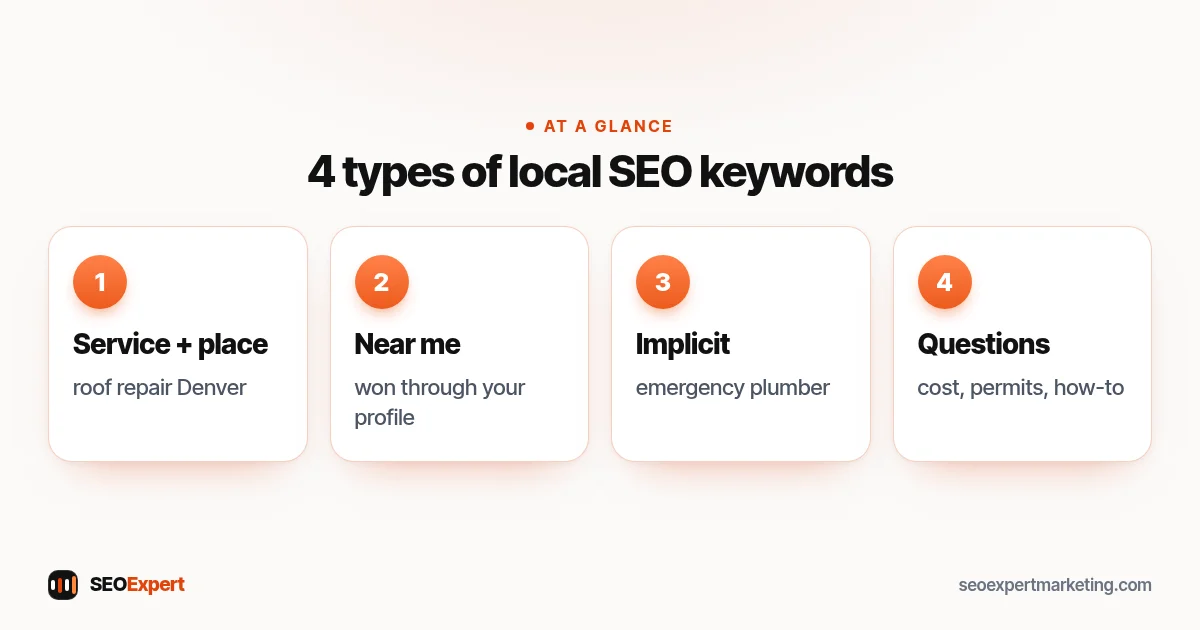
The four types of local SEO keywords
- Service plus place: "roof repair Denver", "accountant in Manchester". The clearest buying signal.
- "Near me" searches: "physio near me", "car mechanic open now". Google uses the searcher's location, so you can't target the words "near me" on your page; you win these through your Business Profile, relevance and distance.
- Implicit local searches: "emergency plumber", "pizza delivery". No place named, but Google shows local results anyway.
- Local questions: "how much does a new boiler cost in Glasgow", "do I need a permit for a fence in Toronto". Great topics for articles.
How to find local SEO keywords for free
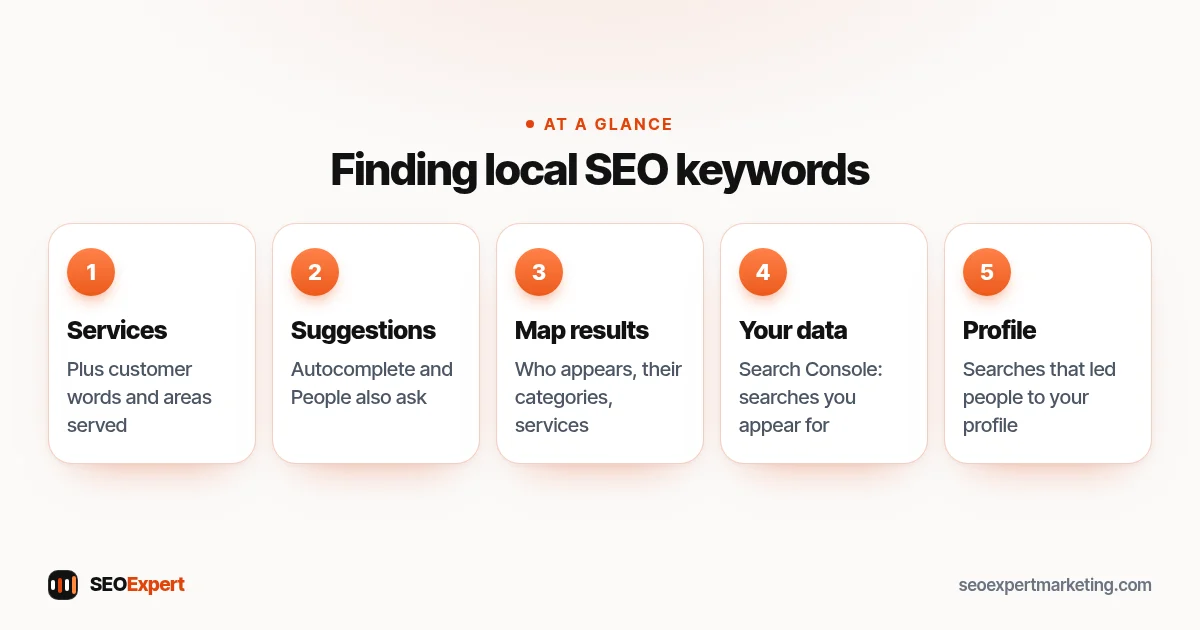
1. Start with your services and areas
List every service you want more of, the words customers use for it (not just your trade terms) and the towns, suburbs or neighborhoods you serve. Combining them gives you a first list of local SEO keywords, such as "boiler service Leeds" or "kitchen fitter Headingley".
2. Use Google autocomplete and "People also ask"
Type each service and place into Google on your phone and note the suggestions and the questions in the "People also ask" box. They show real searches, in the words people actually use.
3. Look at the map results
Search your main local SEO keywords and look at who appears in the map results. Note their primary categories and the services listed on their profiles; they show how Google groups your type of business.
4. Check Search Console
Once your site has been live for a few weeks, the Performance report in Search Console shows the searches you already appear for. Filter by the names of your towns to see your local keywords, and look for ones where you're on page 2: those are the quickest wins.
5. Check your Business Profile performance
Your Google Business Profile also shows the searches that led people to your profile. These are often different from your website's searches and reveal how customers describe what you do.
Five free ways to find local SEO keywords, at a glance:
How to choose which local SEO keywords to target
Sort your list into groups by meaning: all the ways of searching for the same service in the same area belong together and need just one page. Then prioritize:
- Value: searches for your most profitable services first.
- Intent: people ready to buy ("emergency plumber Leeds") before people researching ("how to fix a dripping tap").
- Competition: look at who ranks. If page 1 is all national directories and big brands, a more specific search may be easier to win first.
- Distance: Google's guide to improving your local ranking names distance as a main factor. Focus on the areas close to your base before distant towns.
Wondering how many to target on each page? See our guide on how many keywords to use for SEO.
Local searches with "near me", "emergency" or "cost" in them are usually the closest to a call. See our guide to high intent keywords for more examples and how to find them.
Where to use local SEO keywords
On your website
- Page title: service, area and brand, for example "Boiler Repair in Leeds | Smith Heating".
- H1 and opening paragraph: say clearly what you do and where.
- Body text: mention the areas you serve naturally, with real details such as jobs completed there.
- Image file names and alt text: describe the photo, for example "new-boiler-installation-leeds.webp".
- Internal links: link to service pages using descriptive anchor text.
On your Google Business Profile
- Choose the primary category that matches your main keyword group.
- List your services using customers' words.
- Write a natural description of what you do and where.
- Use your main services and areas naturally in profile posts and photo descriptions. Our guide to Google Business Profile optimization covers every section.
- Don't add keywords to your business name; Google's guidelines for representing your business don't allow it.
Examples of local SEO keywords by business type
| Business | Buying searches | Question searches |
|---|---|---|
| Plumber | emergency plumber [town], boiler repair [area] | how much does a new boiler cost |
| Dentist | dentist [suburb], emergency dentist open Saturday | how much do dental implants cost |
| Lawyer | family lawyer [city], will writing [town] | how long does probate take in [state] |
| Restaurant | Thai restaurant [neighborhood], brunch [city] | best places for a birthday dinner in [city] |
| Landscaper | landscaper [town], lawn care [suburb] | when to reseed a lawn in [region] |
Buying searches belong on service pages; question searches make good articles that link to those pages. Our SEO by industry pages show how this works for different trades.
For the profile side, see where to add Google My Business keywords safely.
For a worked example in one trade, see our guide to handyman keywords.
Location pages: when they help
A separate page for each town works only when each page has genuinely local content: projects completed there, local regulations, travel times or prices that differ. Near-identical pages that just swap the town name can be treated as doorway pages and harm the site. For many small businesses, one strong page per service, listing the areas covered, works better than dozens of town pages.
Local SEO keywords in different countries
The same service is searched differently across the USA, UK, Canada and Australia, so check the words your own customers use. Americans search for an "attorney" or "HVAC repair", while UK searchers look for a "solicitor" or "boiler engineer". Australians often search by suburb, and many Canadian searches include the province. Spelling matters too: "color consultant" versus "color consultant", or "tire shop" versus "tire shop". If you serve customers in more than one country, use each market's terms on the pages written for it rather than mixing them on one page. Google autocomplete, set to the right country, is the fastest way to check.
Mistakes with local SEO keywords
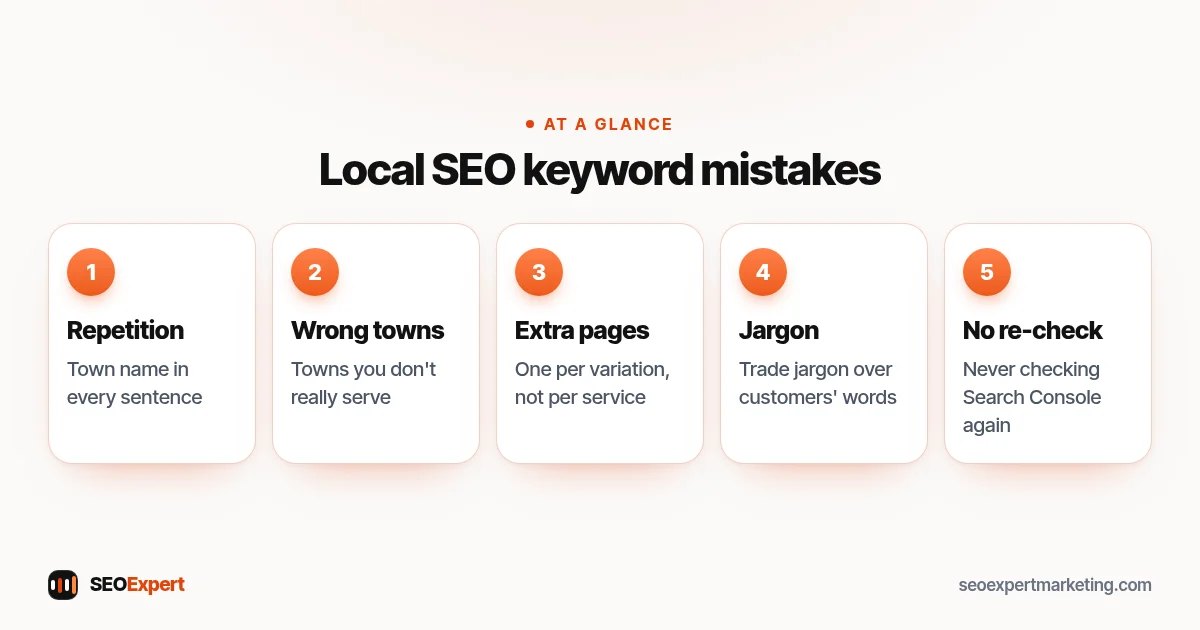
- Repeating the town name in every sentence.
- Targeting towns you don't really serve.
- Building one page per keyword variation instead of one per service.
- Ignoring the words customers use in favor of trade jargon.
- Choosing keywords once and never checking Search Console again.
Five mistakes with local SEO keywords to avoid:
Local SEO keywords: a simple monthly review
Once a month, open Search Console and your Business Profile performance, note any new local searches, check which pages are close to page 1 and improve one of them. Our local SEO checklist includes this in a short monthly routine, and our keyword research services page explains how we build a full keyword map. If you'd like it done for you, our local SEO services cover keyword research, pages and your profile together.
Local SEO keywords: quick answers
Should I put "near me" in my page titles?
No. "Near me" searches are matched using the searcher's location, not the words on your page. Mention the real areas you serve instead, and keep your Business Profile complete and accurate.
How many local SEO keywords should each page target?
One main keyword group per page: a service in an area, plus its close variations. Different services or clearly different areas deserve separate pages only if you have real content for them.
Do I need paid tools for local keyword research?
Not to start. Google autocomplete, "People also ask", the map results, Search Console and your Business Profile performance show real local searches for free. Paid tools add search volumes and save time.
Can I rank in a town where I don't have an office?
Service-area businesses can list the areas they cover, but distance still matters, so you'll appear most often near your base. Pages about other towns help only when they contain real local information.
