High intent keywords are the searches people type when they are close to taking action: calling a business, booking an appointment, asking for a quote or buying. "Emergency plumber near me", "invisalign cost" and "accountant for small business" are good examples. Fewer people search them than broad topics, but each visit is worth far more, because the person already knows what they want. This guide explains what high intent keywords are, how to find them for free, which pages should target them and the mistakes that waste them.
What are high intent keywords?
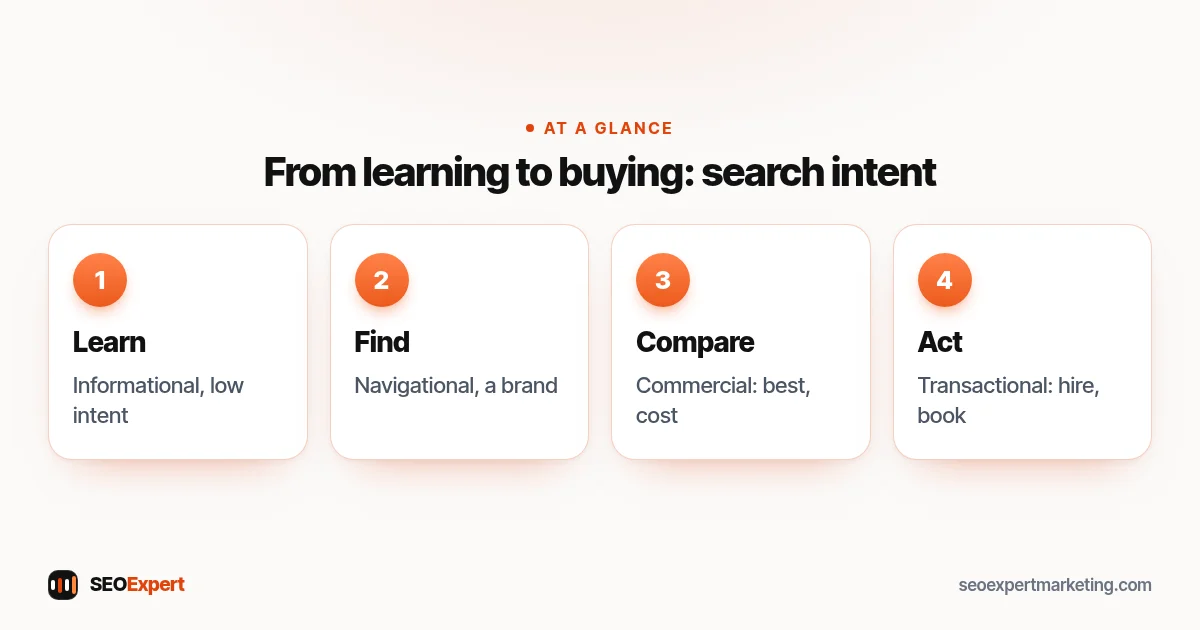
Every search has a purpose behind it, usually called search intent. Some people want to learn ("what is a root canal"), some want a particular website ("dentist login"), some are comparing options ("best dentist in Leeds") and some want to act now ("book dentist appointment today"). High intent keywords are the last two groups: searches with a clear commercial or transactional purpose. The person has a problem, knows the type of solution and is choosing who will provide it.
That is why these searches matter so much for a small business. A page that ranks for "how to fix a leaking tap" may get plenty of visits from people who will never hire anyone. A page that ranks for "tap repair service in Bristol" gets fewer visits, but many of those visitors are ready to call.
New to the idea? Our guide to what a search query is explains how queries differ from keywords and how to read your own query data.
The four types of search intent
| Intent | What the searcher wants | Example | Best page type |
|---|---|---|---|
| Informational | To learn or solve something themselves | why is my boiler losing pressure | Blog guide |
| Navigational | A specific brand or website | british gas login | Home or brand page |
| Commercial | To compare options before choosing | best boiler service company | Service page, comparison or reviews page |
| Transactional | To act now: buy, book, call, get a quote | boiler repair near me | Service, location or product page |
Commercial intent keywords and transactional keywords together make up most of this group. The line between them is not strict: "boiler repair cost" is partly research, but someone checking prices is usually planning to buy soon.
Words that signal high intent
Many of these searches contain a "modifier" that gives the purpose away. Watch for these groups:
- Action words: hire, book, buy, order, get a quote, schedule, call, near me, open now.
- Price words: cost, price, prices, rates, quote, cheap, affordable, packages.
- Comparison words: best, top, reviews, vs, alternative, compared.
- Urgency words: emergency, same day, 24 hour, today, fast.
- Place words: a city, town, neighborhood or "near me".
- Specific needs: a precise service plus the type of customer, such as "bookkeeping for restaurants" or "roof repair for flat roofs".
Trigger words are a useful start, but don't rely on them alone. "Divorce lawyer" has no modifier at all, yet almost everyone who types it needs a lawyer. The test is simple: if the person searching got exactly what they wanted, would they be paying someone like you?
Examples of high intent keywords by business type
| Business | Lower intent search | High intent keywords |
|---|---|---|
| Plumber | how to unblock a drain | emergency plumber near me, drain unblocking cost, 24 hour plumber [city] |
| Dentist | are veneers bad for your teeth | veneers cost [city], emergency dentist open now, invisalign dentist near me |
| Accountant | what is a tax return | accountant for self employed, small business accountant [city], bookkeeping services prices |
| Landscaper | when to plant hedges | landscaping company [city], garden design quote, artificial grass installation cost |
| Lawyer | what is probate | probate lawyer near me, wills and probate solicitor fees, free consultation lawyer |
| Online store | how to choose running shoes | buy trail running shoes, [brand] running shoes sale, best running shoes for flat feet |
For a worked example in one trade, see our guide to handyman keywords.
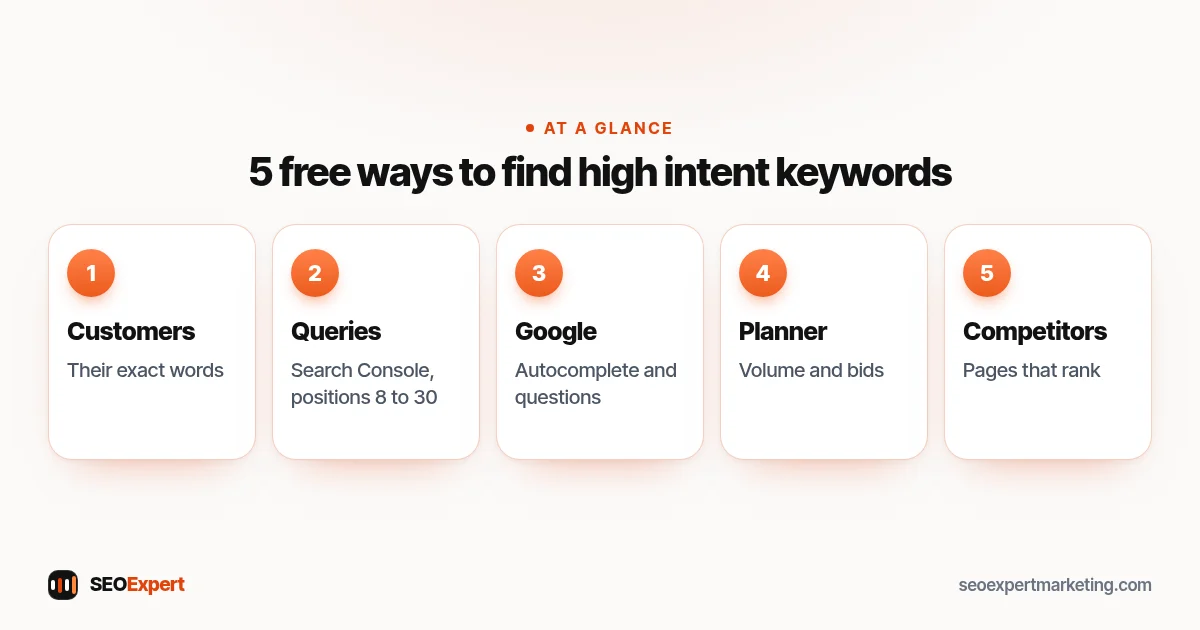
How to find high intent keywords for free
You don't need an expensive tool to build a good list. Most small businesses can build a solid first list in an afternoon.
1. Start with what customers actually say
Read your last 20 enquiries, emails, chat messages and call notes. Write down the exact words people use to describe the job, the problem and the place. Customers rarely use industry terms: they say "boiler making a banging noise", not "kettling". These phrases are often the most valuable searches you will find.
2. Check your Google Search Console queries
If your site is verified, the Search Console performance report shows the searches that already bring you impressions and clicks. Filter the queries for words like "cost", "near me", "best" or your town. Searches where you sit in positions 8 to 30 are quick wins: Google already connects you with them, and a better page can move you up. Our Google Search Console guide shows how to use the report.
3. Use Google's own suggestions
Type your service into Google and look at the autocomplete suggestions, the "People also ask" box and the related searches at the bottom of the page. Add a modifier ("plumber cost", "plumber near", "plumber best") and note what Google offers. These come from real searches.
4. Check search volume in Keyword Planner
Google's Keyword Planner is free with a Google Ads account (you don't have to run ads). It shows rough monthly searches and a "top of page bid" estimate. A high suggested bid is a good sign of commercial value: advertisers pay more for clicks that turn into customers.
5. Look at competitor pages that rank
Search your main service and town, then open the top results. Look at their page titles and headings. Which services and places do they have separate pages for? Every gap is a page you could build.
Business buyers often search with fewer, higher-value phrases. Our guide to B2B vs B2C marketing covers the difference.
How to choose which high intent keywords to target
Once you have a list, score each keyword on three things:
- Value: how much is a customer from this search worth to you? A "kitchen renovation" lead is worth more than a "tap washer" one.
- Fit: do you actually offer this, in this area, at a price the searcher expects? Ranking for a service you don't sell wastes effort.
- Difficulty: who ranks now? If the first page is national directories and big brands, start with a more specific version, such as adding the service type or the town.
Small businesses often do best with long, specific searches. "Accountant" is hard. "Accountant for landlords in Manchester" is easier to rank for, and the person searching it is an ideal client. Our guide to keyword research covers the full process, and how many keywords one page can target explains how to group close variations.
Worked example: a dental clinic's keyword list
Imagine a two-dentist clinic in a mid-sized town that offers check-ups, whitening, Invisalign and emergency appointments. After reading its enquiries and Search Console queries, it might sort its list like this:
- Act now: "emergency dentist [town]", "dentist open saturday [town]", "book dental check up". These go on the emergency and booking pages, with the phone number at the top.
- Ready to compare: "invisalign cost [town]", "teeth whitening price", "invisalign vs braces for adults". These go on the Invisalign and whitening pages, with real price ranges and what's included.
- Still learning: "does teeth whitening hurt", "how long does invisalign take". These become short guides that link to the treatment pages.
The clinic now knows which five pages matter most, what each one must answer and which guides should point to them. That is the whole point of the exercise: a short, focused list beats a long spreadsheet nobody uses.
Which pages should target high intent keywords?
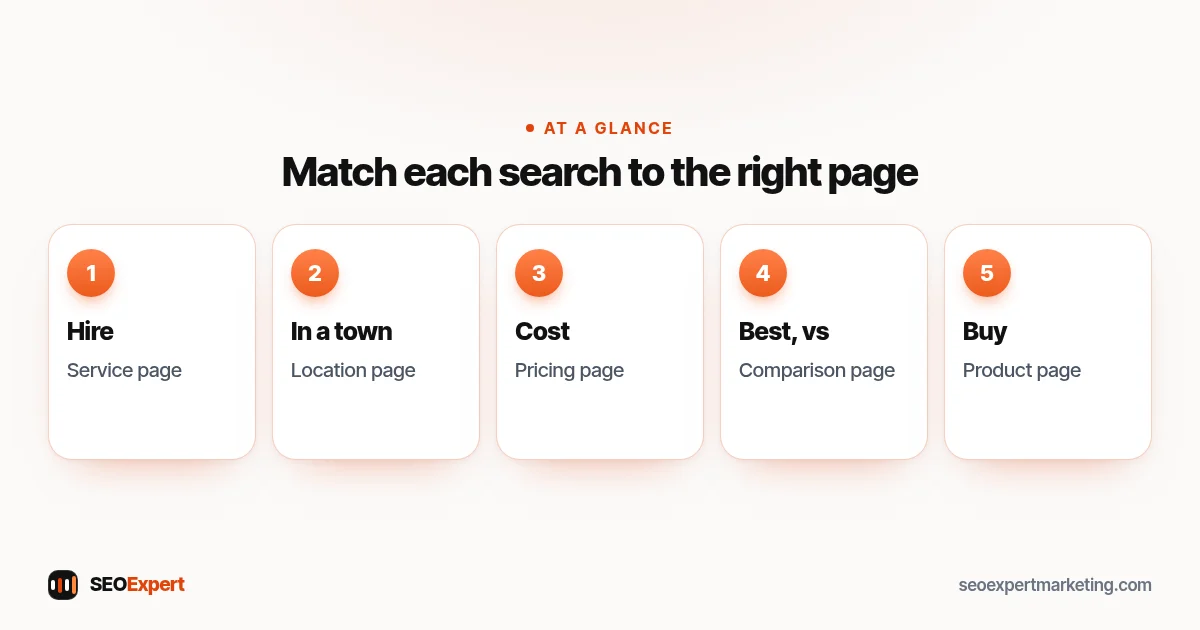
The most common mistake is putting buying searches on the wrong type of page. Someone searching "emergency electrician near me" wants a phone number, prices and proof you cover their area, not a 2,000-word article about wiring. Match the page to the intent:
- Service pages for "[service] company", "[service] near me" and "hire [service]". One main service per page.
- Location pages for "[service] in [town]", when you genuinely serve that town and have something specific to say about it.
- Pricing pages for "cost", "prices" and "packages". Even a price range or "from" price helps the visitor and matches what they asked.
- Comparison pages for "best", "vs" and "alternatives", written honestly.
- Product pages for "buy [product]" in online stores. Our product page SEO guide covers these.
Blog posts still have a job. They answer the informational questions people ask earlier, build trust and link to the right service page when the reader is ready. A good SEO content strategy uses both.
Once you have a shortlist, give each page one main phrase. Our guide to choosing a target keyword explains how.
How to optimize a page for high intent keywords
- Put the main keyword in the page title, the H1 and the first paragraph, written naturally.
- Answer the buying questions on the page: what's included, price or price range, areas covered, how fast you can start and how to book.
- Put a clear call to action near the top and again lower down: call, WhatsApp, quote form or booking link.
- Show real proof: genuine reviews, photos of your own work, qualifications and licenses where they apply.
- Make the page fast and easy to use on a phone, since many urgent searches happen on mobile.
- For local searches, keep your Google Business Profile complete and consistent with the page.
Measuring results
Rankings alone don't tell you whether your keywords are working. Track the actions that matter: calls, form enquiries, bookings and sales. In Google Analytics 4, mark form submissions and click-to-call as key events, then compare them with the queries and pages in Search Console. A page that gets 50 visits and 5 enquiries is worth more than one that gets 500 visits and none.
Common mistakes with high intent keywords
- Ignoring low search volume. A keyword with 30 searches a month can be worth more than one with 3,000, if those 30 people are ready to buy.
- Sending buyers to a blog post. If the page doesn't show the service, price and contact options, the visitor leaves.
- One page for every service. A single "Services" page rarely ranks for many separate high intent keywords. Give each main service its own page.
- Thin location pages. Copying one page and swapping the town name doesn't help readers, and Google treats it as low quality.
- Keyword stuffing. Repeating the phrase makes the page harder to read and doesn't help rankings.
- Only buying ads. Paid ads work for buying searches, but the traffic stops when the budget stops. Our comparison of SEO vs PPC explains when to use each.
Need help finding your high intent keywords?
Our keyword research service finds the searches your customers use, groups them by intent and matches each one to a page on your site. If you'd like to start with a free look at your website and the keywords it already ranks for, ask for a free website analysis.
High intent keywords: quick answers
What are high intent keywords?
High intent keywords are searches that show the person is ready, or nearly ready, to act: hire, book, buy or ask for a quote. Examples are "emergency plumber near me", "invisalign cost" and "buy trail running shoes".
What is the difference between commercial and transactional keywords?
Commercial keywords show someone comparing options, such as "best accountant for small business". Transactional keywords show they want to act now, such as "book accountant consultation". Both are high intent.
Are high intent keywords harder to rank for?
Often, yes, because many businesses want them. Long, specific versions, with the exact service, customer type or town, are usually easier for a small business and still bring ready-to-buy visitors.
Should blog posts target high intent keywords?
Usually not. Service, location, pricing and product pages are better for them. Blog posts should answer earlier questions and link to the page where the reader can act.
How do I find high intent keywords for free?
Read your customer enquiries, check the queries in Google Search Console, use Google's autocomplete and "People also ask", check volumes in Keyword Planner and look at the pages your competitors rank with.
Is "near me" a high intent keyword?
Yes. People who add "near me" usually want a local business soon. You don't need to write "near me" on your page; make your location, service area and Google Business Profile clear instead.
