
Handyman keywords are the words and phrases people type into Google when they need small repairs, fitting or odd jobs done, such as "handyman near me", "TV wall mounting" or "fix a sticking door". Choosing the right handyman keywords for each page of your website and your Google Business Profile helps the right local customers find you. This guide groups the best keywords for a handyman business into seven practical groups, shows how to check which ones people search in your own area, and explains where to use them without breaking Google's rules.
Why handyman keywords are different
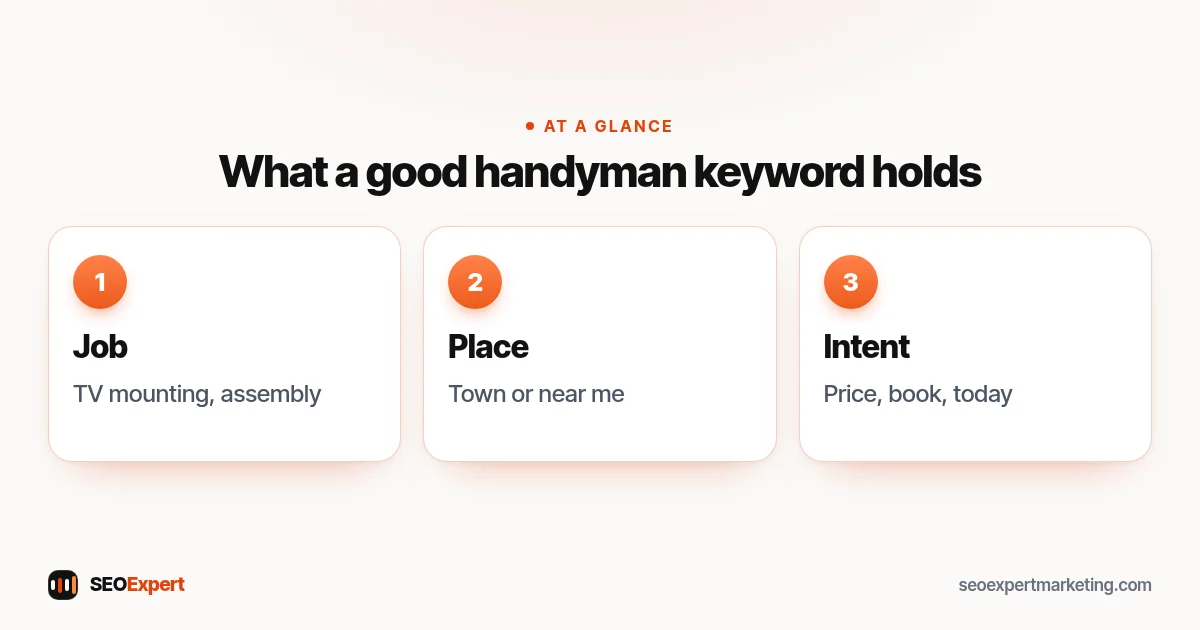
A handyman offers many small services, and customers rarely search for "handyman" alone. They search for the job: "assemble flat pack wardrobe", "replace a door handle", "patch a hole in the wall". They also add a place or "near me", because they want someone local. That means the best handyman keywords usually combine three things: the job, the location and a sign that the person is ready to book. Our guide to high intent keywords explains that last part.
Search demand also changes from town to town, and national figures can be misleading for a business that covers a few postcodes. So this guide doesn't list national search volumes. Instead, it shows the keyword groups to start with and how to check the numbers for your own area.
The 7 groups of handyman keywords
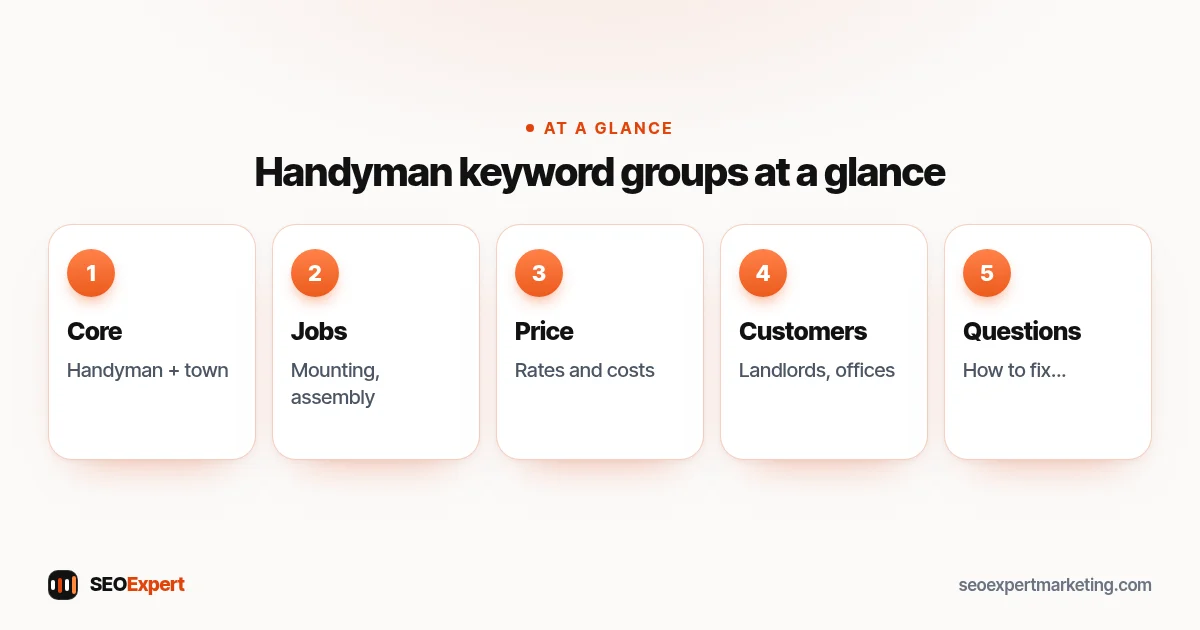
1. Core service and location
The phrases people use when they need a handyman in general: "handyman [your town]", "handyman near me", "local handyman", "handyman services [your town]" and "property maintenance [your town]". These belong on your home page and your main service area pages.
2. Specific jobs
The biggest group, and often the easiest to rank for. Examples: "furniture assembly", "flat pack assembly", "TV wall mounting", "shelf installation", "curtain pole fitting", "door hanging", "door repair", "drywall repair" (or "plasterboard repair" in the UK), "grout repair", "fence repair", "gutter cleaning" and "picture hanging". If a job brings regular work, it deserves its own section or page.
3. Urgent and same-day jobs
"Same day handyman", "emergency handyman" and "handyman available today". Only target these if you genuinely offer quick appointments, and say clearly when you can and can't come out.
4. Price and cost
"Handyman prices", "handyman hourly rate", "how much does a handyman charge" and "cost to mount a TV". People searching these are close to booking. A clear price guide or "from" prices on your service pages answers them directly.
5. Customer types
"Handyman for landlords", "end of tenancy repairs", "rental property maintenance", "handyman for elderly people" and "small office maintenance". If a group of customers brings repeat work, a page written for them can attract better jobs.
6. Questions and DIY problems
"How to fix a sticking door", "how to patch a hole in drywall", "why is my door not closing". Some people will fix it themselves; others will realise they need help. Short, helpful guides answering these can bring visitors who later book. Our guide to search queries explains how question searches work.
7. Trust and reassurance
"Insured handyman", "reliable handyman" and "handyman with reviews". Only use these words if they're true, and back them up with real details: proof of insurance, clear prices, photos of your work and genuine Google reviews. Repeating the words alone won't win you calls.
US and UK words for the same job
| US customers often search | UK customers often search |
|---|---|
| Drywall repair | Plasterboard repair, wall patching |
| Faucet replacement | Tap replacement |
| Yard work | Garden maintenance |
| Baseboard repair | Skirting board repair |
| Weather stripping | Draught proofing |
Use the words your local customers use. If you're not sure, listen to how people describe jobs on the phone, and check your Search Console queries.
How to find the best handyman keywords for your area
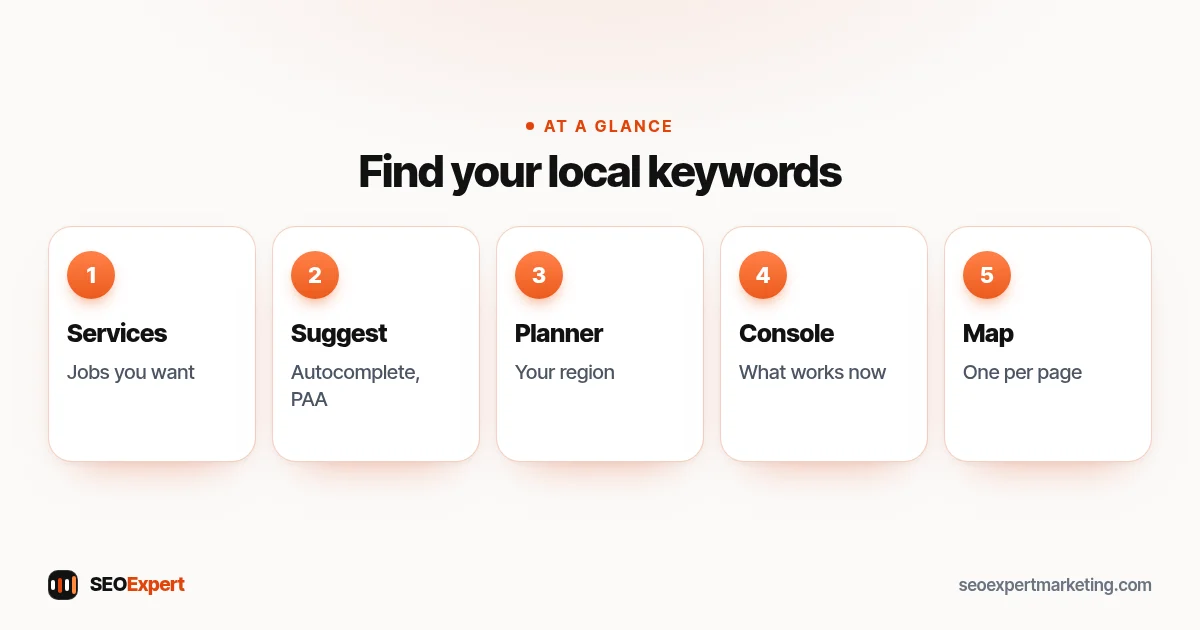
- List your real services. Write down every job you do often and want more of. Don't target jobs you don't do or aren't allowed to do: electrical and gas work, for example, often need specific qualifications.
- Use Google's suggestions. Type each job into Google and note the autocomplete suggestions, the "People also ask" questions and the related searches at the bottom of the page.
- Check volumes for your area. Google's Keyword Planner, inside a Google Ads account (Google asks for billing details when you set one up), lets you discover new keywords and get search volume and forecasts, and you can set the location to your region or city. Treat the numbers as rough, rounded estimates.
- Look at your Search Console data. The Queries report shows the handyman keywords your site already appears for. Our Google Search Console guide shows where. If you have a verified Google Business Profile, its performance section also shows the search terms people used to find you, updated each month.
- Check the competition. Search each phrase. If the results are directories and big national sites, a local page with real detail can still compete. The map results show Google Business Profiles, not web pages, so your profile matters there too.
- Map one main keyword to each page. Your TV mounting page targets TV mounting; your landlord page targets landlord repairs. See our guide to choosing a target keyword.
Seasonal handyman keywords
Many handyman keywords rise and fall with the seasons, and planning for that helps you fill quiet months. In many areas, searches for fence repairs, shed fixes and garden jobs tend to rise in spring, and gutter cleaning and draught proofing often come up in autumn. Before winter holidays, people want shelves, curtain poles and furniture assembled before guests arrive. Keyword Planner shows monthly trends for your region, and your own job diary shows when calls peak. Update the matching service page a few weeks before each season, with fresh photos and a short note about availability.
Where to use your handyman keywords
| Place | Example |
|---|---|
| Page title | TV Wall Mounting in Leeds | Smith Handyman Services |
| Main heading (H1) | TV Wall Mounting in Leeds |
| First paragraph | Say what you do, where, and how to book |
| Subheadings | "What's included", "Prices", "Areas we cover" |
| Image alt text | "55-inch TV mounted above a fireplace with hidden cables" |
| Google Business Profile services | List each main job as a service |
Write naturally after that. Repeating the same phrase over and over reads badly and can be treated as keyword stuffing.
Turning handyman keywords into helpful content
Question-style handyman keywords make good short guides. "How much does it cost to mount a TV?" can become a price guide that explains what affects the cost: wall type, TV size, hiding cables and brackets. "Why won't my door close properly?" can become a simple guide to the common causes, with a clear line on when it's worth calling a professional. Each guide should link to the matching service page, and the service page should link back. Before and after photos from real jobs, with the customer's permission, make these pages far more useful than generic text.
Handyman keywords and your Google Business Profile
Your Google Business Profile is often where local customers find you first, so it matters as much as your website.
- Business name: use your real name only. Google's guidelines for representing your business say your name should reflect your real-world name, and that including unnecessary information in your business name isn't permitted and could result in the suspension of your profile. "Smith Handyman Services" is fine if that's your real name; "Smith Handyman Leeds Cheap TV Mounting" is not.
- Categories: Google's help on business categories says to pick a primary category that best describes your business and to use a few additional categories rather than one for every service.
- Service area: if customers don't come to you, hide your address and list the areas you cover instead. Google says a service area shouldn't usually extend farther than about 2 hours' driving time from where the business is based, and a rented address where you don't actually operate (a virtual office) isn't eligible, so don't use one to appear in other towns.
- Services: add your main jobs as services, using the same words as your website.
- Description and posts: describe your main services and areas in plain words, and post photos of recent jobs.
Our guide to Google Business Profile optimization covers the rest.
Doing bigger renovation projects? Our guide to SEO for remodelers covers kitchens, bathrooms and project galleries.
Which pages should a handyman website have?
- Home page: handyman plus your main town, a list of jobs and how to book.
- Service pages: one for each job group that brings regular work, such as assembly, mounting, door and window repairs, and outdoor jobs.
- Area pages: only for places you really cover, with genuinely local details.
- Prices page: clear "from" prices or an hourly rate, with what's included.
- A few helpful guides answering common questions, linking to the matching service page.
Our guide to SEO for service businesses explains this structure in more detail.
See the same method with real patient search data in our guide to chiropractic keywords.
How to track your handyman keywords
Once your pages are live, check Search Console once a month. Filter by page and look at which handyman keywords bring impressions and clicks, and at the average position. Phrases sitting between positions 5 and 20 are often the quickest wins: improve that page with more detail, photos or prices. Most importantly, track calls, messages and booked jobs, and ask new customers how they found you. A keyword that brings two good jobs a month matters more than one that brings lots of visits but no bookings.
Example: a handyman's keyword map
Imagine a one-person handyman business in Bristol. Its most common jobs are flat pack assembly, TV mounting, shelves, door repairs and small garden jobs. Say Search Console already shows impressions for "tv wall mounting bristol" on the home page, and Keyword Planner suggests "furniture assembly" and "flat pack assembly" are both searched locally. The keyword map becomes: home page "handyman Bristol"; a TV mounting page; an assembly page covering both furniture and flat pack phrases; a doors and windows page; and a price guide answering "how much does a handyman charge in Bristol". Each page gets real photos, from-prices and the areas covered.
Common mistakes with handyman keywords
- One "Services" page listing 40 jobs in a single sentence.
- Keywords stuffed into the Google Business Profile name.
- Copy-pasted area pages that only swap the town name.
- Targeting work you don't do or aren't qualified for.
- Choosing handyman keywords only by national search volume, not by local demand and profit.
- Never checking Search Console to see what's already working.
Want help choosing your handyman keywords?
Our SEO for contractors service maps the right keywords to each of your pages and your Google Business Profile, using real search data for your area. To start, ask for a free website analysis.
Handyman keywords: quick answers
What are the best keywords for a handyman?
Usually a mix of service plus location ("handyman [town]", "handyman near me"), specific jobs ("TV wall mounting", "furniture assembly"), price searches and customer types such as landlords. Check which ones people search in your own area.
How do I find handyman keywords for my town?
Use Google's autocomplete and People also ask, Keyword Planner with your region selected, and the Queries report in Google Search Console.
Should I put keywords in my Google Business Profile name?
Only if the word is part of your real business name, as it appears on your van, website and invoices. Google's guidelines say your name should reflect your real-world name, and adding unnecessary information, such as a town or extra services, could lead to suspension.
Do I need a separate page for every handyman job?
Not for every job. Give a page to each group of jobs that brings regular work, such as assembly or mounting, and cover smaller jobs within those pages.
Are national search volumes useful for a handyman?
Only as a rough guide. A handyman serves a small area, so local demand, your Search Console data and the jobs you want more of matter more.
How many keywords should each page target?
One main keyword per page, plus close variations and related questions with the same intent.
