
Chiropractic keywords are the words patients type into Google when they look for a chiropractor, such as "chiropractor near me", "back pain chiropractor" or "is a chiropractor a doctor". Knowing which chiropractic keywords people really use, and how many search for each, helps a clinic decide which pages to build and what questions to answer. This guide groups real US search data from Semrush (October 2026) into five practical groups, shows which phrases are easier to compete for, and explains how to use them without making health claims you can't back up.
How to read the numbers
The figures below are average monthly searches in the US from Semrush, with keyword difficulty (KD) on a 0 to 100 scale, where lower means it's easier to reach the top 10 regular (organic) results. KD doesn't measure the map results, which depend on your Google Business Profile. They are national estimates: your town will see a small fraction of them, and the mix differs by area. Use them to compare phrases, then check your own region with Google's Keyword Planner and your Search Console data. Our guide to choosing a target keyword explains the method.
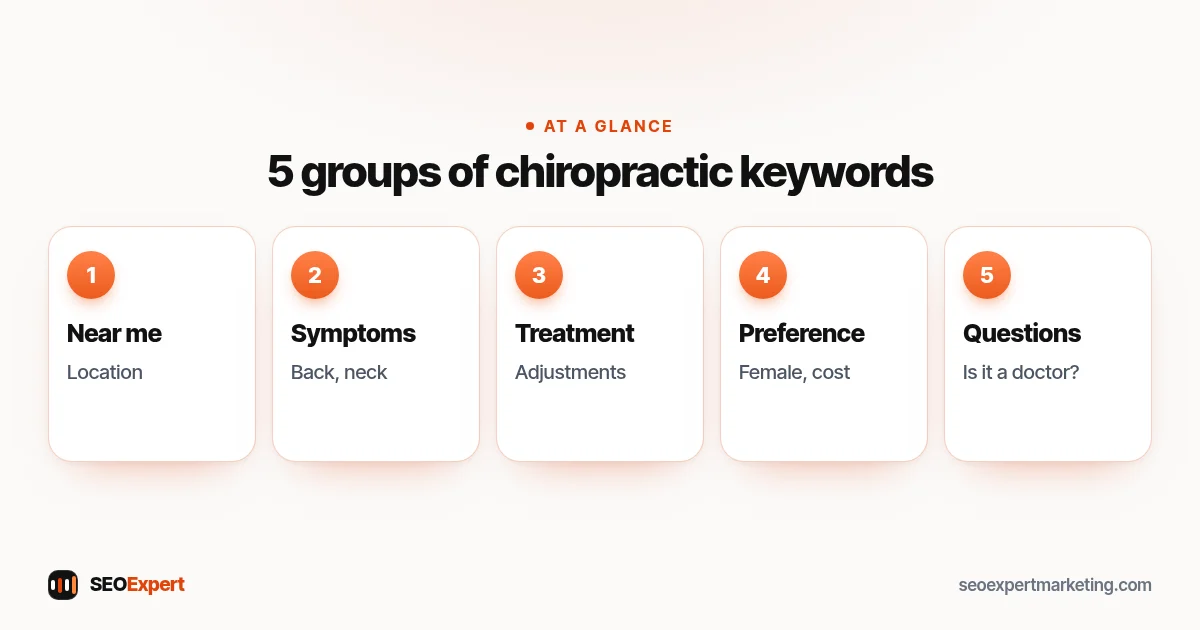
Group 1: "Near me" and location searches
| Keyword | Monthly searches (US) | KD |
|---|---|---|
| chiropractor near me | 246,000 | 65 |
| chiropractors near me | 33,100 | 47 |
| best chiropractor near me | 18,100 | 54 |
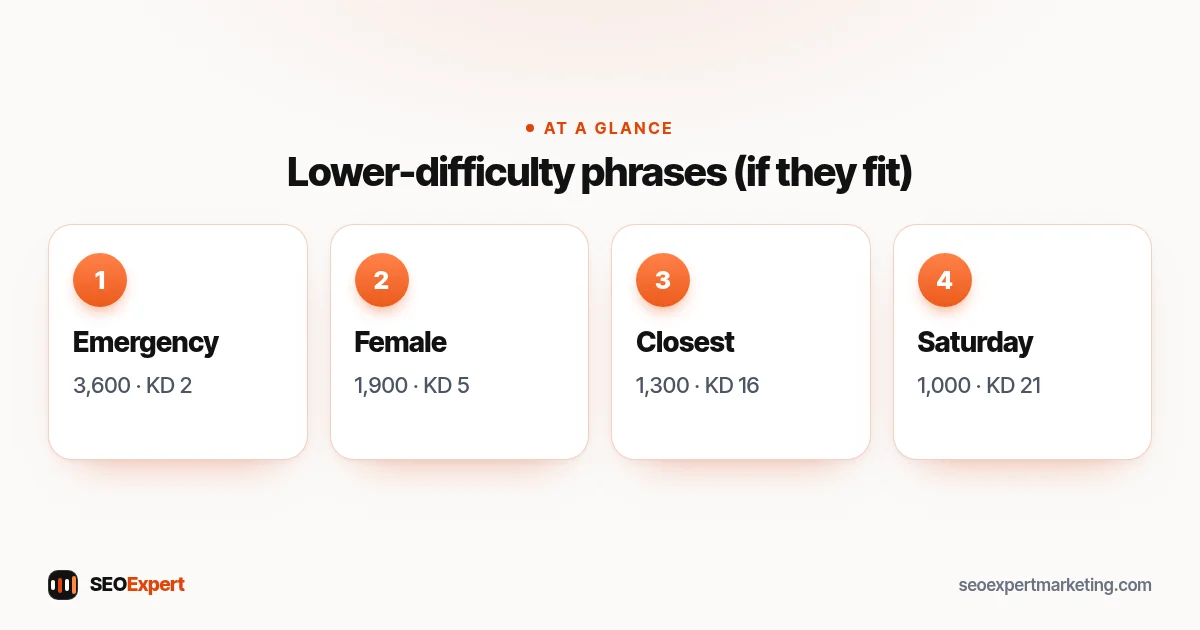
| emergency chiropractor near me | 3,600 | 2 |
| closest chiropractor near me | 1,300 | 16 |
| chiropractor near me open saturday | 1,000 | 21 |
| chiropractor near me now | 880 | 27 |
Results for "near me" searches often include a map of local businesses, so these chiropractic keywords depend heavily on your Google Business Profile: the right category, accurate hours (including Saturdays if you open then), photos and genuine reviews. Only target "emergency" or "open now" phrases if you really offer same-day or out-of-hours appointments, and say clearly on that page when someone should call 911 (999 in the UK) or go to the emergency department instead. Our guide to local SEO keywords covers how place-based searches work.
Group 2: Symptom and condition searches
| Keyword | Monthly searches (US) | KD |
|---|---|---|
| chiropractor for back problems | 6,600 | 54 |
| back pain chiropractor | 5,400 | 63 |
| chiropractor for lower back pain | 1,300 | 27 |
| back pain chiropractor near me | 1,300 | 13 |
| chiropractor for neck pain | 1,000 | 22 |
| knee pain chiropractor near me | 880 | 1 |
These are valuable but sensitive. A page built around a condition is a claim that you treat it. In the UK, the Advertising Standards Authority's guidance on chiropractic advertising lists the conditions chiropractors may claim to treat, some only in limited forms (for example, back pain not arising from injury or accident, mechanical neck pain rather than whiplash, and knee pain from osteoarthritis alongside core treatment and exercise), and says claims beyond them would need robust clinical evidence.
Other countries have their own rules. In the US, the FTC expects health claims in ads to be truthful, not misleading and backed by evidence, and your state chiropractic board may add its own advertising rules. Check what you're allowed to say before targeting any condition keyword.
Group 3: Treatment searches
- "chiropractor adjusts": 4,400 searches, KD 14
- "full body adjustment chiropractor near me": 1,000 searches, KD 29
People searching for treatments want to know what happens in an appointment. A clear page explaining your approach, what a first visit involves, how long it takes and what it costs answers these chiropractic keywords better than a generic services list.
Group 4: Patient preference searches
- "female chiropractor near me": 1,900 searches, KD 5
- "cheap chiropractor near me": 1,300 searches, KD 25
- "low cost chiropractor near me": 880 searches, KD 22
Low difficulty scores suggest fewer strong websites target these phrases, but for "near me" searches your real competition is the other clinics in your local map results, which KD doesn't measure. If your clinic has a female chiropractor, say so on her profile and your team page, with her consent. If you offer lower-cost options, such as introductory consultations or package pricing, explain them honestly with real prices. Don't create pages for preferences you can't meet.
Group 5: Patient questions
| Question | Monthly searches (US) | KD |
|---|---|---|
| is a chiropractor a doctor | 4,400 | 17 |
| what do chiropractors do | 4,400 | 32 |
| are chiropractors safe | 2,900 | 26 |
| when to see a chiropractor | 1,600 | 15 |
| is a chiropractor a real doctor | 880 | 7 |
Questions like these suit short, careful guides or an FAQ page. Answer them accurately, explain qualifications and regulation in your country, and say when someone should see a doctor instead. Be exact about titles: US chiropractors hold a Doctor of Chiropractic (DC) degree, not a medical degree (MD), and in the UK the ASA lets chiropractors use "Dr" only when the title is qualified so it doesn't mislead. Google's guidance on helpful, reliable, people-first content says its systems give even more weight to content with strong experience, expertise, authoritativeness and trust for topics that could significantly impact people's health, so name the qualified author and keep claims evidence-based.
Turning chiropractic keywords into pages
A simple keyword map stops you building pages that compete with each other. Give each page one main phrase and a few close variations:
| Page | Main chiropractic keywords | Supporting phrases |
|---|---|---|
| Home page | chiropractor [town] | chiropractor near me, closest chiropractor |
| Back and neck pain page (if allowed) | back pain chiropractor [town] | chiropractor for neck pain, lower back pain |
| First visit page | what to expect at a chiropractor | chiropractor adjusts, full body adjustment |
| Team page | your chiropractors' names | female chiropractor near me (if true) |
| Prices page | chiropractor prices [town] | low cost chiropractor, first appointment cost |
| FAQ or guides | is a chiropractor a doctor | when to see a chiropractor, what chiropractors do |
Our guide to high intent keywords explains why booking-ready phrases deserve your strongest pages.
Writing about patient questions safely
Question-style chiropractic keywords bring people who are still deciding, so the way you answer matters. Write in plain words, explain what chiropractors are trained and registered to do where you practise, and be clear about limits: when symptoms need a GP or emergency care, and which conditions you don't treat. Name the qualified author and add a "last reviewed" date. Avoid promises of results, and link to your regulator or professional body where that helps people check facts for themselves.
Reviews and patient privacy
Patients often mention their condition in reviews, which naturally adds relevant words to your profile. You don't need to ask them to include keywords, and you shouldn't. When replying, never confirm someone is a patient or mention their treatment, even if they did; thank them in general terms. Ask every patient for a review in the same way, and never offer discounts, free sessions or gifts in return: Google's review policy doesn't allow incentives for any review.
Local differences in chiropractic keywords
National figures can hide local differences. In some areas people may search "chiropractor" plus a neighbourhood; in others, plus a nearby city. Commuter towns may search for early or late appointments, and areas with many sports clubs may search for sports-related care. Check your own region in Keyword Planner and look at the exact phrases in Search Console before you build pages.
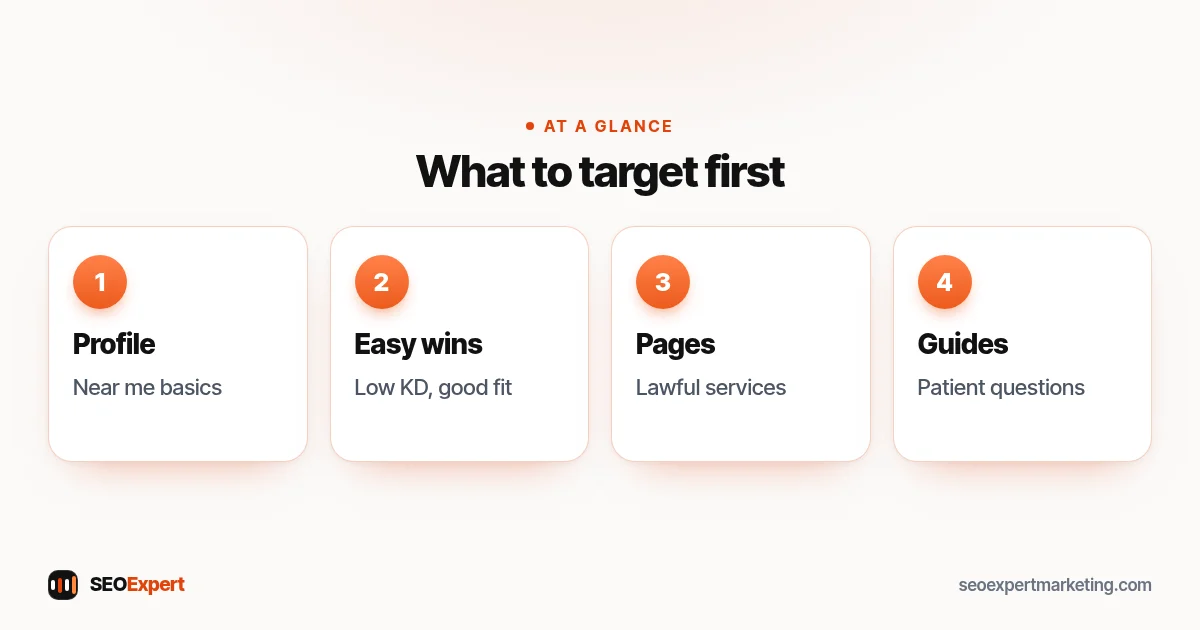
Which chiropractic keywords to target first
- Your Business Profile and "near me" basics. They have by far the most searches in the data above, and improving your profile costs nothing.
- Low-difficulty, high-fit phrases. If they match your clinic and what you're allowed to claim, phrases such as "emergency chiropractor near me" (KD 2), "female chiropractor near me" (KD 5) and "back pain chiropractor near me" (KD 13) have lower difficulty scores in the regular results.
- One page per main service or patient group you can lawfully describe.
- Question guides that build trust and link to booking.
Chiropractic keywords for new and established clinics
A new clinic with no reviews and a young website usually can't compete for the biggest chiropractic keywords straight away. Start with a complete Business Profile, accurate hours, a page for each main service and the lower-difficulty phrases that fit you, then ask every patient for a review. An established clinic with years of reviews can aim higher: improving the pages that already rank on page two, adding practitioner profiles and building guides around the patient questions above. In both cases, the right chiropractic keywords are the ones that match what you actually offer.
Tools for researching chiropractic keywords
- Google autocomplete and "People also ask": free, and they show the wording patients use.
- Google Keyword Planner: search ranges for your region inside a Google Ads account.
- Search Console: the chiropractic keywords your site already appears for, with positions.
- Business Profile performance: the search terms people used to find your profile.
- Paid tools such as Semrush: volumes and difficulty scores like the ones in this guide, useful for comparing phrases.
Where to use chiropractic keywords
- Page titles and headings: "Chiropractor in [Town]: Back and Neck Pain Care", only if the claims are allowed.
- Your Google Business Profile: real business name only, the chiropractor category, services and accurate hours. Google's guidelines for representing your business say unnecessary information in the name isn't permitted and could lead to suspension.
- FAQs: the patient questions above, answered carefully.
- Practitioner profiles: qualifications, registration and special interests.
Keywords to avoid or handle carefully
- Conditions you can't lawfully claim to treat.
- Words like "cure" or promises of results.
- Career searches such as chiropractor salaries or how to become one: they bring students, not patients.
- Competitor clinic names.
- Rankings words such as "best" in your own claims, unless you can support them.
Example: a two-chiropractor clinic
Imagine a clinic with two chiropractors, one male and one female, open Saturday mornings. The keyword plan: update the Business Profile with Saturday hours and the chiropractor category; create a page for back and neck pain care written within the regulator's guidance; add both practitioner profiles, mentioning the female chiropractor with her consent; publish a short guide answering "is a chiropractor a doctor" for their country; and track bookings from each page. They skip career searches and any condition they can't support with evidence.
How to track your chiropractic keywords
Check Search Console monthly for the phrases bringing visitors to each page, and your Business Profile performance for calls and direction requests. Most importantly, track new patient bookings by source. A phrase that brings a few bookings a month matters more than one that brings visits but no appointments.
Want help with chiropractic SEO?
Our SEO for chiropractors service builds pages and profiles around the searches patients really make, within the advertising rules that apply to you. To start, ask for a free website analysis.
Chiropractic keywords: quick answers
What are the best chiropractic keywords?
It depends on your clinic and area. Big phrases like "chiropractor near me" matter most for your Google Business Profile, while lower-difficulty phrases such as "emergency chiropractor near me" or "female chiropractor near me" can be easier to win if they fit your clinic.
How many people search for a chiropractor near me?
Semrush estimates about 246,000 US searches a month for "chiropractor near me" (October 2026). Your town will see a small share of that.
Can chiropractors target condition keywords?
Only for conditions they're allowed to claim. In the UK the ASA says claims beyond the accepted conditions need robust clinical evidence; other countries have their own rules.
Should chiropractors answer patient questions on their website?
Yes, carefully. Questions like "is a chiropractor a doctor" and "when to see a chiropractor" are searched often; answer them accurately with a named, qualified author.
Are career searches useful for chiropractors?
Usually not. Searches about chiropractor salaries or training bring students, not patients.
How do I check chiropractor keywords for my area?
Use Google's Keyword Planner with your region, your Search Console queries and your Business Profile performance.
