
Niche keywords are the specific searches made by a small, well-defined group of people: "gluten-free wedding cakes", "heat pump installer for old houses" or "standing desk for short people". If you serve a niche, these searches matter more than broad, popular terms, because the people typing them want exactly what you offer. This guide explains how to research keywords for a niche in seven steps, where to find niche keywords that tools miss, and how to decide which ones deserve a page.
What are niche keywords?
A niche is a focused part of a bigger market. Niche keywords are the words that part of the market uses when it searches. They're often longer and more specific than general terms, but not always: a two-word search can be a niche keyword if only a small, specialist group makes it.
For a small business, your niche is usually your specialty. A bakery might specialize in gluten-free cakes, a plumber in heat pumps, an accountant in contractors or a shop in one type of product. Ranking for broad terms like "bakery" or "plumber" is hard and often brings the wrong visitors. Ranking for the searches that match your specialty is more realistic and brings people who are a better fit.
Niche keywords vs long-tail keywords
The two overlap but aren't the same. Long-tail keywords are specific searches that each get few searches a month; they're usually longer, like "best running shoes for flat feet". Niche keywords belong to a specialist market, whatever their length. "Fly-tying vise" is short but niche; "cheap blue t-shirt size large" is long-tail but not niche. In practice, most niche keywords for a small business are long-tail too, which is why they're often easier to rank for than broad terms.
Why keyword research for a niche is different
- Small numbers. Keyword tools often show niche searches as 0 to 10 a month. Those estimates are rough, and a search made a few times a month by the right buyers can still be worth a page.
- Missing data. Tools estimate from limited data, so many rare phrases aren't in their databases at all. You have to find them in other places.
- Insider language. Experts and beginners use different words for the same thing. Your keywords should match the people you want to reach, not your own jargon.
- Different competition. In many niches, the results pages show forums, small blogs or thin pages instead of big brands. That can be a sign of an opening.
Our guide on how to do keyword research covers the general method. Below is how to adapt it for niche keywords.
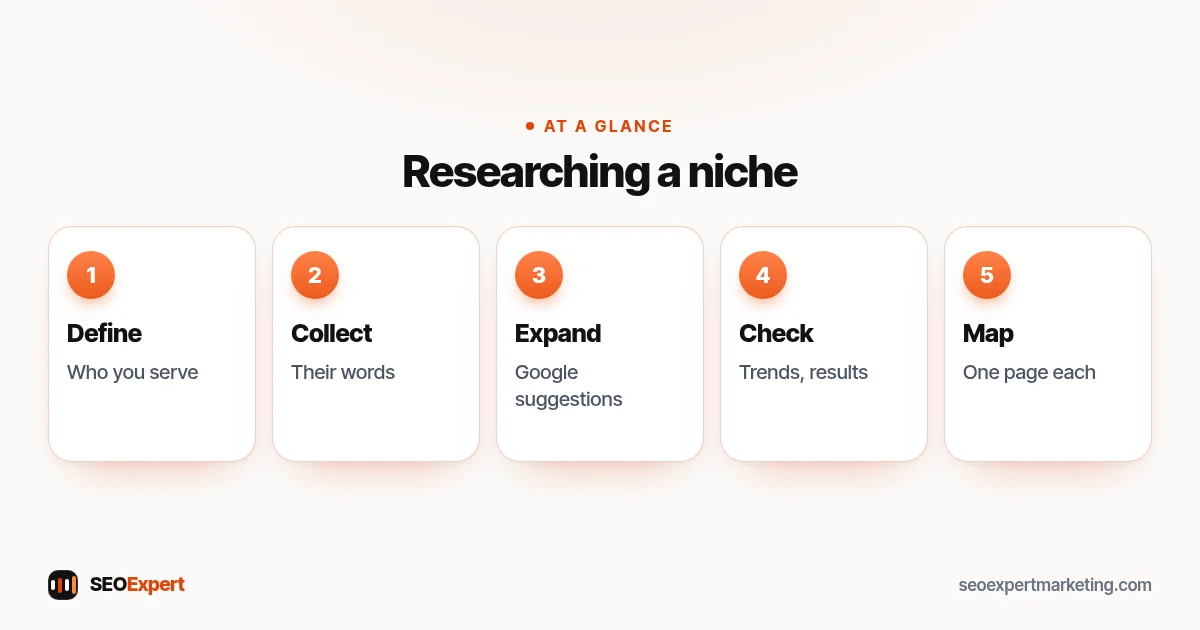
How to research keywords for a niche: 7 steps
Step 1: Define your niche and audience
Write one sentence describing who you serve, what problem they have and what they can spend. For example: "Couples in our region planning a wedding where one partner has coeliac disease." Then decide whether you're writing for beginners, who need explanations, or experienced buyers, who compare specifications. This decides which niche keywords you go after.
Step 2: Collect the words your audience uses
The best niche keywords come from real conversations. Read your customer emails, enquiry forms and call notes. Read reviews of your business and of competitors. Look at forums, Reddit threads, Facebook groups, YouTube comments and question sites where your audience talks. Copy the exact phrases people use, including their questions and complaints. These are often the searches tools never show.
Step 3: Expand with Google's own suggestions
Type your main terms into Google and note the predictions. Google says its autocomplete predictions reflect real searches that have been done on Google, shaped by language, location, trending interest and your past searches. Add a letter after your term ("gluten-free cake a", "gluten-free cake b") to see more. Then note the "People also ask" questions and the related searches at the bottom of the results page.
Step 4: Check demand and trends
Use Google Trends to compare two phrases and see which one is searched more, and whether interest rises at certain times of year. Trends shows relative interest on a 0 to 100 scale, not search counts, and phrases with very few searches show as 0, so compare shorter versions of your phrases. Google's Keyword Planner, inside a Google Ads account with billing details set up, gives monthly search estimates; accounts that spend little on ads may see only broad ranges. Once you have pages live, Google Search Console shows real searches that already find you, including many that no tool lists, though Google hides some very rare ones for privacy.
Step 5: Study the results page
Search each important phrase and look at what ranks. Are the top results shops, guides, forums or videos? That tells you the intent and the type of page to create. If the results are old posts or pages that don't fully answer the question, a focused, well-written page has a real chance. Forum threads are different: Google now shows many of them on purpose for first-hand experience, so to beat them your page needs your own photos, steps and examples.
Step 6: Group niche keywords into topics
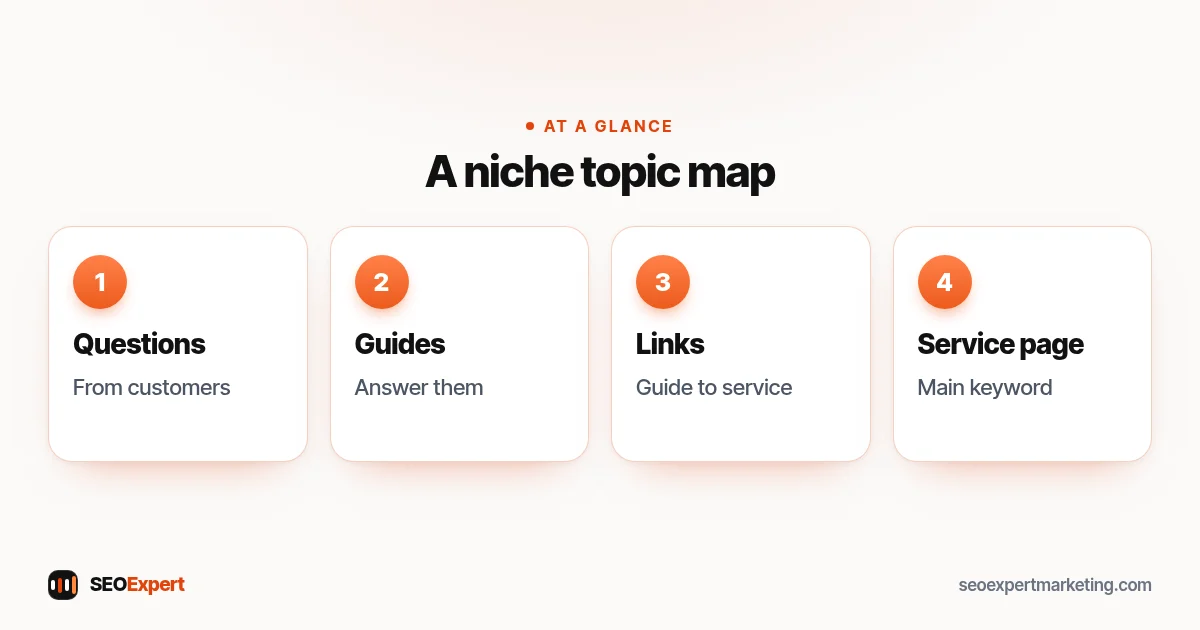
Put phrases that mean the same thing into one group, and give each group one page. "Coeliac-safe wedding cake" and "gluten-free wedding cake" probably belong on one page; "how to keep a cake gluten-free at a venue" might be a separate guide. To check, search both phrases: if most of the top results are the same pages, one page can cover both; if the results differ, plan separate pages. One main keyword per page avoids pages competing with each other; our guide to target keywords explains how to choose it. Link the guides to your main service or category page so visitors can move from learning to buying.
Step 7: Prioritize by value
Start with the niche keywords closest to a sale: searches that include a product, a service, a price question or a comparison. Then add guides for the questions people ask earlier in their research. Our guide to high intent keywords explains how to spot the searches that bring buyers.
Where to find niche keywords
| Source | What you get | Tip |
|---|---|---|
| Customer emails and calls | Exact questions buyers ask | Keep a running list |
| Reviews | The words customers use for results and problems | Read competitors' reviews too |
| Forums and Reddit | Detailed problems and comparisons | Search the niche name plus "help" or "recommend" |
| Google autocomplete and "People also ask" | Common searches and questions | Try each letter after your main term |
| YouTube | How-to searches and video titles | Check the search suggestions and comments |
| Marketplace search bars | Product words shoppers use | Note the suggestions as you type |
| Your own site search | Exact words visitors type on your site, including products you don't stock yet | Check the search terms in Google Analytics or your shop platform's reports |
| Google Search Console | Real searches already finding your site | Look for queries with impressions but no page written for them |
How to judge whether a niche keyword is worth a page
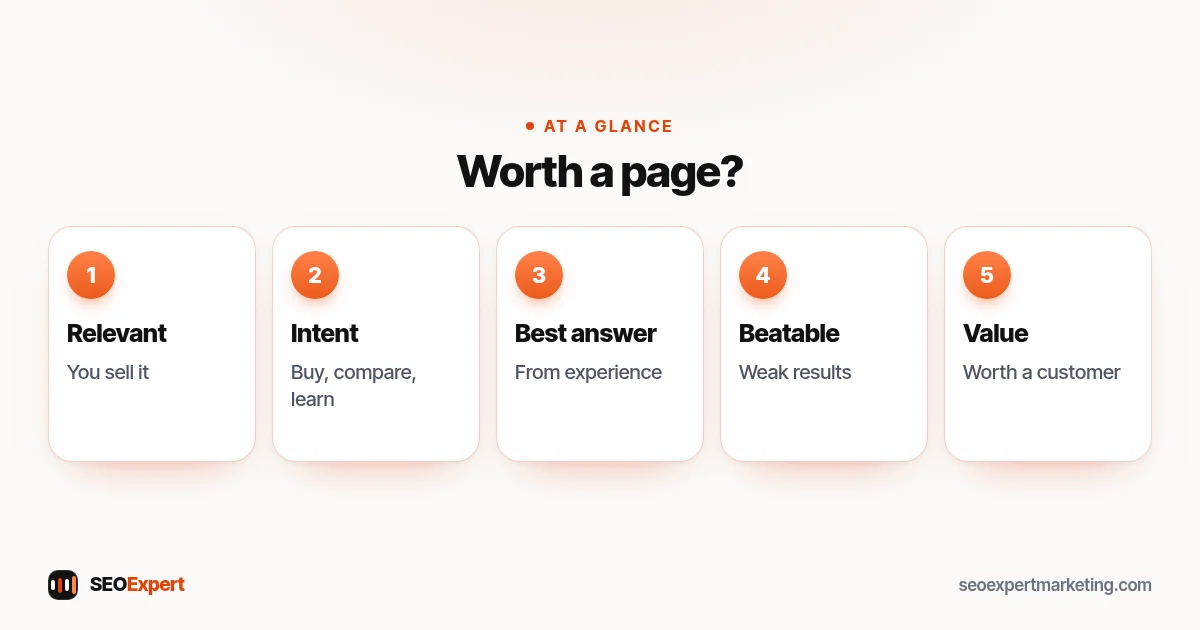
Ask five questions before you write:
- Relevant: does it match something you sell or know well?
- Intent: does the searcher want to buy, compare or learn, and can your page serve that?
- Best answer: can you write something more useful than what ranks now, from real experience?
- Beatable: are the current results weak, old or off-topic?
- Value: is one customer from this search worth the effort?
A keyword that tools call "zero volume" can still pass all five. If customers ask the question in emails, others are probably searching for it too.
A made-up example: a gluten-free bakery
Imagine a small bakery that wants more wedding cake orders from couples who need gluten-free options. Broad terms like "wedding cakes" are dominated by big directories and national bakeries. So the owner collects phrases from past enquiries and coeliac forums: "gluten-free wedding cake", "coeliac-safe cake" (US searchers spell it "celiac"), "gluten and dairy free wedding cake" and "how to stop cross-contamination at a wedding".
Autocomplete adds variations with the town name and with "near me". Google Trends shows "gluten-free" is used far more often than "coeliac-safe", so that phrase leads the main page, while "coeliac" appears in the text and headings. The bakery creates one strong service page for gluten-free wedding cakes and two guides answering the most common questions, all linked together. Every allergen claim is checked against the bakery's own process and food labelling rules ("gluten-free" has a legal meaning), because accuracy matters more than any keyword.
Once your niche list is ready, the next job is turning it into a plan. Our guide on what to do after keyword research covers grouping the list, mapping each group to one page and deciding what to write first.
Turning niche keywords into pages
Each group of niche keywords needs the right type of page. Searches that name a product or service usually need a service or product page with prices or price ranges, what's included and how to order. Comparison searches ("X vs Y") need an honest comparison. Questions need a clear guide that answers them in the first paragraph, then adds detail.
Use the main phrase naturally in the page title, the main heading and the opening paragraph, and use the variations where they fit. Write from experience: photos of your own work, the steps you follow and the mistakes you see customers make. In a small niche, readers quickly spot generic content. Our guide to SEO copywriting covers how to write pages that read well and rank.
Niche keywords for local service businesses
For a local business, a niche keyword often combines a specialty with a place: "heat pump installer" plus a town, or "listed building roofer" plus a county. Specialist services may have small search numbers locally, but the people searching usually have a specific job and a budget. Make the specialty clear on its own page, mention the areas you really serve and keep your Google Business Profile services list up to date. Our guide to local SEO keywords shows how to combine services and places without creating thin pages for every town.
Free and paid tools for niche keyword research
You can do most of this research for free: Google autocomplete, "People also ask", Google Trends and Search Console, plus Keyword Planner, which needs a Google Ads account with billing details set up. Paid keyword tools add estimated volumes, difficulty scores and competitor data, which help when you research many terms at once. Treat their numbers as estimates, especially for small niches, and don't rule out a phrase just because a tool shows no volume.
How to track niche keywords
Small numbers make tracking tricky: a page might get a handful of impressions a week, and positions can jump around. In Search Console, filter the Performance report by page to see the searches that find it, and check over months rather than days. Google hides very rare searches for privacy, so the list is never complete. Watch for new searches appearing that you haven't written about yet; they're ideas for your next page. Most important, track the enquiries and sales each page brings, because in a niche a few visitors can be worth more than thousands of general ones.
Common mistakes
- Chasing the biggest number instead of the best-fit searches.
- Using your trade's jargon when customers use plainer words.
- Creating a separate page for every tiny variation of the same phrase.
- Writing a guide when the results show people want a product or service page, or the other way round.
- Trusting tool numbers as exact counts.
- Researching once and never checking Search Console for new niche keywords.
Need help finding your niche keywords?
Our Keyword Research Report covers up to 30 keywords for one website, grouped by search intent and matched to existing or new pages, with easy quick wins marked. For ongoing work, see our keyword research services, or ask for a free website analysis.
Niche keywords: quick answers
What are niche keywords?
Niche keywords are the specific searches made by a small, well-defined group of people, such as a specialty product or service. They usually have lower search numbers but attract visitors who closely match what you offer.
How do I research keywords for a niche?
Define your audience, collect the phrases they use in emails, reviews and forums, expand with Google autocomplete and "People also ask", check trends, study the results pages, then group the phrases into pages and prioritize by value.
Are zero-volume keywords worth targeting?
Sometimes. Tools often miss small niche searches. If customers ask the question and you can answer it well, a page can still bring the right visitors.
What is the best free tool for niche keywords?
Google itself: autocomplete shows real searches people make, "People also ask" and related searches show connected questions, Google Trends compares phrases, and Search Console shows most of the searches already finding your site.
How many niche keywords should one page target?
One main keyword plus close variations with the same meaning. If two phrases need different answers, give them separate pages.
Is niche keyword research different for local businesses?
Yes. It usually combines a specialty with the places you serve, and your Google Business Profile categories and services matter too, alongside your website pages.
