
Setting an SEO budget is hard because SEO doesn't have a fixed price. You can spend nothing and do it yourself, or spend thousands a month with an agency. The right SEO budget for your business depends on what a new customer is worth, how competitive your market is and how quickly you need results. This guide gives you a simple five-step way to set one, using your own numbers rather than guesswork.
What does SEO usually cost?
Market prices are a sensible starting point. In Ahrefs' survey of 439 SEO providers, the most common monthly retainer was $501 to $1,000, and 68.8% of providers charged $2,000 a month or less. Providers serving local markets averaged about $1,557 a month, against about $3,474 for those working with clients worldwide. Our article on SEO agency pricing breaks these figures down further.
Those are averages across all kinds of businesses. A local plumber and a national online store don't need the same SEO budget, which is why it's better to work from your own numbers.
How to set your SEO budget in 5 steps
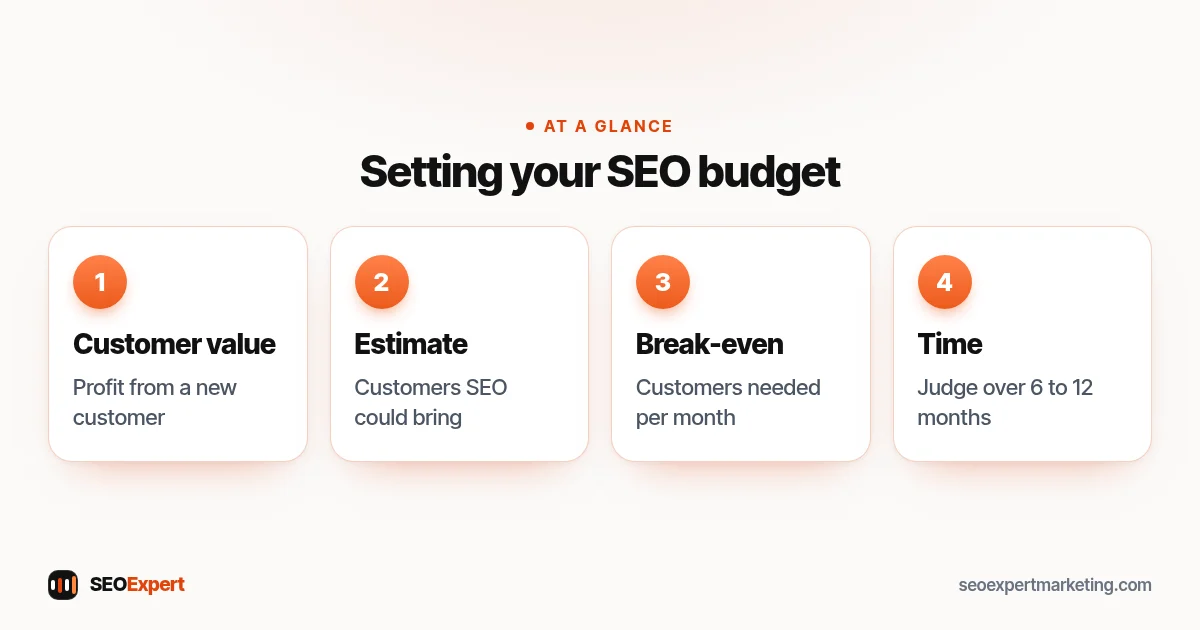
Step 1: Work out what a new customer is worth
Start with the profit from an average new customer, not the revenue. If customers come back, include repeat business over a year. A dentist whose new patients stay for years can justify spending more than a business that sells one low-margin item.
Step 2: Estimate how many customers SEO could bring
Look at how many people search for your services in your area and how many enquiries your site turns into customers today. Even a rough estimate helps. Our free SEO ROI calculator does this maths with your own numbers in about a minute.
Step 3: Set a break-even point
Divide the monthly cost of a plan by the profit per customer. If a plan costs $795 a month and each new customer brings $400 in profit, you need two extra customers a month to break even. If that sounds achievable within six to twelve months, the SEO budget is realistic.
Step 4: Allow for time
SEO usually takes several months to show steady results. Plan to keep the spending in place for at least six months before judging it, and look at progress signals in the meantime, such as impressions and enquiries. Our guide to how long SEO takes explains what to expect month by month.
Step 5: Decide how to split the money
Most of an SEO budget goes on four things: technical fixes, content, local SEO and links. Where the money should go depends on your site. A site with technical problems needs those fixed first; a healthy site with little content needs pages; a local business needs its Google Business Profile and reviews in order. An audit tells you which applies.
Typical SEO budget ranges by business type
| Business | Usual starting point | Why |
|---|---|---|
| Local service business in a small town | DIY or a few hundred dollars a month | Few competitors, local results matter most |
| Local business in a big city | Several hundred to around $1,500 a month | More competitors for the same searches |
| Online store | Often more, depending on products | Many pages, national competition |
| National or international site | Usually higher | Broad, competitive searches |
These are rough guides based on the survey figures above and how competition works, not fixed rules.
Hidden costs to include
The fee you pay a provider isn't the only cost. Content often needs your time: answering questions, checking facts, supplying photos and approving pages. Some fixes need a developer, especially on custom-built sites. Paid tools can add a monthly cost if you do the work yourself, although Google Search Console, Google Analytics and Google Business Profile are free. If your website is old or slow, a rebuild may be the better investment before any ongoing SEO. Ask any provider which of these costs they expect for your site, so there are no surprises in month three.
Four hidden costs to include in your SEO budget:

Example: setting a budget for a roofing company
Here's an illustrative example with made-up numbers. A roofing company makes about $1,200 profit on an average job. It currently gets two enquiries a month from its website and wins half of them. A $795 monthly plan would need one extra job every month or so to break even. Search Console shows the site appearing for roofing searches but mostly on page 3. The owner decides to start with a fixed-price audit, then commits to six months on a monthly plan, reviewing enquiries every month against the break-even point.
What if your SEO budget is very small?
A small budget can still go a long way if you spend it on the right things. Do the basics yourself: set up Google Search Console, complete your Google Business Profile, ask every happy customer for a review and make sure each service has its own clear page. Our DIY SEO guide walks through this. Then spend a small amount on expert help where it counts most, such as a one-off audit that tells you what to fix first.
Avoid cheap SEO that promises quick rankings. Bought links and mass-produced pages break Google's spam policies, and fixing the damage costs far more than doing it properly.
SEO budget vs ads budget
With Google Ads you pay for every click, and the visitors stop when the spending stops. With SEO you pay for work, and pages that rank can keep bringing visitors. Many small businesses split their marketing money: ads for quick leads while SEO builds up, then a gradual shift toward SEO as organic visits grow. If you're starting from zero, keeping some ad spend while you invest in SEO is often sensible.
How to tell if your SEO budget is working
- Months 1 to 3: work is being done and listed, technical issues are fixed and impressions in Search Console's Performance report start to rise.
- Months 3 to 6: more searches show your pages, positions improve and the first organic enquiries arrive.
- Months 6 to 12: enquiries from search grow steadily and you can compare them with your break-even point.
If nothing has moved after six months and the work list is thin, ask hard questions or change provider.
How to tell if your SEO budget is working over time:

Where our plans fit
Our SEO packages cost $395, $795 and $1,495 a month (USD), or $295, $595 and $1,095 a month paid yearly, and one-off jobs on our SEO price list start at $39, with a $59 audit. If your SEO budget is tight, the audit is a good first step: it shows what your site actually needs before you commit to anything monthly. Send us your website address on WhatsApp for a free review first.
SEO budget: quick answers
How much should a small business spend on SEO?
It depends on what a customer is worth and how competitive your market is. Work out how many extra customers a month a plan would need to pay for itself; if that's achievable within six to twelve months, the budget is realistic.
Is $500 a month enough for SEO?
For many local businesses in less competitive markets, a few hundred dollars a month on the right work can make real progress. In crowded markets or for online stores, it may only cover the basics.
What percentage of a marketing budget should go to SEO?
There's no reliable standard percentage. Base it on your goals and numbers instead: what a customer is worth, how many you need and how quickly you need them.
Should I cut my SEO budget if rankings don't move?
Check the work first. If useful work is being done and impressions are growing, give it time. If the work list is thin after several months, change the plan or the provider.
