SEO for technology companies has to serve two kinds of visitor at once: the person with a problem who has never heard of you, and the technical evaluator who wants to know exactly what your product does, what it connects to and how it behaves. This page is for small tech firms, such as SaaS start-ups, software and app developers, IT services firms, managed service providers (MSPs) and IT consultancies. It explains the six areas we work on, how a JavaScript-heavy site affects search, how pricing works and what a realistic first three months looks like.
If you sell to other businesses in general, our B2B SEO services page covers buying committees and long decisions. If your company is brand new, SEO for startups covers launching a site from zero. This page focuses on what is specific to SEO for technology companies.
What makes tech company SEO different
Tech company SEO, including SaaS SEO, uses the same foundations as any site, but four things change the work:
- Your product has a vocabulary. Buyers search feature names, integrations, file formats, protocols and error messages, not just "software for X".
- Many visitors are technical. Developers and IT admins skim fast, distrust marketing language and leave pages that hide the details.
- The site is often built with JavaScript frameworks. That can work well in search, or it can quietly hide pages from Google.
- The conversion is rarely a sale. It's a trial, a demo request, a sign-up or a call booked, often weeks before money changes hands.
Our six areas of SEO for technology companies
1. Feature pages and use-case pages, kept separate
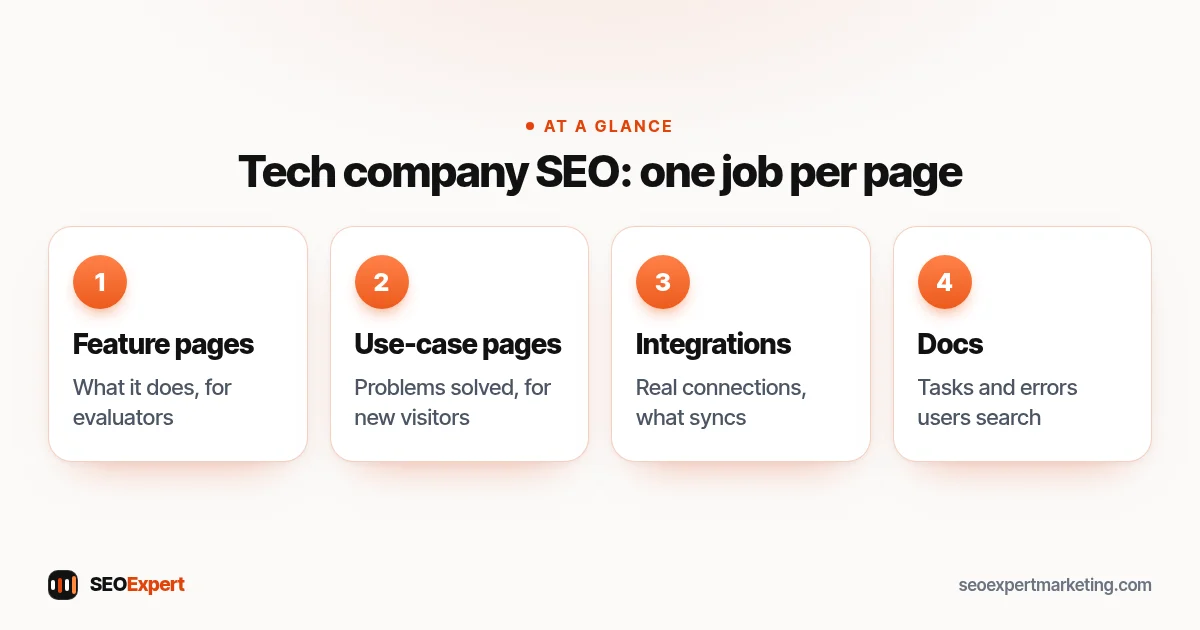
A feature page answers "what does it do?" for someone already evaluating you: what the feature is, how it works, limits, screenshots and which plans include it. A use-case page answers "how do I solve this problem?" for someone who doesn't know you yet, such as "automate client onboarding for an accounting firm". Many tech sites blur the two and rank for neither, so this split is the first step of SEO for technology companies. We map each important search to one page type, so every page has a clear job and pages don't compete with each other.
2. Integration pages that say what really works
People search "[your product] + [tool they already use]" before they buy. A page for each real integration, explaining what data syncs, in which direction, how setup works and what isn't supported, catches those searches and saves your support team questions later. In SEO for technology companies, only build pages for integrations that exist and work today; a page for a planned connector misleads buyers.
3. Comparison and alternatives pages, done honestly
"X vs Y" and "X alternatives" searches come from buyers close to a decision, so these pages are worth having. They only work long term if they're fair: compare on facts a buyer can check, date the comparison, say where a competitor is the better choice, and update the page when either product changes. Google's guide to creating helpful, reliable content asks whether a page provides original, complete information; a one-sided list of reasons you win is neither. We avoid claims about competitors that you can't back up.
4. Documentation and help-centre pages as entry points
Good SEO for technology companies treats the help centre as part of the site. Docs, API references, setup guides and troubleshooting articles often attract more searches than the marketing site, because users search the exact task or error message. We make sure your help centre can be crawled and indexed, that each article has a clear title and description, that old versions of the docs don't compete with current ones (Google explains how to consolidate duplicate URLs with canonical tags), and that good articles link to the relevant feature or trial page.
5. A site Google can actually render
Many SaaS sites and web apps are built with React, Vue, Angular or similar frameworks. Google's JavaScript SEO basics explains that Google processes JavaScript pages in three phases: crawling, rendering and indexing. The same guide notes that server-side or pre-rendering is still a great idea, because it makes sites faster and not all bots can run JavaScript. It also says Google can only discover links that are HTML <a> elements with an href attribute, so menus built from click handlers or URL fragments can hide pages. Our technical SEO services check what Google sees after rendering, not just the source code.
6. Measuring trials and demos, not just traffic
Tech sales cycles are long, so SEO for technology companies should be judged on pipeline. Someone may read a docs article today, compare you next month and book a demo after their team agrees. We set up tracking for trial sign-ups, demo requests and contact forms, and show which pages those visitors first arrived on, so decisions follow pipeline rather than page views.
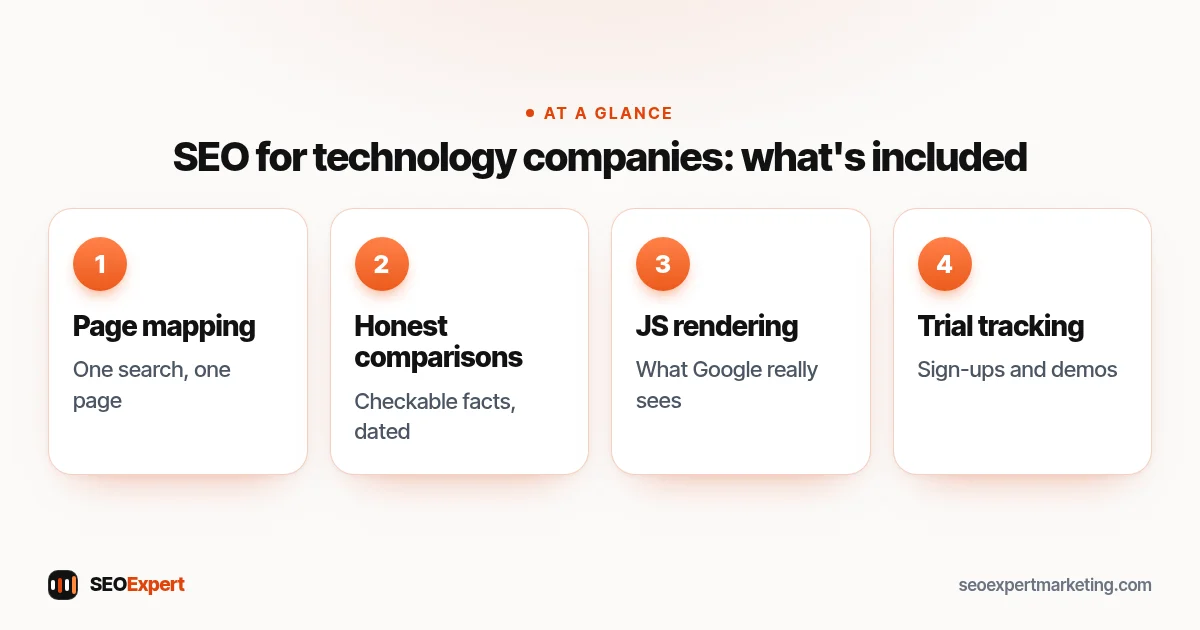
In short, SEO for technology companies with us covers four connected areas:
Writing for developer audiences
Developers and IT buyers respond to specifics: code samples, version numbers, real limits, pricing that is easy to find and honest answers about what the product can't do. They're put off by vague claims and gated basics, which is why SEO for technology companies depends on accuracy. We draft pages in plain language and ask someone on your team to check every technical detail before it goes live. Our SEO content writing services work the same way for blog articles and guides.
Local SEO for technology companies: MSPs and IT services
An MSP or IT support company usually sells to businesses within driving distance, so search often happens in Google Maps: "IT support near me", "managed IT services [city]". That means a complete Google Business Profile with the right category and service areas, following Google's Business Profile guidelines, plus service pages for what you really offer, such as managed IT, cybersecurity, cloud migration and help desk. Genuine reviews matter here; Google's spam policies and consumer law both work against fake ones.
Which platforms we work on
We make changes ourselves on WordPress and Shopify sites, which covers many marketing sites and some product sites. If your site or docs run on another stack, such as a custom React or Next.js app, a headless CMS or a docs generator, we audit it, write clear recommendations and content, and your developers make the changes. We say this upfront so nobody expects edits we can't make. Either way, the SEO for technology companies plan is the same; only who makes the change differs.
SEO for technology companies: pricing with us
Tech firms use the same plans as every client: SEO Starter at $395 a month, SEO Growth at $795 and SEO Authority at $1,495 (USD). Paid yearly, they cost $295, $595 and $1,095 a month, billed once a year. Monthly plans have no long contract, and every plan starts after a written proposal. A local MSP with a handful of services often starts with SEO Starter; a SaaS company with features, integrations and a help centre usually needs SEO Growth. You can compare the packages line by line.
If you'd rather start with one job, fixed-price options include a Full SEO Audit for $59 (credited to your first payment if a monthly or yearly plan starts within 30 days), a Keyword Research Report for $79, a Google Business Profile Setup for $99, a Technical SEO Fix Pack for $199, SEO Page Writing at $39 a page or 5 for $179, and Link Building Outreach at $149 for 3 or $249 for 5. The full list is on our SEO price list.
Who it suits, and who it doesn't
Our SEO for technology companies suits small tech firms with a clear product or service, someone technical who can review drafts for an hour or two a month, and the patience to build visibility over months. It doesn't suit companies wanting mass-generated feature or integration pages, comparisons that misrepresent competitors, or promised rankings. Manufacturers selling technical products may prefer our manufacturing SEO page, and you can see every sector we cover on our industries page.
A realistic first three months
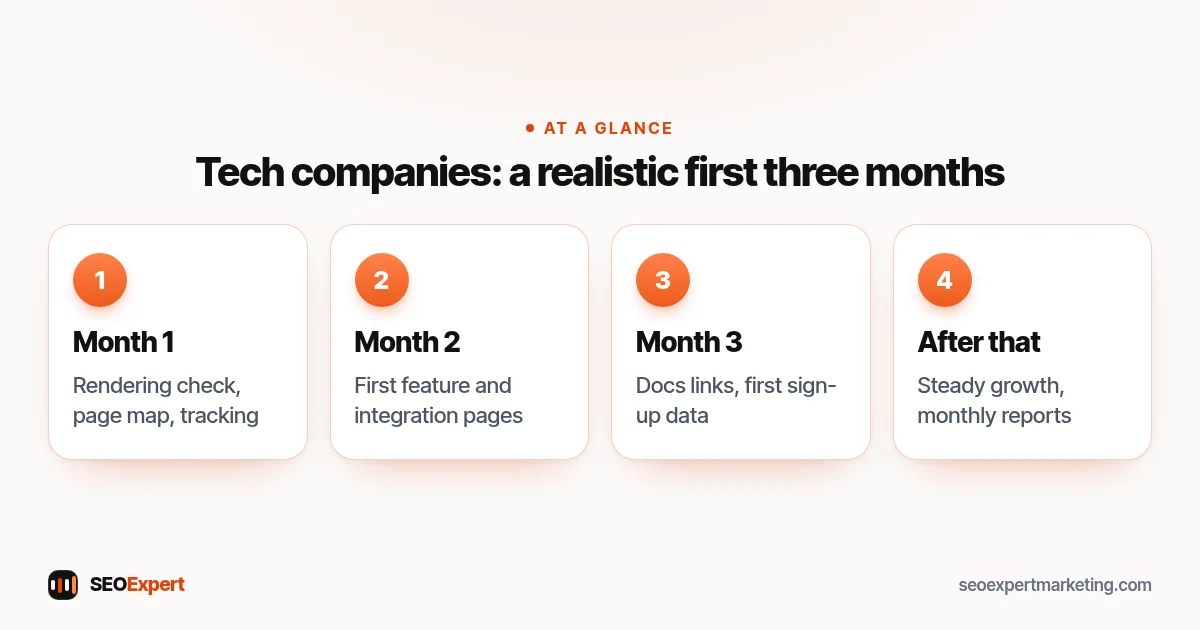
Month one is research and fixes: a crawl and rendering check, a map of searches to page types and tracking for trials and demos. Month two is building: the first feature, use-case or integration pages, and fixes to your help centre. Month three is expanding and measuring: more pages, internal links from docs to product pages and a first look at which pages bring sign-ups. SEO for technology companies on competitive terms usually takes longer, and nobody can honestly promise rankings. If you'd like a view of your own site first, ask for a free website review.