Choosing the best ecommerce platform for SEO is less about finding a platform that ranks you and more about avoiding one that holds you back. Google doesn't prefer Shopify over WooCommerce or any other platform; it ranks pages, not software. What the platform decides is how much control you have over URLs, page speed, content, structured data and crawling, and how much work it takes to get those right. This guide compares the main options honestly and gives you seven checks to make before you choose.
What makes a platform good for SEO?
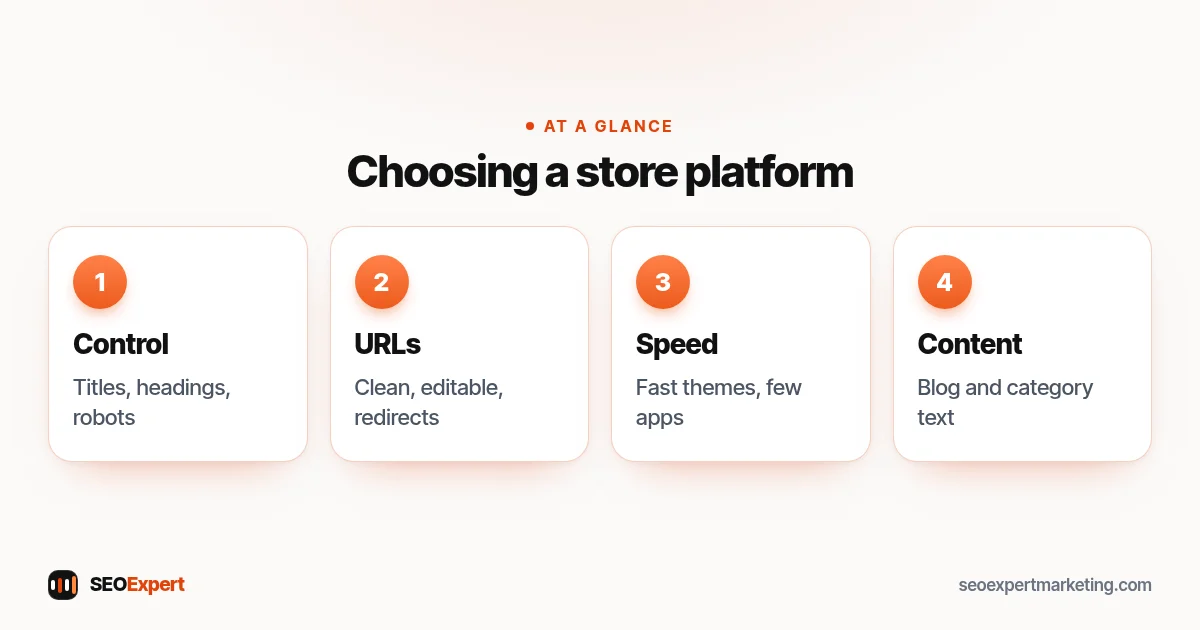
Google's ecommerce SEO guide describes what it needs from online stores: pages it can crawl and index, clear site structure, product data it can understand and pages that load well. A platform is good for SEO when it lets you deliver those without fighting it. In practice, look at:
- Control over titles, descriptions and headings on every page type.
- Clean, editable URLs and simple redirects.
- Canonical tags and sitemaps handled automatically and correctly.
- Control of crawling, especially for filter and search pages.
- Speed on phones, with themes and apps that don't add bloat.
- Content tools: a proper blog, category descriptions and flexible page layouts.
- Product structured data built in or easy to add.
Shopify
Shopify is often named the best ecommerce platform for SEO for small stores, mainly because it's easy to run. It's a hosted platform: it handles servers, security and updates for you. It generates sitemaps and canonical tags automatically, and its help center explains how to edit titles, descriptions and URL handles. Since 2021 you can also customize the robots.txt file through a theme template.
The main limits are structural: product, collection and page URLs sit under fixed paths such as /products/ and /collections/, and products are often reachable under collection paths too, relying on canonical tags. Apps can slow pages down. For most small and medium stores none of this is a serious barrier, and the low maintenance is a real advantage. Our Shopify SEO services page covers the platform in detail.
WooCommerce (WordPress)
WooCommerce is a free plugin that turns a WordPress site into a store. You get almost complete control: URLs, templates, structured data and robots.txt are all editable, and WordPress is strong for content. An SEO plugin handles titles, descriptions and sitemaps.
The trade-off is responsibility. You choose and pay for hosting, keep WordPress, plugins and themes updated, and fix speed problems yourself. A badly hosted WooCommerce store with too many plugins can be slow. Well set up, it's one of the most flexible options for SEO. See our WordPress SEO services for more.
Other hosted builders
Website builders rarely top lists of the best ecommerce platform for SEO, but they can be a sensible start. Website builders with store features, such as Wix and Squarespace, have improved their SEO tools a lot and suit small catalogs well. They handle hosting and give you settings for titles, descriptions and URLs. They usually offer less control over templates, structured data and advanced crawling than WooCommerce, which matters more as a catalog grows.
Best ecommerce platform for SEO: comparison
| Factor | Shopify | WooCommerce | Website builders |
|---|---|---|---|
| Hosting and updates | Handled for you | Your responsibility | Handled for you |
| URL control | Fixed path prefixes | Full control | Varies |
| Robots.txt | Editable via theme | Editable | Varies |
| Content and blog | Good | Excellent | Good |
| Speed | Good; apps can slow it | Depends on hosting and plugins | Varies |
| Best for | Most small to mid stores | Content-heavy stores wanting control | Small catalogs |
This is a general comparison; platforms change their features often, so check the current documentation before deciding.
7 checks before choosing a platform
Use these checks to find the best ecommerce platform for SEO for your own catalog:
- Can you edit the title, meta description and H1 on every page type? Including categories and filtered views you want indexed.
- Can you set your own URLs and add redirects? Essential when products change or you move from another platform.
- How are duplicate URLs handled? Check that canonical tags point to one version of each product.
- Can you control crawling of filters and internal search? Large stores need this most.
- How fast are the demo stores on a phone? Test real theme demos against Google's Core Web Vitals guidance.
- Is product structured data included? And can you add missing fields?
- Can you export everything? Products, content and URLs, in case you move later.
Which is the best ecommerce platform for SEO for you?
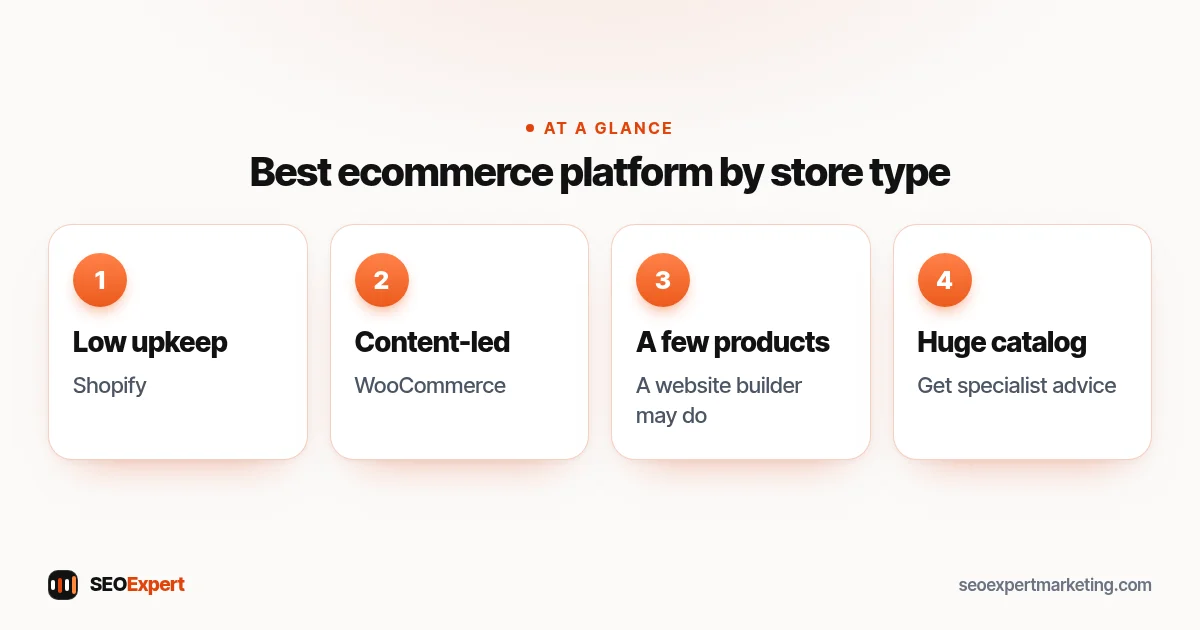
There's no single best ecommerce platform for SEO for every store. It depends on size, content plans and who maintains the site:
- A small to medium store that wants low maintenance: Shopify is usually the easiest choice, and its SEO limits rarely matter at this size.
- A store that relies on content, or wants full control: WooCommerce, with good hosting and someone to maintain it.
- A handful of products alongside a service business: a website builder may be enough.
- A very large catalog or complex needs: get specialist advice; the right answer depends on integrations and budget.
In all cases, the best ecommerce platform for SEO is simply the one you'll actually maintain well. A well-run store on any major platform will outrank a neglected store on the "best" one.
The best ecommerce platform for SEO, by type of store:
What matters more than the platform
Whichever you pick, the same work decides how well the store ranks: categories built around what people search for, unique product descriptions, fast pages, product structured data, genuine reviews and links from relevant sites. Our guides to category page SEO and product page SEO cover that work. Think of the best ecommerce platform for SEO as the one that makes this work easy for your team, not the one with the longest feature list. If a platform makes every change a support ticket or a developer job, the work tends not to happen, and that costs more rankings than any technical limit.
Questions to ask a platform's sales team
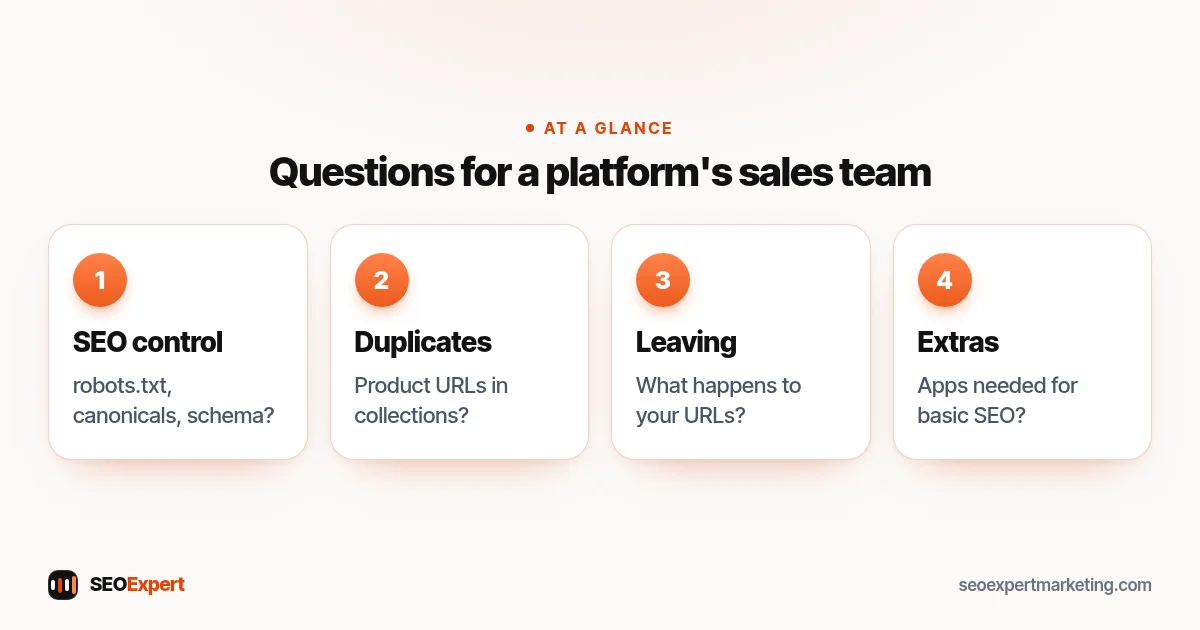
- Can I edit robots.txt, canonical tags and structured data?
- How do you handle duplicate product URLs across collections?
- What happens to my URLs and content if I leave?
- Which apps or plugins are needed for basic SEO, and what do they cost?
Clear answers to these four questions, and a short trial, tell you more about the best ecommerce platform for SEO for your store than any review site.
Questions to ask before you choose the best ecommerce platform for SEO:
Switching platforms without losing rankings
If you're moving, the biggest SEO risk is losing URLs. List every current URL that gets traffic or links, map each to its new address and set up permanent redirects before launch. Keep titles and content similar at first, then check Search Console daily for errors in the weeks after. Our guide to an ecommerce SEO audit covers the checks to run before and after a move.
Example: choosing the best ecommerce platform for SEO
Here's an illustrative example, not a client result. A tea company with 80 products and a popular brewing blog is deciding between Shopify and WooCommerce. The owner has no developer and wants to spend time on content and sourcing, not updates. The blog matters, but Shopify's blog is good enough for their articles, and the fixed /products/ path doesn't matter to them. They choose Shopify, keep the blog URLs as close as possible to the old ones, and map every old URL to its new address before launch. A different business with a large content library and an in-house developer might sensibly choose the other way.
Not sure which platform suits your store? Our ecommerce SEO services include platform advice, and you can start with a free review on WhatsApp.
Best ecommerce platform for SEO: quick answers
Does Google rank Shopify stores higher?
No. Google ranks pages, not platforms. Shopify, WooCommerce and others can all rank well when the store is set up and maintained properly.
Is WooCommerce better than Shopify for SEO?
WooCommerce offers more control, especially over URLs and templates, but needs more maintenance. Shopify is easier to run, and its limits rarely matter for small and medium stores.
Will changing platform hurt my rankings?
It can, temporarily or permanently, if URLs change without redirects. With a full redirect map, similar content and careful checks, most stores keep their visibility.
Are website builders bad for ecommerce SEO?
Not for small catalogs. They give less control as a store grows, so check the seven points in this guide before committing.