
LSI keywords are usually described as words and phrases related to your main keyword, such as "oven", "flour" and "proving" on a page about bread. The name comes from latent semantic indexing, an information retrieval method from the 1980s. In SEO the term is widely used but often misunderstood: there's no evidence Google uses latent semantic indexing, and you don't need a special list of LSI keywords to rank. What does help is covering a topic fully, in the words your customers use. This guide explains what the term means, where it came from and what to do instead.
What are LSI keywords? A simple definition
In everyday SEO talk, people use the phrase to mean terms that are closely connected to a page's main topic: synonyms, related concepts and words that naturally appear together. For a page targeting "boiler repair", they might list "heating engineer", "no hot water", "pressure", "Gas Safe" and "service".
That idea, using related words to show what a page is about, is sound. The label is the problem. Latent semantic indexing is a specific mathematical technique, and the "LSI keywords" sold by many tools have nothing to do with it. They are simply related terms.
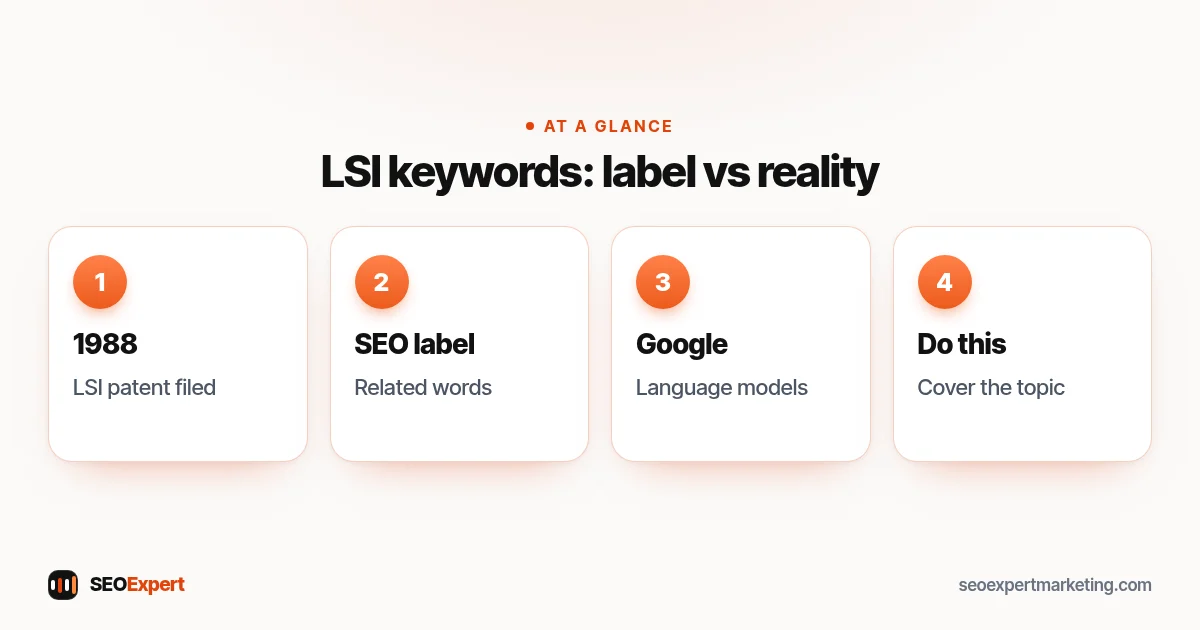
Where the term "LSI" comes from
Latent semantic indexing was developed by researchers at Bell Communications Research. Their patent, "Computer information retrieval using latent semantic structure", was filed on September 15, 1988 and published in 1989. The method looks at which words tend to appear together across a collection of documents and uses a mathematical technique to find hidden ("latent") connections between words and topics. That way, a search for one word can find documents that use a related word instead.
It was designed for fixed, fairly small collections of documents, decades before the modern web. Search engines today work at a vastly larger scale and use very different methods. The patent has also long expired.
Does Google use LSI keywords?
There is no evidence that Google uses latent semantic indexing, and Google has never said it does. What Google does describe is something more advanced. Its How Search Works pages say it builds language models to work out the meaning of a search, a system it says took over five years to develop and improves results in over 30% of searches across languages. Google gives the example that a search for "change laptop brightness" can find a page that says "adjust laptop brightness", because its synonym system understands the words are related.
In 2019 Google introduced BERT, a language model that looks at each word in relation to the words around it. Google's announcement of BERT said it would help Search better understand one in 10 searches in the US in English. Systems like these understand language far better than a 1980s indexing method ever could, which is why stuffing a page with lists of related words doesn't help.
So are LSI keywords useless?
The label is misleading, but the advice underneath it isn't. Pages that rank well tend to cover their topic thoroughly, and that naturally means using related words, answering the follow-up questions and explaining the terms a reader expects. A page about "boiler repair" that never mentions pressure, hot water, error codes or safety probably isn't very helpful. A page that covers them because it answers real questions is.
So think of LSI keywords as a reminder to write complete, natural content, not as a checklist of words to insert. Our guide to choosing a target keyword explains how the main phrase and its supporting terms fit together.
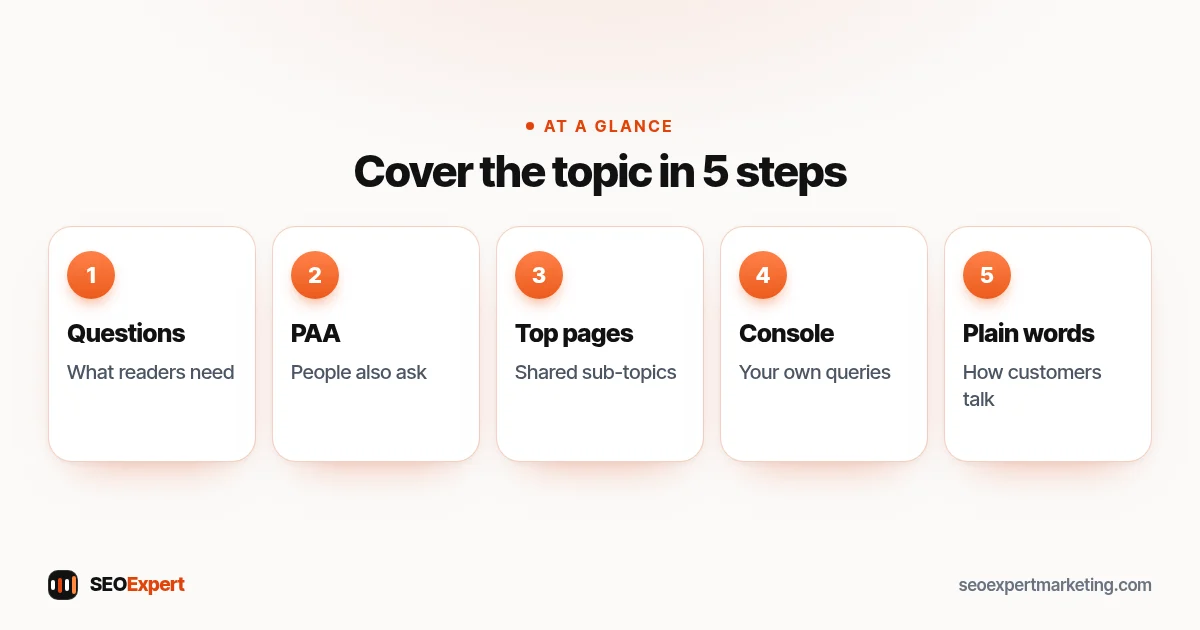
What to do instead: cover the topic, not a word list
- Start with the reader's questions. What does someone searching your main keyword need to know before they buy, book or act? Write those questions down.
- Look at "People also ask" and related searches. They show the questions and phrases Google already connects with your topic.
- Read the pages that rank. Note which sub-topics they all cover. If every top page explains prices, timings and aftercare and yours doesn't, that's a gap.
- Check your own Search Console queries. They show the related words people already use to find you. See our guide to what a search query is.
- Use the words customers use. If they say "boiler service" and you write "annual heating appliance maintenance", you're making it harder for everyone.
- Answer, then add detail. A clear answer near the top, then the supporting information, examples and FAQs.
LSI keywords vs related keywords vs entities
| Term | What it really means | Useful? |
|---|---|---|
| LSI keywords | A popular label for related words; not how Google works | Only as a reminder to cover the topic |
| Related keywords | Other searches with the same or similar intent | Yes, as secondary phrases on the same page |
| Synonyms and variations | Different words for the same thing | Yes, used naturally in the writing |
| Entities | Real things: people, places, brands, products, concepts | Yes, naming them clearly helps understanding |
| Questions | What people ask about the topic | Very: they become sections and FAQs |
Example: a boiler repair page
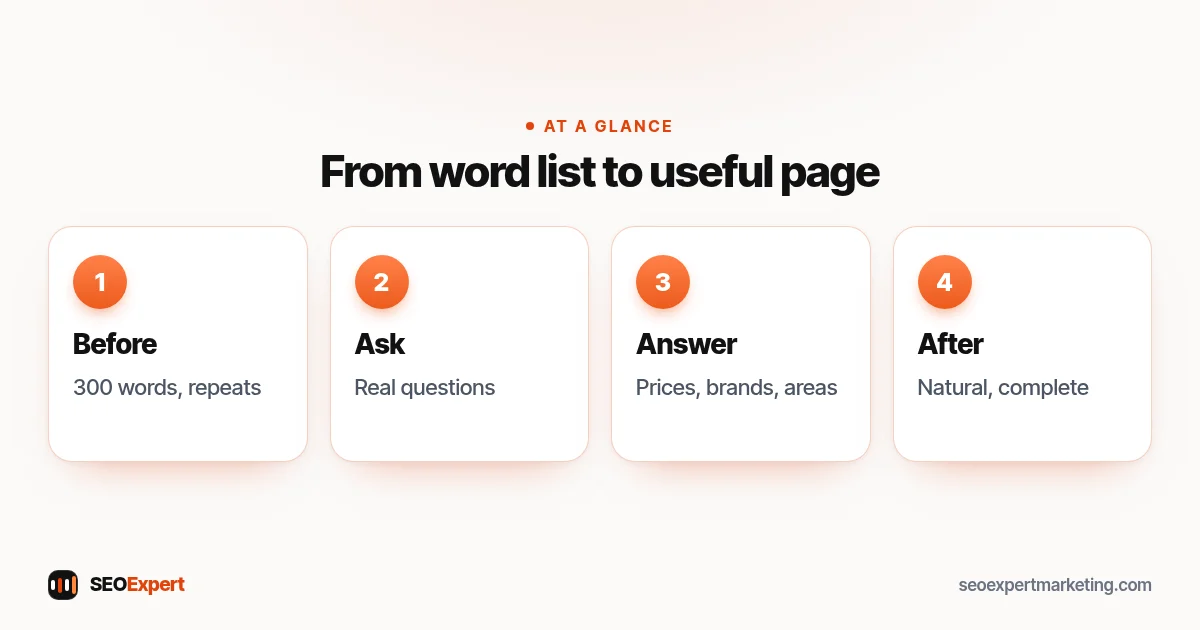
A heating engineer's "boiler repair" page has 300 words that repeat "boiler repair" eight times and say little else. A tool suggests a list of LSI keywords to paste in. Instead, the engineer lists what customers actually ask on the phone: "How much does a boiler repair cost?", "Is it worth repairing an old boiler?", "How quickly can you come out?", "Do you fix my make of boiler?" and "What does the pressure gauge mean?".
The rewritten page answers each one, lists the boiler brands they work on, explains their Gas Safe registration and adds a price range and areas covered. It now naturally contains words like "pressure", "no hot water", "call-out", "Worcester Bosch", "Vaillant" and "annual service". No word list was needed: the page simply became complete.
LSI keywords for local businesses
For a local business, the most useful "related words" are often local and practical rather than technical. Think of the neighbourhoods and towns you cover, the landmarks people use to describe locations, the brands and products you work with, the problems customers describe in their own words and the questions they ask before booking. A roofer's page that names the areas covered, the roof types handled and the common problems after storms will naturally use the language local searchers use.
That beats any generic list of LSI keywords, because it also proves the business actually works in the area and knows the job. Just avoid blocks of town names with no real content: Google's spam policies call that out as keyword stuffing.
A quick checklist for complete content
- Does the first paragraph answer the main search directly?
- Have you answered the three to five questions customers ask most?
- Do you explain the terms a beginner wouldn't know?
- Are prices, timings, areas and next steps included where relevant?
- Have you named the specific products, brands, places or methods involved?
- Would an expert in your trade find anything important missing?
- Does the page link to your related pages, and do they link back?
If you can tick every line, you won't need a separate list of LSI keywords: the related words will already be there.
Tools that claim to find LSI keywords
Many free tools generate "LSI keyword" lists. They're not useless, but know what they are: lists of related terms, usually built from autocomplete, related searches or word co-occurrence in top-ranking pages. They can spark ideas for sections you've missed. Don't paste the list into your page, don't aim for a set number of them and don't trust a tool that claims its list is what Google uses.
Better free sources of related terms are Google's own: autocomplete, "People also ask", related searches at the bottom of the results page, and the Queries report in Search Console.
Common mistakes with LSI keywords
- Stuffing related words. Lists of synonyms dropped into text read badly. Google's spam policies treat keyword stuffing as spam.
- Writing for a score. Content tools that grade "term coverage" can push you to add words that don't help the reader.
- Ignoring intent. Related words won't save a page that doesn't match what the searcher wants.
- Forgetting your own expertise. Real details from your work, such as prices, timings and examples, add more meaning than any word list.
Does a complete page need to be long?
Not necessarily. Complete means the page answers what the searcher needs, not that it hits a word count. A page about an emergency locksmith service should be quick to scan: what you do, where, how fast, the price range and how to call. A guide to choosing a new boiler naturally needs more depth, with comparisons, costs and questions to ask an installer.
A useful test is to compare your page with the ones already ranking and with the questions your customers ask. If the top pages and your customers all expect certain information and your page leaves it out, add it. If your page is long because it repeats itself or pads the introduction, cut it. Clear headings, short paragraphs, tables for prices or comparisons and a short FAQ make longer pages easy to read on a phone.
Why the LSI keywords idea won't go away
The phrase sounds technical, it gives people a simple task (add these words) and many tools are built around it. It also contains a grain of truth: pages that use rich, natural language about a topic tend to perform better than thin pages that repeat one phrase. The mistake is believing the words themselves are the trick. Google's language systems are built to understand meaning, so the most reliable approach is to write the most useful page on the topic, in plain words.
How this fits into your SEO plan
Related terms belong in your content plan, not in a separate list. When you map a target keyword to a page, add the main questions and sub-topics that page should cover. Our guide to keyword research shows how to build that plan, and our guide to SEO content strategy shows how pages on related topics should link together so the whole site covers your services fully.
Want help planning content that covers the whole topic?
Our keyword research services map each page to its main phrase, the related questions people ask and the details it should include. To start, ask for a free website analysis.
LSI keywords: quick answers
What are LSI keywords?
LSI keywords is a popular SEO term for words and phrases related to a page's main keyword. The name comes from latent semantic indexing, a 1980s retrieval method, but the lists tools sell are simply related terms.
Does Google use LSI keywords?
There's no evidence Google uses latent semantic indexing. Google describes using language models and a synonym system to understand meaning, which is far more advanced.
Are LSI keywords a ranking factor?
No list of related words is a ranking factor on its own. What helps is content that covers the topic fully and answers the searcher's questions in natural language.
How do I find related keywords for a page?
Use Google's autocomplete, People also ask, related searches and your own Search Console queries, and read the pages that already rank.
How many LSI keywords should I use?
There's no set number. Use related words where they naturally help explain the topic; adding lists of words to hit a count is keyword stuffing.
What does latent semantic indexing mean?
It's an information retrieval method, patented in 1988-1989 by Bell Communications Research, that finds hidden connections between words based on how they appear together in documents.
