An LLM SEO tool tracks how your business shows up in answers from AI assistants such as ChatGPT, Gemini, Perplexity, Microsoft Copilot and Claude, and in Google's AI Overviews and AI Mode. It asks the questions your customers ask and records whether your brand is named or linked. This guide explains what an LLM SEO tool can and can't measure, compares eight real options, and shows a free monthly check you can run yourself.
What "LLM SEO" means
LLM stands for large language model, the technology behind AI assistants. "LLM SEO" (also sold as AEO, GEO or AI SEO) means helping those assistants find, understand and mention your business. Many of them search the web live and link to the pages they used.
Google's guide to AI features says that "the best practices for SEO remain relevant" and that there are "no additional requirements to appear in AI Overviews or AI Mode, nor other special optimizations necessary." So LLM SEO is mostly good SEO, plus checking what the assistants say about you. That second part is the job of an LLM SEO tool. For Google's answers, see our guide to AI Overviews and SEO.
What an LLM SEO tool measures
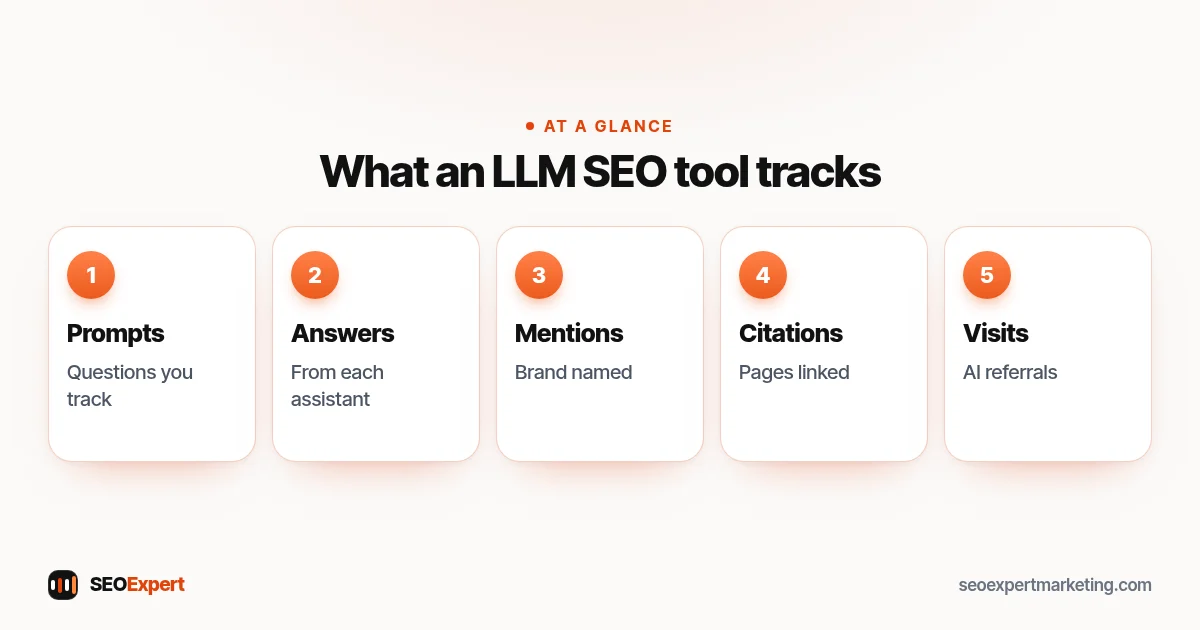
Most products track the same things under different names:
- Prompts: the questions the tool asks for you, such as "best emergency plumber in Leeds".
- Mentions: whether your brand is named in the answer text.
- Citations: whether the answer links to your pages, and which other sites it cites.
- Share of voice: how often you are mentioned compared with competitors, a kind of competitor analysis for AI answers.
- Sentiment: whether the answer describes you well or badly.
- AI crawler and referral data: AI bot visits to your site, and visitors sent by an assistant.
Mentions and citations differ. Ahrefs, for example, counts a mention when your brand is named in an answer and a citation when the answer links to your page. A useful LLM SEO tool reports both, because an assistant can name you without linking, or link without naming you.
8 LLM SEO tool options compared
We checked each vendor's own pages in October 2026. We left prices out because they vary by region and change often. Confirm the details before you choose an LLM SEO tool.
| Tool | AI platforms named | Free way to try (Oct 2026) |
|---|---|---|
| Semrush AI Visibility Toolkit | ChatGPT, Google AI Mode | No free trial |
| Ahrefs Brand Radar | AI Overviews, AI Mode, ChatGPT, Perplexity, Gemini, Copilot; Claude available | Free AI Visibility Checker |
| SE Ranking AI Visibility Tracker | AI Overviews, AI Mode, ChatGPT, Gemini | 14-day trial; free checker |
| Otterly.AI | ChatGPT, AI Overviews, Perplexity, Copilot; others as add-ons | Free trial |
| Profound | Up to 9 engines on Enterprise | 7-day trial, 50 prompts |
| Peec AI | ChatGPT, Perplexity, Gemini; AI Mode tracker listed | Not shown |
| Scrunch | ChatGPT, Claude, Gemini, Perplexity, AI Mode, AI Overviews, Meta | 7-day trial of Starter |
| Rankscale | "17+" engines, not named | "Try Pro for Free" offer |
Semrush AI Visibility Toolkit
Semrush's toolkit gives an AI Visibility Score (how often you are mentioned compared with competitors), shows prompts where competitors are cited and you are not, reports share of voice and sentiment, and tracks prompts daily. Its help page names ChatGPT and Google AI Mode and says there is no free trial. If you already use Semrush, it is the simplest LLM SEO tool to add.
Ahrefs Brand Radar
Brand Radar covers AI Overviews, AI Mode, ChatGPT, Perplexity, Gemini and Copilot, with Claude listed as available. It reports mentions, citations, share of voice and estimated impressions from an index of more than 512 million prompts, plus your own prompts.
SE Ranking AI Visibility Tracker
SE Ranking tracks mentions and links for your prompts in AI Overviews, AI Mode, ChatGPT and Gemini, maps which URLs are cited, and compares competitors. A 14-day free trial without a card, plus a free checker with five attempts a day, makes it an easy LLM SEO tool to test.
Otterly.AI
Every Otterly plan tracks ChatGPT, AI Overviews, Perplexity and Copilot; Claude, AI Mode and Gemini are paid add-ons. It reports brand visibility, sentiment and cited sources. New users get a free trial, and its smallest plan covers 15 prompts, enough for one local business.
Profound
Profound is aimed at larger companies. Its Enterprise plan tracks up to nine answer engines, including ChatGPT, Perplexity, Gemini, Copilot and Claude. A free trial runs 50 prompts daily for seven days on ChatGPT, Gemini and AI Overviews, but you can't choose the prompts. Both plans include analytics for AI-sourced traffic.
Peec AI
Peec AI tracks visibility, position, sentiment and share of voice in ChatGPT, Perplexity and Gemini daily, and its site lists an AI Mode tracker. It sorts cited sources into competitor, editorial, reference and user-generated sites, so you see what the answers lean on. Its pricing page showed no amounts when we checked.
Scrunch
Scrunch covers ChatGPT, Claude, Gemini, Perplexity, AI Mode, AI Overviews and Meta. Besides citation tracking, it monitors AI agent traffic, and its AXP platform builds an AI-friendly version of your site. Its Starter plan has a seven-day free trial with no card.
Rankscale
Rankscale says it covers "17+" AI engines but doesn't name them, so check that your assistants are included before you pick it as your LLM SEO tool. It offers visibility tracking, competitor benchmarking, citation analysis and prompt research. Its entry plan is billed yearly.
Two free sources to check first
Before you pay for an LLM SEO tool, look at the data you already have for free.
Google Search Console
Google says sites that appear in AI Overviews and AI Mode are "included in the overall search traffic" and reported in the Performance report under the "Web" search type. There is no separate AI filter, but a sharp change in a page's impressions or click rate is worth a look. Search Console isn't an LLM SEO tool, but our Google Search Console guide shows how to read the report.
Bing Webmaster Tools
In February 2026, Bing added an AI Performance report in public preview. It shows how often your pages are cited in Copilot, Bing's AI summaries and some partner integrations, and the "grounding queries" behind them. In June 2026, Bing added a citation share figure. Bing says the data is "a sample of overall citation activity" and calls citation share "an observational metric – not a ranking system". See Bing's announcement of the AI Performance report.
A free LLM SEO check you can run yourself
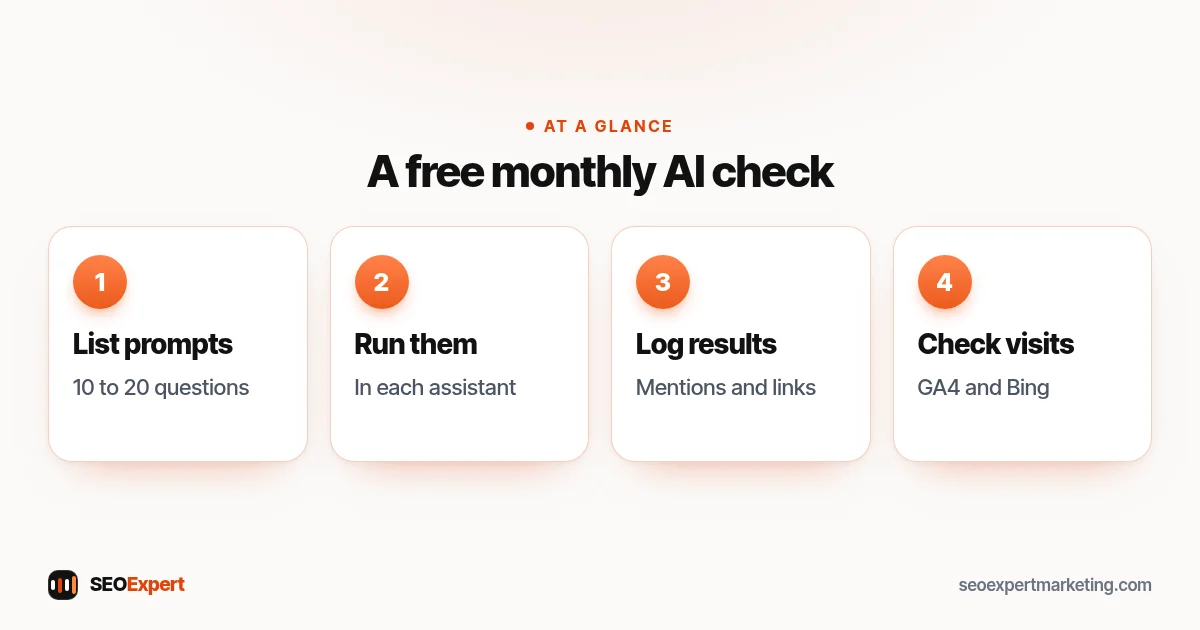
For one business, you can do a basic version of what an LLM SEO tool does in an hour or two a month:
- Write 10 to 20 prompts. Use questions customers really ask, such as "best [service] in [town]" or "is [your business] any good". Sales calls and Search Console queries are good sources.
- Run them in each assistant. Use ChatGPT, Gemini, Perplexity, Copilot, AI Mode and a normal Google search (for AI Overviews), in a private window where you can, so your history doesn't shape the answers.
- Log the results. In a spreadsheet, note whether you are mentioned or linked, which competitors and sites appear, and any wrong facts about you.
- Check AI referral visits. In Google Analytics 4, create a custom channel group with an "AI assistants" channel, as Google's help shows, using a source rule that matches chatgpt, perplexity, gemini, copilot or claude. Move it above Referral, or GA4 counts those visits as Referral.
- Check Bing's AI Performance report for Copilot citations.
- Repeat with the same prompts each month, so that changes mean something.
AI answers vary between runs of the same prompt, so don't read too much into one result. A paid LLM SEO tool runs your prompts every day and keeps the history, which is its main advantage.
Check that AI crawlers can reach your site
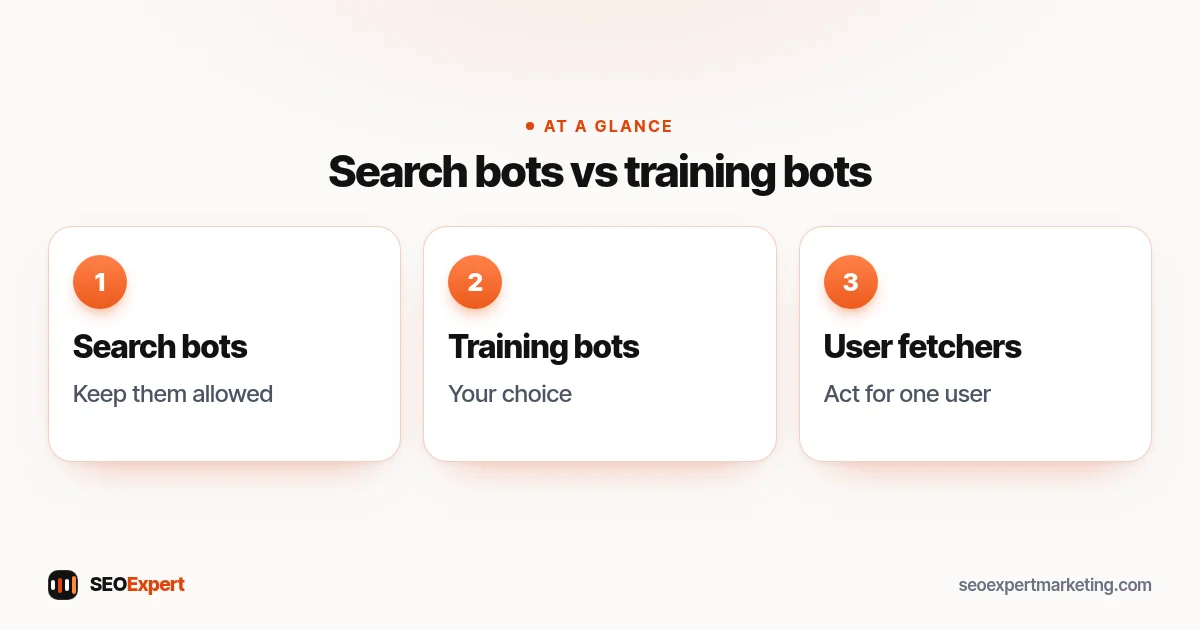
An assistant can only cite pages it can fetch. Companies run separate bots for search and for training, and blocking the wrong one in robots.txt can keep you out of AI answers. If your robots.txt blocks none of them, it isn't the problem. Google's own AI features follow normal Googlebot and snippet rules. The official documentation says:
| Bot | Company | What it does |
|---|---|---|
| OAI-SearchBot | OpenAI | Controls appearing in ChatGPT search answers |
| GPTBot | OpenAI | Training OpenAI's models |
| ChatGPT-User | OpenAI | Fetches for a user; robots.txt may not apply |
| PerplexityBot | Perplexity | Links sites in Perplexity results; not for training |
| Perplexity-User | Perplexity | Fetches for a user; generally ignores robots.txt |
| Claude-SearchBot | Anthropic | Improves Claude's search results |
| ClaudeBot | Anthropic | Training |
| Google-Extended | A robots.txt token, not a crawler: Gemini training and grounding; no effect on Google Search |
OpenAI says sites that block OAI-SearchBot "will not be shown in ChatGPT search answers", and that robots.txt changes take about 24 hours to reach its search. Anthropic says blocking Claude-SearchBot may reduce your visibility in Claude's search results. Google says Google-Extended "does not impact a site's inclusion in Google Search". So you can block training bots and still allow search bots. Our robots.txt guide explains the file, and OpenAI's crawler documentation lists its bots.
Some products, such as Ahrefs and Peec AI, report AI bot visits, so an LLM SEO tool can confirm the bots arrive.
Do you need an llms.txt file?
llms.txt is a proposal, published in September 2024 by Jeremy Howard, for a markdown file at /llms.txt that gives language models a short summary of a site and links to key pages. For Google, the answer is no: its AI features guide says "you don't need to create new machine readable files, AI text files, or markup to appear in these features." The file does no harm, but don't pay for it as a ranking fix, and be wary of any LLM SEO tool or agency that sells it as one.
What an LLM SEO tool can't do
- It can't make an assistant recommend you. It measures; the work of earning mentions is still yours.
- It samples; it doesn't see everything. Answers depend on wording, location, history and model version, and Bing calls its own citation data a sample.
- Citations are not clicks. Pew Research Center (July 2025) found that people clicked a link inside a Google AI summary in just 1% of visits to pages with one, and clicked a regular result in 8% of visits with a summary against 15% without. Ahrefs (February 2026) linked AI Overviews to a 58% lower average click rate for the top-ranking page.
So treat an LLM SEO tool as a measuring tape, not a growth engine.
How to improve what AI answers say about you
The fixes are mostly the ones good SEO already asks for:
- Let the search bots in and keep key pages indexable.
- Answer questions directly. A Microsoft Advertising blog post (October 2025) on AI search answers recommends question headings, one- or two-sentence direct answers, lists and tables. It warns that "AI systems may not render hidden content", so don't hide key answers in tabs or keep core facts only in PDFs or images. Pages written for featured snippets already follow this pattern.
- Keep your title, H1 and description consistent, which Microsoft says helps AI systems find and trust a page.
- Use standard schema markup. Microsoft recommends it; Google says no special schema is needed for its AI features, but standard markup such as local business schema still helps search engines understand you.
- Fix the sources the answers cite. If your LLM SEO tool shows directories or review sites cited for your prompts, get listed there and keep your details accurate.
- Keep earning real reviews. For local businesses, a complete Google Business Profile and steady Google reviews remain the basics of local search.
Does a small business need a paid LLM SEO tool?
Usually not at first. If you serve one town, the free monthly check, Search Console and Bing's report tell you most of what you need. A paid LLM SEO tool earns its cost when you track many prompts, several locations or brands, or report to clients.
If you buy one, check which assistants it covers, how many prompts your plan includes, whether you can write your own prompts and choose the country, and whether it shows cited sources, not just a score. Most offer a trial or a free checker, so test an LLM SEO tool with your own prompts before you commit.
A made-up example: a wedding florist
Rosa runs a small wedding florist in Bristol (a made-up business). She writes 12 prompts, such as "best wedding florist in Bristol", and runs them in ChatGPT, Gemini, Perplexity and Copilot. In the first month she is named in 3 of the 48 answers. Two answers give an old phone number from a directory listing she had forgotten.
She fixes the listing, adds a clear prices and questions section to her bouquets page, and checks that robots.txt allows OAI-SearchBot and PerplexityBot. Three months later the same prompts name her in 7 of 48 answers. Two runs prove little, and this is no forecast for you; the point is that the log became a list of fixes. If she opens a second shop, a paid LLM SEO tool would save her the manual work.
Want help checking your AI visibility?
Every one of our managed SEO plans includes an AI visibility check: what ChatGPT, Gemini and Perplexity say about your business. We read it with your Search Console data and tell you plainly what is worth fixing. You can also start with a free website analysis, or see how our SEO services work.
LLM SEO tools: quick answers
What is an LLM SEO tool?
Software that asks AI assistants such as ChatGPT, Gemini and Perplexity a set of prompts for you, and records whether your brand is mentioned or linked, and which competitors and sources appear.
What is the best LLM SEO tool for a small business?
There is no single best one. Start free: a manual monthly check, Google Search Console and Bing's AI Performance report. If you need more, test tools with a free trial or checker, such as SE Ranking or Otterly.AI, using your own prompts.
Can an LLM SEO tool get my business into ChatGPT answers?
No. It measures visibility; it can't make an assistant mention you. What helps is answering questions clearly, keeping your details accurate on cited sites, and letting OAI-SearchBot reach your site.
Do I need an llms.txt file for AI search?
Not for Google. Its AI features guide says you don't need new machine-readable files, AI text files or markup to appear in AI Overviews or AI Mode.
Can I see ChatGPT traffic in Google Analytics?
Yes, as referral traffic. Google's GA4 help shows a custom channel group with an AI assistants channel as an example.
Does Google Search Console show AI Overviews traffic?
It includes it but doesn't separate it: Google counts AI Overviews and AI Mode in the Performance report under the Web search type.
