Is local SEO dead? No. People still search for businesses near them every day, and Google still shows local results with maps, reviews, opening hours and call buttons. What has changed is where those searches lead and how people act on them: more answers appear directly on Google, more calls start from a Business Profile, and AI summaries sit above some results. This guide explains what has changed, what still works and what to stop doing.
The short answer
Local SEO isn't dead, but some old tactics are. Stuffing keywords into a business name can get a profile suspended, thin pages for every nearby town are the kind of doorway pages Google's spam policies warn against, and chasing directory links mostly wastes time. The basics are as important as ever: an accurate Business Profile, real reviews, a clear website with pages for the services you offer, and a reputation in your area. For a business that serves customers in person, local SEO is often still the most direct way to be found by people ready to buy.
Why people ask whether local SEO is dead
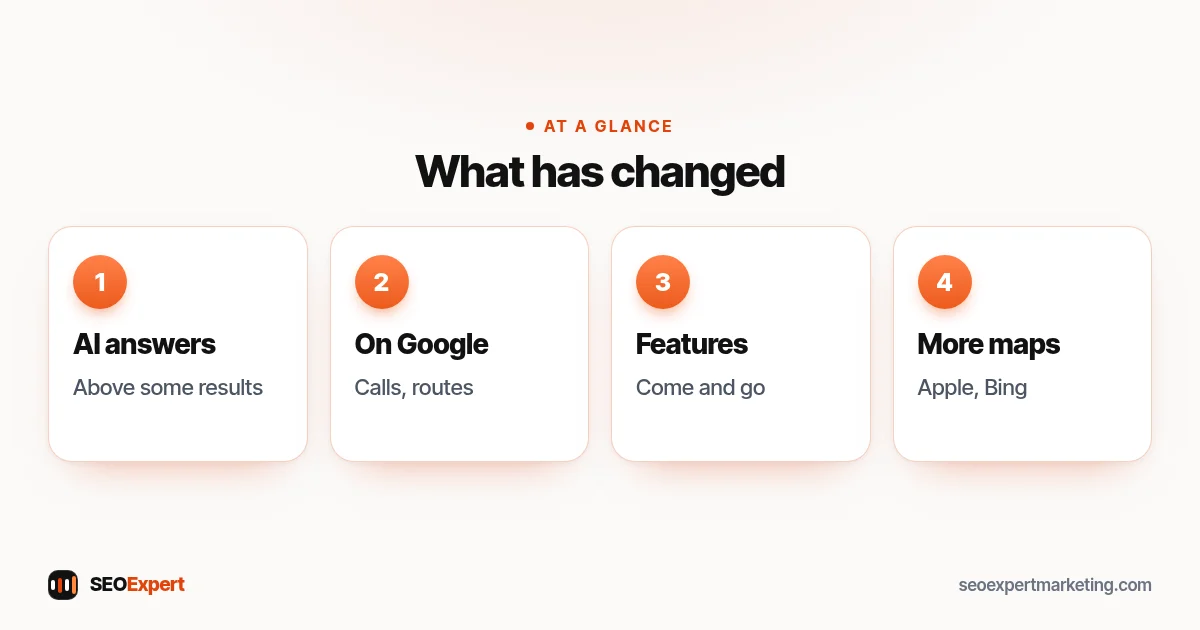
- AI answers. AI Overviews now answer some questions at the top of Google, and AI Mode gives longer AI answers in its own mode, so fewer people may click through for simple information searches.
- Fewer website visits. Many local searches end on the Business Profile itself, with a call, a route or a look at the reviews, so website traffic alone can make local SEO look weaker than it is.
- Changing features. Google has added and removed Business Profile features over the years; for example, chat and call history were removed in 2024. Owners who relied on one feature felt the change.
- More places to be found. People also search on Apple Maps, Bing, social media and review sites, not only Google.
None of these makes the work pointless. They change what you measure and where you spend your time.
What hasn't changed
Google's help page on how local ranking works says local results are mainly based on relevance, distance and popularity, which the page also calls prominence. Relevance is how well a Business Profile matches what someone is searching for. Distance is how far the business is from the searcher. Prominence means how well-known a business is, based partly on information like how many websites link to the business and how many reviews it has. Google also says more reviews and positive ratings can help a business's local ranking.
Distance is the one factor no amount of work changes: a business usually shows best near its own address and less often across town, whoever does the work. Rankings also differ street by street, so a check from your own phone shows only one spot.
Google is clear that there is no way to request or pay for a better local ranking. That hasn't changed either: the work is still about being relevant, complete, trusted and well reviewed. Our local SEO checklist covers each part.
What has changed, and what to do about it
AI features in search
Google's guidance on AI features and your website says the best practices for SEO remain relevant for AI Overviews and AI Mode, and that there are no additional requirements or special optimizations to appear in them. For a local business, that means the same work: a helpful website, accurate business details and pages that answer customers' real questions. Google's page even lists checking that your Business Profile information is up to date among those practices. Our guide to AI Overviews explains more.
To see whether AI assistants such as ChatGPT name your business, our guide to LLM SEO tools includes a free monthly check.
More actions happen on Google itself
A customer might find you, read your reviews and call you without ever visiting your website. If you only look at website visits, you'll miss these. Add UTM tags to the website link on your Business Profile so your analytics can show which visits and enquiries came from the profile. Track Business Profile calls, direction requests and website clicks alongside your website numbers; our guide to the local SEO report shows how.
Features come and go
Because Google changes Business Profile features, don't build your whole marketing on one of them. Keep the essentials up to date (categories, services, hours, photos and reviews) and make sure customers can always reach you by phone, email and your website.
Reviews matter to customers and rankings
Reviews help both rankings and decisions. Ask every customer, make it easy with a direct link, and reply to reviews, good and bad. Our guide on how to get Google reviews explains a simple routine.
More than one map matters
Apple Maps and Bing also show local businesses. Claiming and checking those listings takes little time; our guide to local SEO tools lists the free ones.
Is local SEO essential for brick-and-mortar businesses?
For most, yes. If customers visit your shop, office, clinic or restaurant, they need your address, opening hours, directions and a reason to choose you over the business down the road. Your Business Profile and website provide all of that at the moment someone searches. Without it, you rely entirely on people who already know your name.
It matters less for businesses that only sell online with no local customers. Even then, a Business Profile may still help if you have a physical location customers can visit, but the main work shifts to national SEO.
Why local SEO is important for small and medium businesses
- Buyers close to a decision. Many local searches come from people who need something soon, such as a repair, an appointment or a table tonight.
- A fairer contest. Distance and relevance give a small business near the searcher a chance against bigger brands.
- Low running costs. A Business Profile is free, and most of the work is time rather than ad spend.
- Trust before the call. Reviews, photos and clear information answer questions before the customer contacts you.
What still works in local SEO
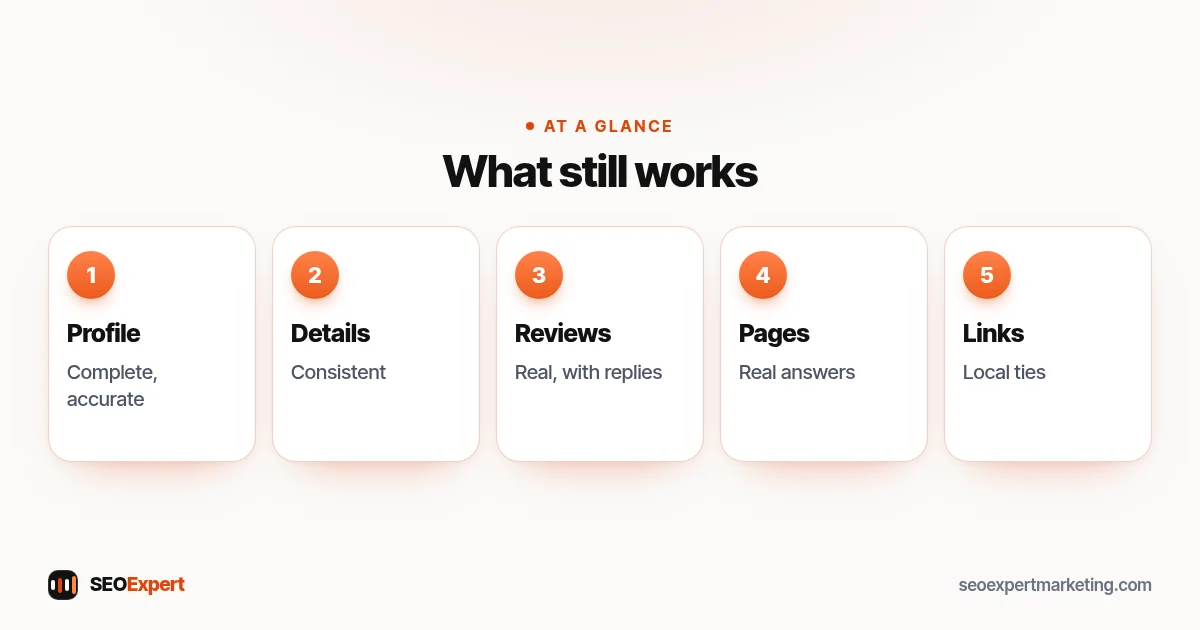
- A complete Business Profile: the right primary category, services, hours, photos and an accurate address or service area.
- Consistent details: the same name, address and phone number on your website and main listings; see our guide to local SEO citations.
- A steady flow of real reviews, with replies.
- Service pages that answer real questions: what you do, prices or price ranges, areas served and how to book.
- Location pages only where you have something real to say, such as a branch, a team or work you've done in that area.
- Local links and mentions: suppliers, associations, sponsorships and local news.
- Regular updates: new photos, seasonal hours and Business Profile updates.
What to stop doing
- Keyword stuffing your business name. Google's Business Profile guidelines say your name should reflect your business's real-world name, and adding unnecessary information, such as service descriptions, isn't permitted.
- Fake or virtual addresses. Google says a profile must be for your actual, real-world location; a virtual office (a mailing address you don't work from) isn't eligible, and P.O. boxes at remote locations aren't accepted.
- Buying or faking reviews. It breaks Google's policies, and the law in some countries: a US Federal Trade Commission rule banning fake reviews took effect in October 2024, and UK law has banned them since April 2025.
- Copy-and-paste town pages. Pages that only swap place names add nothing for visitors.
- Bulk directory submissions. A few accurate listings beat hundreds of low-quality ones.
Local SEO vs paid local ads
Paid ads can appear in and above local results, and they're labelled as ads. They're useful when you need calls quickly, for a new business or a quiet season, but they stop the day you stop paying. Unpaid visibility from your Business Profile, reviews and website builds more slowly and keeps working. Many small businesses use both: ads for speed, and steady work on the profile and website for the long term. Our guide to local PPC vs organic local search compares the two in detail.
How much time it takes
Setting up properly takes a few focused days: claiming and verifying your Business Profile, choosing categories, writing your services, adding photos, fixing your main listings and checking your service pages. After that, a monthly routine of a few hours is enough for most small businesses: new photos, replies to reviews, updates for holidays and offers, and a quick look at calls and enquiries. Results build over months; our guide on how long SEO takes explains why.
If you don't have a shop or office
Plumbers, cleaners, electricians and other businesses that visit customers can still show in local results as service-area businesses. Hide your home address on the profile, set the areas you really serve and create clear service pages. Google's guidelines say a service area shouldn't extend more than about two hours' drive from where the business is based, though larger areas may be appropriate for some businesses. Our guide to service-area business SEO covers the set-up.
Signs your local SEO is working
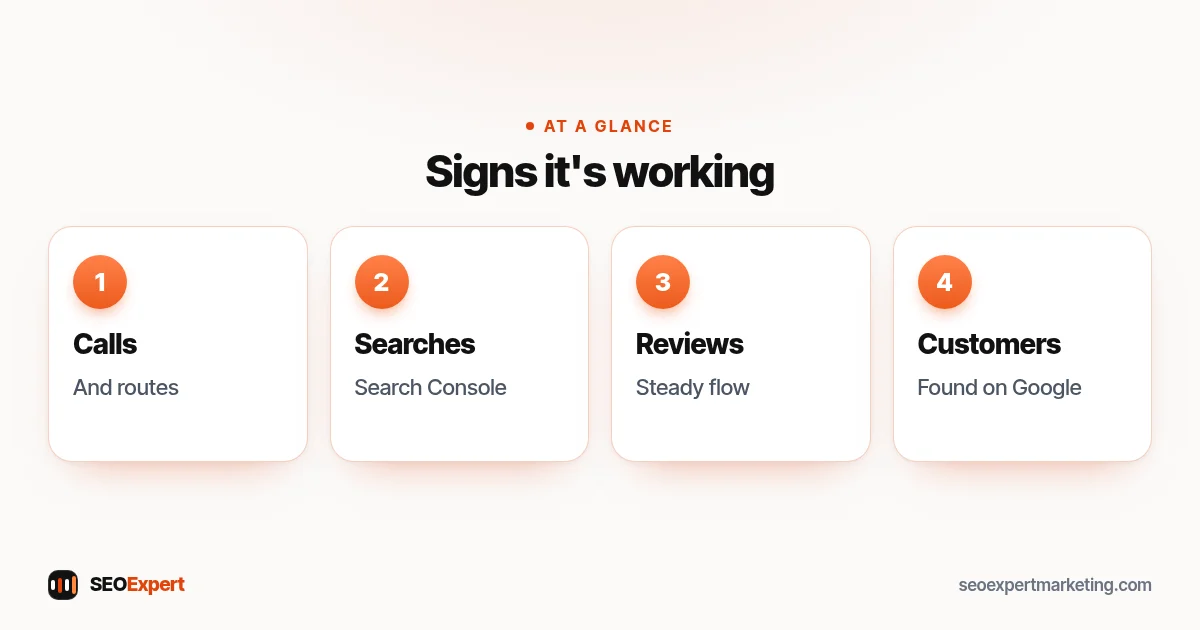
Look at trends over months, not single weeks. Good signs include more Business Profile calls, direction requests and website clicks; more of your service pages appearing in Search Console for searches that include your town or area; a steady rise in reviews; and new customers saying they found you on Google or Maps. If none of these move after several months of steady work, go through the questions below before deciding it doesn't work for you.
Questions to ask before you give up
- Is your Business Profile verified, with the right primary category?
- Do you have recent reviews, and how do they compare with nearby competitors?
- Does your website have a clear page for each main service, mentioning the areas you serve?
- Are your name, address and phone number the same everywhere?
- Are you measuring calls and direction requests, not just website visits?
If the answer to any of these is no, fix that first. Most disappointing results come from gaps in the basics rather than from local search itself.
A made-up example: a family hardware store
Imagine a family-run hardware store that noticed fewer website visits and wondered whether local SEO was still worth the effort. Looking at its Business Profile performance, it found plenty of calls and direction requests: customers were finding the store on Google, then visiting without opening the website. The owners kept their profile up to date with seasonal hours and photos of the products they stock, asked regular customers for reviews, and added a page answering the questions people phoned about most, such as key cutting and paint mixing. Their measure of success changed from website visits to calls, visits and sales.
How we can help
We help small businesses with the parts that still matter: Business Profile set-up and clean-up, consistent listings, review routines, service pages and local links, with reports that focus on calls and enquiries. See our local SEO services and local SEO packages, or ask for a free website analysis.
Is local SEO dead? Quick answers
Is local SEO dead?
No. People still search for local businesses every day, and Google still shows local results with maps, reviews and contact buttons. What has changed is how people act on those results, and some old tactics no longer work.
Is local SEO still worth it in 2026?
For businesses that serve customers in person or in a local area, usually yes. A Business Profile is free, and most local SEO work is time rather than ad spend.
Will AI replace local SEO?
Not so far. Google says the usual SEO best practices remain relevant for AI Overviews and AI Mode, with no special optimizations needed. Accurate business details and helpful pages still matter.
Is local SEO essential for brick-and-mortar businesses?
For most, yes. Customers need your address, hours, directions and reviews when they search, and your Business Profile and website provide them.
Why is local SEO important?
It puts your business in front of nearby people who are often close to a decision, gives small businesses a fair chance against bigger brands and builds trust through reviews and clear information.
Can I pay Google to rank higher in local results?
No. Google says there is no way to request or pay for a better local ranking. Ads can appear in local results, but they are labelled as ads and are separate from the unpaid ranking.
